
Organic Chemistry II Laboratory Safety Practice Test
$69.00
- Buy to unlock unlimited access to all Quiz questions and Answers in this Quiz.
- After purchase you can print a PDF of the whole quiz at any point. The PDF will contain the questions and the correct answers.
About this Exam
The Organic Chemistry II Lab Safety Practice Exam is an essential tool for advanced undergraduate chemistry students and laboratory personnel. This test is specifically designed to assess and reinforce critical safety protocols required in an Organic Chemistry II setting, which often involves more complex syntheses, highly reactive reagents, and sophisticated equipment than introductory courses. For students, mastering these safety concepts is not just about passing a course; it is a necessary prerequisite for entering a professional research or industrial environment. This practice exam ensures that individuals can confidently identify hazards, manage emergencies, and execute experiments without compromising their safety or that of their colleagues.
Ready to test your knowledge?
Buy Now to Access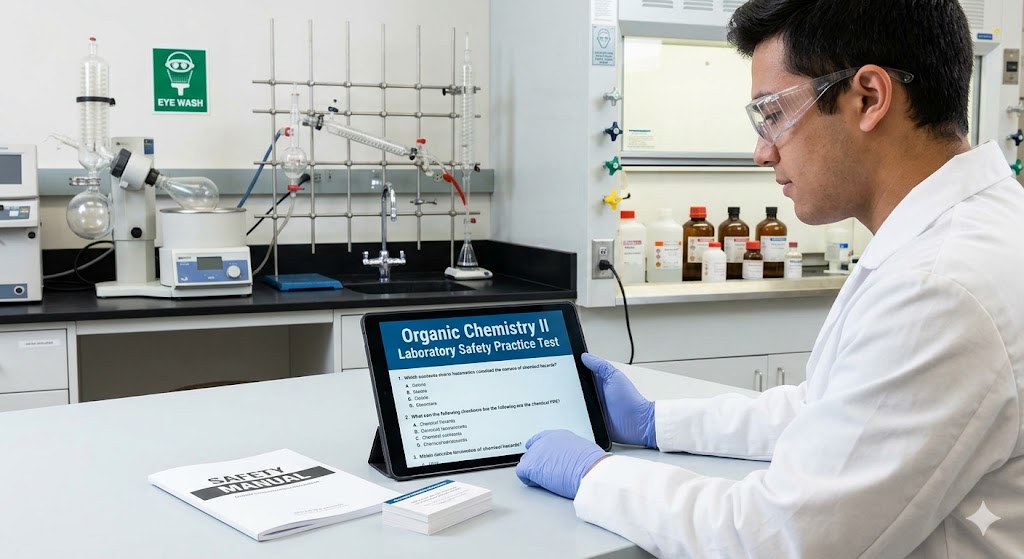
Additional Information
What the Course Entails and Exam Details
This examination focuses purely on the safety aspect of the advanced organic chemistry laboratory environment. While traditional Organic Chemistry II lectures cover reaction mechanisms and molecular structures, the corresponding laboratory safety curriculum dictates how these substances are handled. The practice exam validates knowledge in managing dangerous reagents such as strong oxidizers, pyrotechnic compounds, and highly toxic synthesis precursors. Students must also understand the nuances of the Globally Harmonized System (GHS) labels, Safety Data Sheets (SDS), and complex waste compatibility. The focus is on practical, decisive knowledge, ensuring that safe practices are second nature during multi-step organic synthesis reactions.
What to Expect in the Final Exam
When sitting for the final exam (or the standard coursework safety quiz it prepares you for), students should expect a challenging, often digital, assessment. The format typically utilizes multiple-choice questions, true/false scenarios, and often visual identification tasks where students must select proper PPE or correct a faulty experimental setup. The time limit is usually strict—approximately 60 minutes for 50 questions—reflecting the need for quick safety decisions. Most institutions enforce a high passing score, often between 90% and 100%, reflecting a zero-tolerance policy for safety errors. Unlike some exams, correct answers here directly correlate to preventing real-world laboratory accidents.
How to Study and Exam Centers
Effective studying requires active engagement rather than passive reading. Start by taking this comprehensive practice test to establish a baseline of your knowledge gaps. For any questions missed, return to your institution’s provided laboratory safety manual, not just your lecture notes. Create flashcards for incompatibilities (e.g., reagents that react violently with water), and practice interpreting GHS pictograms and signal words. Re-read the SOPs (Standard Operating Procedures) for common techniques like vacuum distillation and reflux. The exam center is typically organized by your university chemistry department; it will likely be hosted via an online learning management system or, less commonly, in a supervised campus computer lab.
Job Opportunities from the Course
A strong command of advanced organic chemistry safety, validated by passing this exam, is a critical competency highly sought after by employers in various chemical and pharmaceutical sectors. Demonstrating this commitment to safety significantly enhances a candidate's resume for hands-on roles.
Chemical Laboratory Technician: Conducting synthesis and analysis in industrial R&D.
Pharmaceutical Research Assistant: Working on drug discovery and process development teams.
Quality Control (QC) Chemist: Ensuring the safety and purity of manufactured chemical products.
EHS Specialist (Environmental, Health, and Safety): Managing safety protocols and compliance within chemical facilities.
Medical Laboratory Scientist: Utilizing organic chemistry principles in clinical diagnostic testing.
Process Development Chemist: Scaling up reactions from benchtop to manufacturing, where understanding safety parameters is crucial.
Here is the comprehensive, SEO-optimized article on the [Organic Chemistry II Laboratory Safety Practice Test] along with the requested featured image.
Organic Chemistry II Laboratory Safety Practice Test
Description
The Organic Chemistry II Laboratory Safety Practice Exam is a crucial preparation tool designed for university students, college chemistry students, and laboratory professionals entering advanced chemical environments. This specific test is engineered to assess and reinforce the high-level safety knowledge required to handle the more complex synthesis reactions, reactive reagents, and sophisticated equipment that are characteristic of an Orgo II laboratory. Students will find that mastering this safety content is not just an academic requirement but a foundational step for safely navigating experiments that involve higher physical and chemical hazards than introductory courses. The practice test demonstrates a candidate's readiness to handle compounds responsibly before they begin practical wet chemistry work.
What the Course Entails and Exam Details
This examination covers the full spectrum of advanced laboratory safety protocols necessary for Organic Chemistry II. The focus shifts from basic hazard recognition to the safe management of complex synthesis scenarios. Core topics include the in-depth understanding of Globally Harmonized System (GHS) pictograms, signal words, and hazard statements for advanced organic reagents. Candidates will be tested on the safe handling of strong oxidizers, pyrophoric and water-reactive compounds, high-pressure equipment, and the proper maintenance and use of complex glassware setups like reflux and distillation apparatus. The exam also details stringent protocols for managing mixed organic waste streams, interpreting Safety Data Sheets (SDS) for multi-step reactions, and executing correct emergency response procedures during a chemical spill or fire.
What to Expect in the Final Exam
The actual Organic Chemistry II Laboratory Safety Exam is typically administered digitally through your institution’s learning management system or in a dedicated on-campus computer lab. It is characterized by a time limit—often 60 to 90 minutes—and a standardized format, primarily utilizing multiple-choice, matching, and true/false questions. Due to the critical nature of safety, a very high passing score, often 90% or higher, is strictly required for students to gain access to the physical lab. The test will often include visual questions where candidates must identify unsafe laboratory setups or incorrect personal protective equipment (PPE) usage. This stringent formatting ensures that student reactions to hazards are both accurate and rapid.
How to Study and Exam Centers
Effective preparation requires a mixture of rote memorization and practical, scenario-based application. Students are strongly encouraged to start by thoroughly reviewing their specific institutional laboratory safety manual and any Standard Operating Procedures (SOPs) relevant to Organic Chemistry II. Utilize this comprehensive practice test repeatedly to identify knowledge gaps; don't just find the right answer, understand why the other answers are hazardous. Create flashcards for incompatibilities among common organic solvents and reagents. The final exam center is almost always the individual’s own authorized school, university, or college department, as this certification is mandatory for continuing with the practical coursework on-site.
Job Opportunities from the Course
A robust, demonstrated mastery of Organic Chemistry II laboratory safety is a foundational skill that is highly attractive to a wide array of employers in the chemical, pharmaceutical, and biotech sectors. Safety consciousness is a key metric in modern laboratory employment. While this is an academic course prerequisite, the knowledge directly unlocks professional paths such as:
Chemical Laboratory Technician: Conducting reaction scale-ups and synthesis in industrial research.
Pharmaceutical Research Assistant: Supporting drug discovery in medicinal chemistry labs.
Quality Control (QC) Chemist: Managing analytical testing for product purity.
Environmental Health and Safety (EHS) Officer: Developing safety protocols for chemical handling.
Medical Laboratory Scientist: Utilizing chemical knowledge in clinical analysis.
Process Development Chemist: Ensuring the safe transition of chemicals from the lab to production.
Frequently Asked Questions
Reviews
5.0
Based on 0 reviews
Leave a Review
No reviews yet. Be the first to review!