
Organic Chemistry MCAT Practice Exam
$69.00
- Buy to unlock unlimited access to all Quiz questions and Answers in this Quiz.
- After purchase you can print a PDF of the whole quiz at any point. The PDF will contain the questions and the correct answers.
About this Exam
The Medical College Admission Test (MCAT) is a standardized, multiple-choice examination designed to assess your problem-solving, critical thinking, and knowledge of natural, behavioral, and social science concepts and principles prerequisite to the study of medicine.
The Organic Chemistry portion of the MCAT is contained within the Chemical and Physical Foundations of Biological Systems section. It evaluates your understanding of the foundational principles of organic chemistry and their application to biological systems. This is not just a recall of reactions, but a test of your ability to apply these concepts in a novel medical and biological context.
This exam is designed for students aspiring to enter medical schools in the United States and Canada.
Ready to test your knowledge?
Buy Now to Access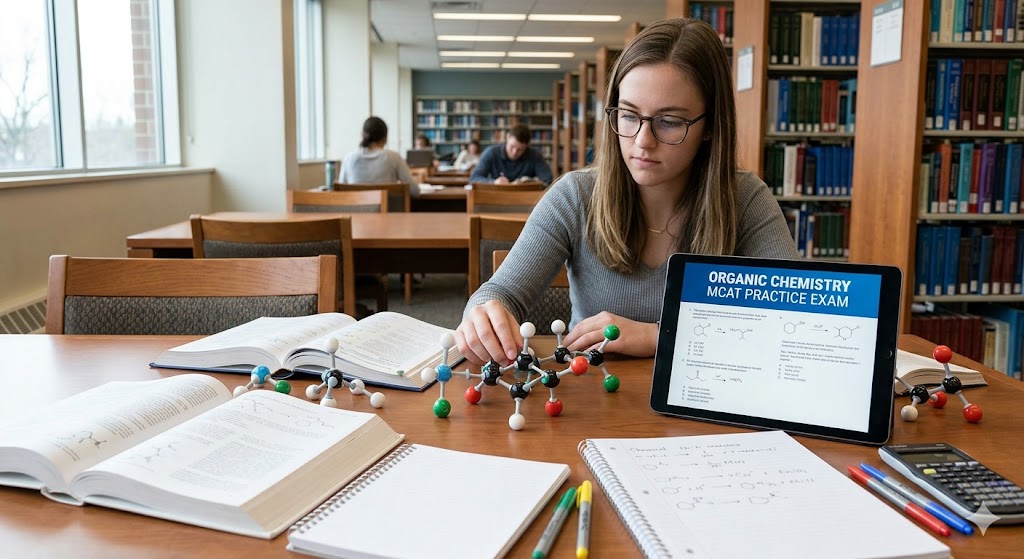
Additional Information
What the Course Entails and Exam Details
The organic chemistry section of the MCAT is integrated with other sciences. You can expect questions focusing on the following core areas:
Structure and Function of Biological Molecules: This includes understanding the properties and reactions of amino acids, proteins, carbohydrates, lipids, and nucleic acids.
Principles of Organic Chemistry: You must master foundational concepts like functional groups, isomerism (structural, geometric, and stereoisomers), and the fundamentals of chemical nomenclature.
Mechanisms of Organic Reactions: This includes understanding and predicting the outcomes of substitution (SN1, SN2), elimination (E1, E2), addition, and oxidation-reduction reactions, particularly those that occur in biological pathways.
Spectroscopy and Separations: You will need to interpret common spectroscopic techniques like Infrared (IR), Nuclear Magnetic Resonance (NMR), and Ultraviolet (UV) spectroscopy, as well as separation techniques like chromatography.
The MCAT does not have a separate "Organic Chemistry" score. Your performance is part of the overall Chemical and Physical Foundations of Biological Systems score, which ranges from 118 to 132. The entire MCAT takes approximately 7.5 hours, with this specific section being 95 minutes for 59 multiple-choice questions.
What to Expect in the Final Exam
The actual MCAT Organic Chemistry section will consist of passage-based and discrete (stand-alone) multiple-choice questions. A significant number of questions will be passage-based, requiring you to read and synthesize information from scientific experiments or descriptions before answering questions.
You must remember that this is a timed exam. The speed at which you can analyze a passage and accurately answer questions is crucial. There is no official "passing" score for the MCAT, as different medical schools have their own average acceptance scores. However, a highly competitive score in this section is generally considered 127 or higher. All questions have four options with only one correct answer. No points are deducted for incorrect answers, so it is in your best interest to answer every question.
How to Study and Exam Centers
Effective study for the MCAT involves a combination of content review and diligent practice. Here are key strategies:
Content Review: Start with a thorough review of fundamental organic chemistry concepts using a comprehensive MCAT preparatory course or reliable textbooks. Focus on understanding the 'why' and 'how' of reactions, not just memorization.
Passage Practice: This is essential. Utilize official AAMC (Association of American Medical Colleges) practice materials, which are the most representative of the actual exam questions. Work through passages under timed conditions to improve your speed and critical thinking skills.
Analyze Your Errors: After each practice exam or set of questions, thoroughly review incorrect answers. Understand why you got them wrong and correct any underlying conceptual gaps.
Full-Length Practice Exams: Take multiple full-length, timed practice exams to simulate the actual test-taking experience and build endurance.
The MCAT is not administered at school-specific sites. You can only take the official exam at designated Pearson VUE professional testing centers across the United States, Canada, and select international locations. Registration is done through the official AAMC website.
Job Opportunities from the Course
A strong performance on the Organic Chemistry section of the MCAT is not a direct path to a job itself. However, it is a critical component of a successful medical school application, which is the gateway to becoming a licensed physician (MD or DO). With this medical degree, a wide array of career paths opens up, including:
Physician (in various specialties like Family Medicine, Pediatrics, Surgery, Oncology, Emergency Medicine, and many more)
Medical Researcher (conducting clinical trials, epidemiological studies, or laboratory research)
Medical Educator (teaching at medical schools or in residency programs)
Global Health Professional
Biotechnology and Pharmaceutical Industry Professional (in research, drug development, or regulatory affairs)
Healthcare Administrator or Policy Maker
Frequently Asked Questions
Reviews
5.0
Based on 0 reviews
Leave a Review
No reviews yet. Be the first to review!