
Orthodontic Assistant Practice Exam
$69.00
- Buy to unlock unlimited access to all Quiz questions and Answers in this Quiz.
- After purchase you can print a PDF of the whole quiz at any point. The PDF will contain the questions and the correct answers.
About this Exam
The Orthodontic Assistant practice exam is an essential stepping stone for dental professionals looking to specialize in orthodontics. This exam is meticulously designed to evaluate a candidate's proficiency in supporting orthodontists, from technical skills to patient interaction. It serves as a benchmark for both dental assistants aiming for certification and those seeking to validate their expertise in this dynamic field. The certification not only recognizes a higher level of knowledge but also signifies a commitment to professional growth and patient care.
Ready to test your knowledge?
Buy Now to Access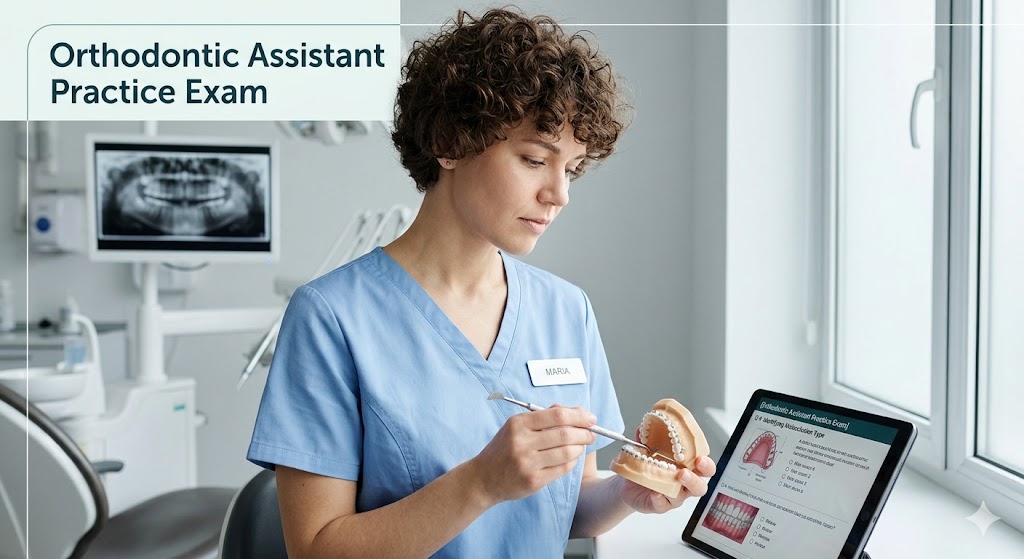
Additional Information
What the Course Entails and Exam Details
This comprehensive course provides a detailed exploration into the world of orthodontics, offering both theoretical knowledge and practical skills necessary for success. The curriculum is broad, covering key areas such as dental anatomy, orthodontic terminology, instrument recognition, and chairside assistance during various procedures like bonding, adjustments, and appliance placement. Candidates will gain deep insights into patient management, understanding how to communicate effectively with patients of all ages about their treatment plans and oral hygiene.
Furthermore, the course places significant emphasis on the practical application of skills. Candidates will learn about sterilization protocols, diagnostic record taking, including impressions and photographs, and emergency management in an orthodontic setting. The final exam details are meticulously structured to test these competencies, ensuring that every certified orthodontic assistant meets the high standards expected in the profession.
What to Expect in the Final Exam
The final exam for the Orthodontic Assistant certification is a rigorous assessment, typically consisting of multiple-choice questions that cover the entire syllabus. Candidates should expect scenarios that require critical thinking and the application of their knowledge to real-world orthodontic situations. The questions will test understanding of dental procedures, the functionality of different orthodontic tools, patient safety protocols, and ethical considerations.
A key aspect of the final exam involves time management. The exam is usually timed, demanding that candidates not only know the correct answers but can also recall and apply this information efficiently. Achieving a passing score requires a comprehensive grasp of both clinical skills and the theoretical foundations of orthodontics. The exact format, passing score, and time limit vary by the certifying body, so it is crucial for candidates to review the specific guidelines provided.
How to Study and Exam Centers
Preparation for the Orthodontic Assistant exam should be systematic and comprehensive. Successful study strategies often include a mix of reviewing textbook materials, utilizing online study guides, and participating in practical workshops. Taking practice exams is highly recommended as it helps candidates familiarize themselves with the question format and identify areas where they need further study. Forming study groups with peers can also be an excellent way to reinforce knowledge and share different perspectives on complex topics.
For many candidates, enrolling in a preparatory course can provide a structured learning path. These courses often cover the entire syllabus in detail and include extensive practice with past exam questions. In addition to studying, candidates need to be aware of the exam centers. These are typically secure testing locations equipped with computers where the exam is administered. Registration and specific locations can be found on the certifying organization’s website, where candidates can also find information on online proctored exam options, if available.
Job Opportunities from the Course
Upon successfully passing the exam and obtaining the Orthodontic Assistant certification, a wide array of career opportunities becomes available. This qualification is highly regarded by employers in the dental field and can lead to positions such as:
Certified Orthodontic Assistant (COA) in private orthodontic practices, where duties involve directly assisting orthodontists with patient care.
Orthodontic Assistant in specialized dental groups and community health centers.
Treatment Coordinator, helping patients understand their treatment options and financial plans.
Lead Orthodontic Assistant, overseeing the clinical team and managing clinic workflow.
Dental Sales Representative for companies specializing in orthodontic products and technology.
This certification not only enhances job security but also provides a platform for salary advancement and further specialization within the dental profession.
Frequently Asked Questions
Reviews
5.0
Based on 0 reviews
Leave a Review
No reviews yet. Be the first to review!