
Orthodontic Force Systems Practice Test
$69.00
- Buy to unlock unlimited access to all Quiz questions and Answers in this Quiz.
- After purchase you can print a PDF of the whole quiz at any point. The PDF will contain the questions and the correct answers.
About this Exam
The Orthodontic Force Systems Practice Test is an essential preparatory tool designed for dental students, orthodontic residents, and practicing dental professionals seeking to validate their expertise in the biomechanics of tooth movement.
Mastering force systems is critical for predictable treatment outcomes, and this exam is designed for individuals aiming to demonstrate advanced proficiency in applying physics to clinical orthodontics.
This practice test provides a realistic simulation of the challenging questions encountered in advanced orthodontic certification exams or residency finals.
Ready to test your knowledge?
Buy Now to Access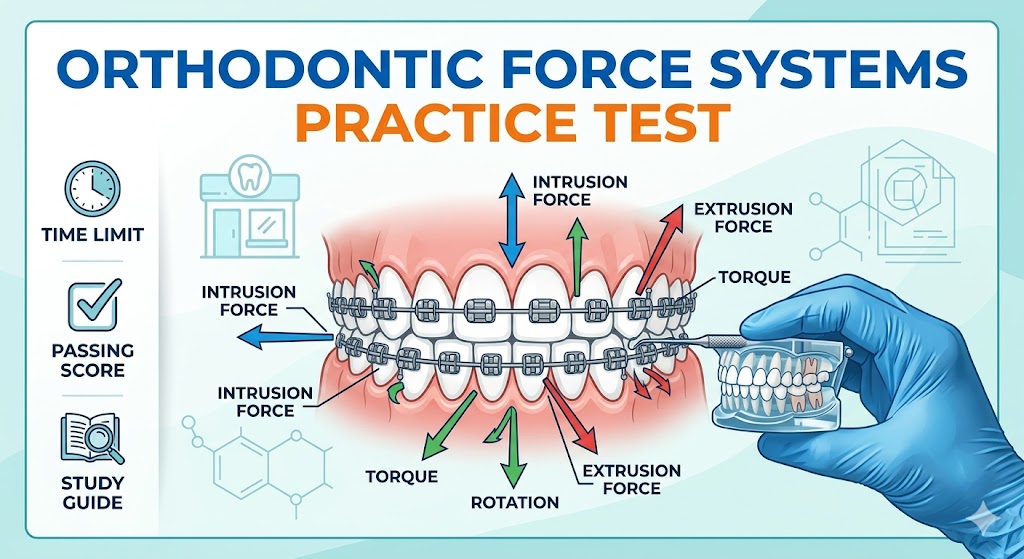
Additional Information
What the Course Entails and Exam Details
The core curriculum covered by this practice test focuses heavily on the application of physics principles to dental anatomy.
Topics include Newton's Laws of Motion as they apply to the oral cavity, the concept of the Center of Resistance (CRe) in single and multi-rooted teeth, and the determination of the Center of Rotation (CRot).
You will be tested on your ability to calculate moments of force, differentiate between different types of movement—such as pure translation, uncontrolled tipping, and controlled tipping—and understand the interplay between brackets, archwires, and auxiliaries in generating precise force systems.
A strong emphasis is also placed on the friction of various material combinations and the biology of tooth movement in response to mechanical stress.
What to Expect in the Final Exam
While this is a practice simulation, it mirrors the structure of standard professional board exams.
The final exam typically consists of 100 to 150 multiple-choice questions, many of which are case-based scenarios requiring visual analysis of cephalometric radiographs or dental casts.
Participants must determine the necessary force magnitudes and directions to achieve specific treatment goals while minimizing adverse effects.
The passing score is generally set at 75% or higher, reflecting a requirement for high competency.
Candidates are usually allotted 2 to 3 hours to complete the exam, demanding strong time-management skills alongside theoretical knowledge.
How to Study and Exam Centers
The best way to prepare is to combine a rigorous review of core textbooks, such as "Contemporary Orthodontics" by Proffit, with targeted practice questions.
When using this practice test, do not just aim for the correct answer; ensure you understand the mechanics and physics behind why the other options are incorrect.
Create diagrams to visualize the moments and force vectors for various clinical scenarios, and memorize common CRe locations.
For the formal certification exams associated with this topic, candidates usually register through the American Board of Orthodontics (ABO) or their respective national dental boards.
Testing is typically administered via secure, computerized testing centers like Pearson VUE, though some university-based residency programs may host the exams internally.
Job Opportunities from the Course
Achieving mastery and certification in Orthodontic Force Systems opens significant career pathways within the dental field.
Professionals who demonstrate this advanced level of biomechanical expertise are highly sought after by private orthodontic practices and multi-specialty dental groups.
Potential job titles and roles include:
Certified Orthodontist
Orthodontic Associate
Dental School Faculty / Clinical Instructor in Orthodontics
Orthodontic Treatment Coordinator (requiring advanced clinical knowledge)
Dental Consultant for Orthodontic Appliance Manufacturers
Researcher in Dental Biomechanics
Frequently Asked Questions
Reviews
5.0
Based on 0 reviews
Leave a Review
No reviews yet. Be the first to review!