
Orthopedic Technologist Certification Practice Exam
$69.00
- Buy to unlock unlimited access to all Quiz questions and Answers in this Quiz.
- After purchase you can print a PDF of the whole quiz at any point. The PDF will contain the questions and the correct answers.
About this Exam
The Orthopaedic Technologist Certified (OTC) designation is a premier credential for healthcare professionals specializing in the musculoskeletal system. It is designed for individuals who have gained expertise through a minimum of two years of full-time, supervised on-the-job training or completion of an authorized orthopedic technology program. This certification validates your specialized knowledge and technical skills in immobilization, traction, and surgical assisting. Earning your OTC not only establishes a high standard of professional competence but also signifies a commitment to delivering high-quality patient care, giving you a competitive advantage in the healthcare field. This practice exam is an essential tool to help you gauge your readiness and confidently approach the final certification.
Ready to test your knowledge?
Buy Now to Access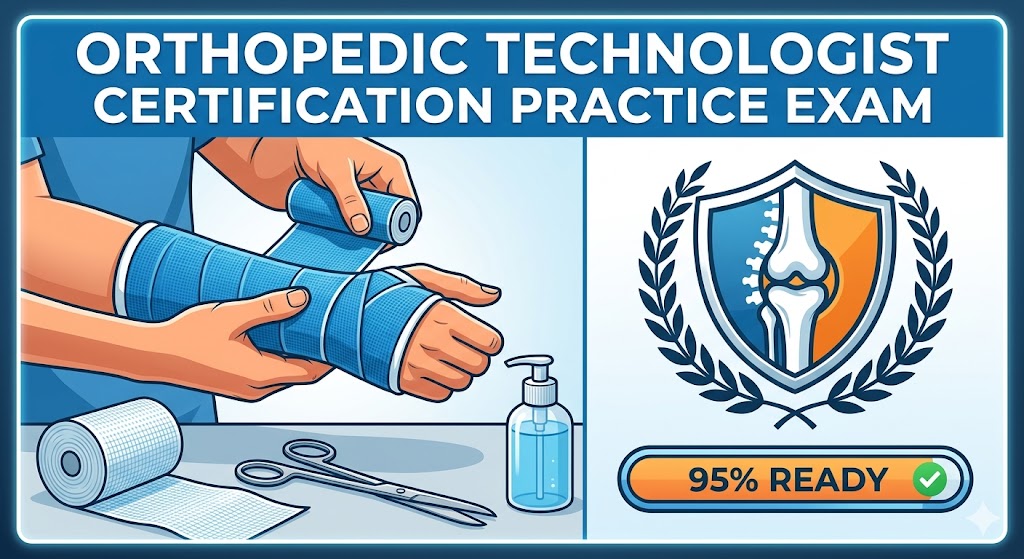
Additional Information
What the Course Entails and Exam Details
The path to certification requires a thorough understanding of orthopedic principles and practical applications. The core topics, which form the basis of the comprehensive exam, include:
Patient Assessment and Management (30%) : Covering effective patient interviewing, conducting physical examinations, interpreting radiographic images, educating patients on procedures and devices, and recognizing critical orthopedic conditions and emergencies.
Office and Clinic Management (10%) : Including foundational inventory management, maintaining patient privacy (HIPAA compliance), and strictly adhering to universal precautions for infection control and sterilization.
Casting, Splinting, and Orthopedic Appliances (40%) : Mastering the application, modification, and removal of upper extremity, lower extremity, torso, and specialty casts and splints, as well as fitting and educating patients on pre-fabricated orthotics.
Clinic and Hospital Surgical Procedures (20%) : Understanding common orthopedic surgeries, proper patient positioning, prepping, and draping, as well as assisting the surgical team and managing post-operative patient care.
What to Expect in the Final Exam
The Orthopaedic Technologist Certified (OTC) examination is a rigorous evaluation of your competency. Here are the precise details of the final test:
Format : The exam is entirely computer-based and consists of 165 multiple-choice questions.
Scored Questions : Out of the 165 questions, 150 are scored, and 15 are unscored "pretest" questions used for future research purposes.
Time Limit : You will have exactly 3 hours to complete the examination. There are no scheduled breaks.
Passing Score : To receive your OTC credential, you must achieve a final scaled score of 700 or higher. This approximately correlates to answering at least 101 of the 150 scored questions correctly.
Results : Upon completion, a proctor at the testing center will provide you with an immediate, official printout of your score results before you leave.
How to Study and Exam Centers
Preparation is the key to success. To maximize your chances of passing, adopt these actionable study strategies:
Utilize Practice Exams : Make extensive use of OTC practice tests, like this one. They are invaluable for familiarizing yourself with the question format, identifying your specific areas of weakness, and building your testing endurance.
Review Official Reference Materials : Consult the official references and textbooks recommended by the National Board for Certification of Orthopaedic Technologists (NBCOT).
Develop a Study Plan : Create a structured plan that allocates dedicated time to each of the four exam domains, giving extra focus to the areas where you need the most improvement.
The OTC examination is administered at authorized Pearson VUE testing centers located throughout the United States and internationally. You can register for the exam and schedule your testing appointment directly through the NBCOT and Pearson VUE portals. Some authorized orthopedic schools or military training centers may also serve as physical testing centers.
Job Opportunities from the Course
Becoming a Certified Orthopedic Technologist (OTC) unlocks a range of rewarding career paths in hospitals, private clinics, and specialized fracture centers. This certification can lead to the following job titles:
Certified Orthopedic Technologist (OTC)
Orthopedic Casting Technician
Fracture Clinic Technologist
Surgical Orthopedic Assistant
Orthopedic Traction Specialist
Immobilization Technician
Chief Orthopedic Technologist
Orthopedic Care Coordinator
Frequently Asked Questions
Reviews
5.0
Based on 0 reviews
Leave a Review
No reviews yet. Be the first to review!