
Orthotics and Prosthetics Combined Written Boards Practice Exam
$69.00
- Buy to unlock unlimited access to all Quiz questions and Answers in this Quiz.
- After purchase you can print a PDF of the whole quiz at any point. The PDF will contain the questions and the correct answers.
About this Exam
The [Orthotics and Prosthetics Combined Written Boards Practice Exam] is a vital educational resource designed for aspiring Certified Prosthetist Orthotists (CPOs) and single-discipline certified professionals seeking to validate their knowledge on the path to dual certification. This comprehensive practice tool mirrors the theoretical, clinical reasoning, and regulatory content of the official combined written board examinations. This exam is essential for individuals who have completed their formal education and residency in both orthotics and prosthetics, ensuring they are well-prepared for the final, critical step in the credentialing process. Candidates must already have a strong foundation in human anatomy, physiology, biomechanics, and the design and application of orthotic and prosthetic devices. The practice exam aims to build confidence and identify knowledge gaps, paving the way for success in the actual testing environment.
Ready to test your knowledge?
Buy Now to Access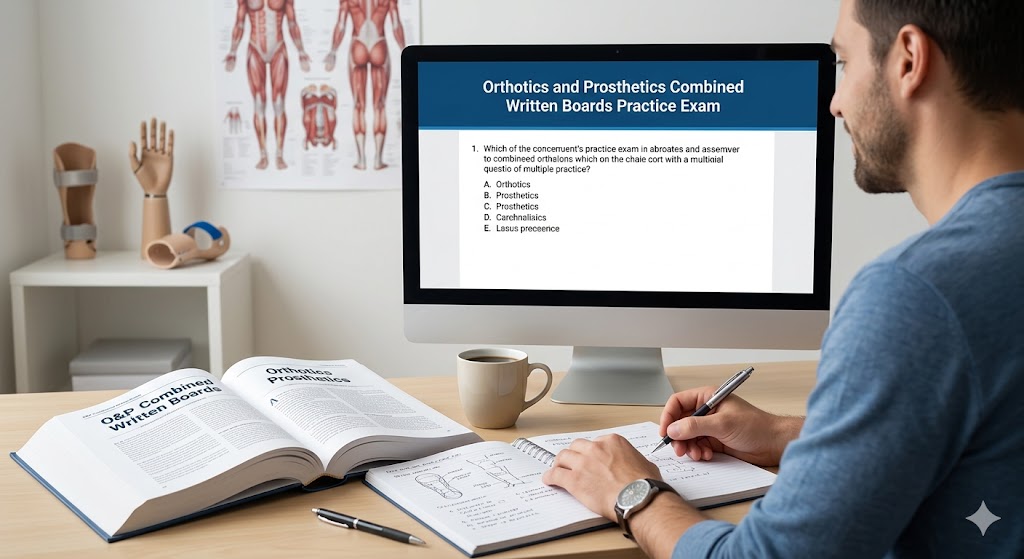
Additional Information
What the Course Entails and Exam Details
This rigorous study experience and practice exam comprehensive program encompasses the core educational pillars of both orthotics and prosthetics. The content is meticulously curated to reflect the knowledge domains and tasks essential for successful O&P practice.
Candidates will delve into a wide range of topics, including:
Human Anatomy and Physiology: Deep understanding of the musculoskeletal system, nervous system, and systemic diseases affecting mobility.
Biomechanics and Kinesiology: Analysis of joint mechanics, muscle function, and human gait, both pathological and normalized.
Pathology and Disease Processes: Study of conditions commonly managed by O&P, such as limb loss, peripheral neuropathy, cerebral palsy, spinal cord injury, and various orthopedic conditions.
Material Science and Fabrication Principles: Knowledge of the properties of materials used in O&P, and the fundamental steps and considerations in the fabrication process for different devices.
Orthotic Device Design and Management: Specific application of bracing systems for the spine, lower limb (e.g., AFOs, KAFOs, hip orthoses), and upper limb.
Prosthetic Device Design and Management: Comprehensive review of prosthetic limb systems (both upper and lower extremity), including socket design principles, suspension, component selection, and alignment.
Patient Assessment and Practice Management: Skills in patient evaluation, treatment planning, outcome measurement, documentation, and adhering to professional, ethical, and regulatory standards (e.g., Medicare, HIPAA).
What to Expect in the Final Exam
While a practice resource, candidates should understand the structure of the official [Orthotics and Prosthetics Combined Written Boards]. The final exam is generally a proctored, computer-based test, designed to be rigorous.
Candidates can typically expect:
Format: A significant number of multiple-choice questions, often structured around clinical scenarios, case studies, and fundamental knowledge. These questions assess recall, understanding, analysis, and clinical decision-making.
Scope: The exam will comprehensively cover both orthotic and prosthetic disciplines, often presenting content either in distinct sections or integrated scenarios that require knowledge from both fields.
Time Limit: Expect a strict time constraint, possibly structured into multiple sessions over one or more days, reflecting the length of taking two comprehensive written board exams.
Passing Score: The required passing score is determined by the certifying body (e.g., American Board for Certification in Orthotics, Prosthetics & Pedorthics - ABC) based on psychometric analysis. It represents the minimum level of knowledge required to be deemed competent.
Specific Rules: Candidates must adhere to strict testing center rules, which include presenting valid identification, allowing only approved items into the testing room, and prohibited use of external aids.
How to Study and Exam Centers
Preparation is paramount for success on the O&P Combined Written Boards. Utilize a combination of strategic approaches:
Comprehensive Review: Systematically revisit course materials, textbooks, clinical experience notes, and professional practice guidelines in both orthotics and prosthetics. Focus on key domains outlined by your certifying body.
Practice Exams: Repeatedly take practice exams under timed conditions. Use resources like the [Orthotics and Prosthetics Combined Written Boards Practice Exam] to familiarize yourself with the question types, assess your knowledge across both fields, and practice time management. Review the answers to all questions, understanding why the correct choice is correct and why others are incorrect.
Study Groups: Collaborate with peers to discuss complex concepts, share resources, and quiz each other on anatomy, biomechanics, and clinical problem-solving.
Official Resources: Prioritize study materials, task outlines, and preparation courses offered directly by your certification board (e.g., ABC’s Exam Prep page).
Exam Centers and Scheduling:
The official O&P Board exams are not usually taken at educational schools but are administered through high-security computer-based testing centers. Candidates are typically directed to schedule their exams through professional test administration services (such as Pearson VUE, Prometric, etc.), which have numerous physical locations across the country. Candidates must apply and receive authorization from their certifying body before they can schedule a testing slot at a designated center. Practice exams, conversely, are frequently accessible online via specialized educational portals and preparation platforms.
Job Opportunities from the Course
Successfully navigating your educational program and passing both components of the [Orthotics and Prosthetics Combined Written Boards] unlocks advanced career paths and significant professional autonomy. Certified CPOs are in high demand across a range of healthcare settings.
Job roles and career paths include:
Certified Prosthetist Orthotist (CPO): The primary designation for dually certified practitioners, allowing you to assess, design, fabricate, fit, and manage patient care for both orthotic and prosthetic needs.
O&P Practitioner/Clinician: Working in hospitals, private clinics, rehabilitation centers, and home healthcare settings.
Clinical Director/Manager: Leading O&P clinics or departments in larger healthcare facilities.
Research & Development Specialist: Contributing to the innovation and improvement of O&P devices, materials, and clinical techniques.
Educator/Instructor: Teaching in O&P education programs at the university or assistant level.
Product Specialist/Sales Representative: Working for O&P manufacturers, providing clinical support, training, and sales services for devices and components.
Clinical Consultant: Advising insurance companies, legal teams, or healthcare organizations on O&P care and policy.
Frequently Asked Questions
Reviews
5.0
Based on 0 reviews
Leave a Review
No reviews yet. Be the first to review!