
OSCE Vet Nurse Instrument ID Practice Exam
$69.00
- Buy to unlock unlimited access to all Quiz questions and Answers in this Quiz.
- After purchase you can print a PDF of the whole quiz at any point. The PDF will contain the questions and the correct answers.
About this Exam
The OSCE Veterinary Nursing Instrument Identification Practice Test is a critical self-assessment tool designed specifically for aspiring and practicing veterinary nurses.
It serves as an essential stepping stone towards mastering the identification of surgical instruments, clinical equipment, and dental tools, a foundational skill required in diverse veterinary settings.
This practical, hands-on practice exam is crafted to mirror the format and rigour of authentic OSCEs (Objective Structured Clinical Examinations), ensuring that candidates build confidence, speed, and accuracy in recognizing key tools.
Whether you are a student preparing for your qualifying exams or a professional looking to refresh and sharpen your skills, this practice test provides invaluable feedback on your proficiency.
It’s your opportunity to simulate the real exam experience, identify knowledge gaps, and refine your instrument identification abilities in a pressure-free, illustrative environment.
Ready to test your knowledge?
Buy Now to Access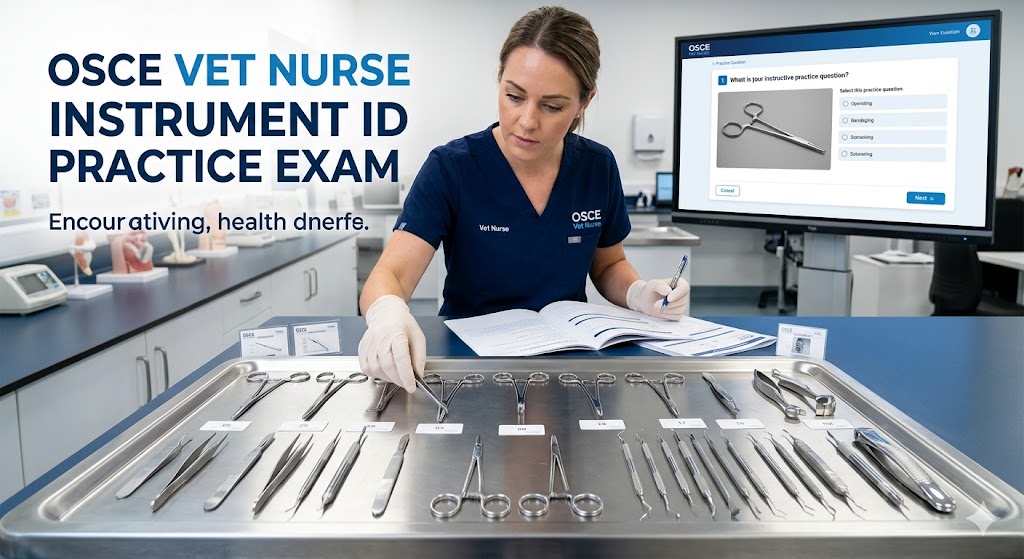
Additional Information
What the Course Entails and Exam Details
While not a full course itself, this practice exam is intrinsically linked to the practical knowledge required in veterinary nursing curricula and practical training.
It covers a broad spectrum of instruments and equipment that are fundamental to modern veterinary practice.
Candidates will interact with visuals or actual instruments across several key categories:
Surgical Instruments: Identification of common surgical tools including various types of forceps (hemostatic, tissue, dressing), scalpel handles, blades, needle holders, retractors, and surgical scissors (operating, bandage, suture).
Dental Instruments: Recognition of essential dental tools such as dental explorers, probes, scalers, curettes, and extraction forceps, crucial for oral hygiene procedures and extractions.
Clinical and Diagnostic Equipment: Familiarity with diagnostic tools, monitoring devices, fluid therapy apparatus, and standard clinical equipment used daily in veterinary hospitals and clinics.
Orthopedic and Specialized Tools: While potentially less extensive, basic recognition of key orthopedic or specialized instruments (e.g., bone cutters, plate holders) might be included.
The exam is laser-focused on practical, visual identification rather than theoretical knowledge.
It demands quick recall and the ability to distinguish between very similar instruments, demonstrating real-world competence.
What to Expect in the Final Exam
This practice exam simulates a real-world OSCE practical station focused on instrument identification.
It often utilizes an online, interactive format where you are presented with high-resolution images or, in a physical setting, actual instruments laid out on stations.
Question Type: The format typically involves multiple-choice questions or fill-in-the-blank text boxes.
Response Structure: You may be asked to select the correct name, specific function, or use cases for the displayed instrument.
Timing and Stations: Expect multiple stations or sets of questions, each dedicated to different instrument categories, requiring rapid, successive identification.
As a practice test, "passing scores" may be illustrative or aimed at demonstrating proficiency (e.g., aiming for 80% or higher).
Time limits are generally strict, designed to replicate the time pressure of a genuine OSCE (e.g., 30-60 seconds per instrument, multiple stations with limited total time).
Ensure you approach the practice exam with a commitment to integrity, attempting it without referencing external materials initially, as this best prepares you for real-world scenarios.
Pay close attention to subtle differences, as precision is paramount.
Specific instructions regarding response format and navigation should be carefully followed.
How to Study and Exam Centers
Study Strategies:
Visual Aids: Utilise flashcards (digital or physical), detailed anatomical charts, veterinary instrument catalogs, and online image libraries showcasing instruments from multiple angles.
Hands-on Practice: Whenever possible, gain actual practical experience in a veterinary practice.
Handling Tools: Request permission to handle clean (non-sterile/sterilised) instruments, practice laying them out, and have colleagues or mentors quiz you. Repetition is key.
Practice Quizzes: Leverage various online practice quizzes and simulated OSCE resources specific to veterinary nursing. Focus on areas where you consistently make errors.
Mnemonics: Create catchy mnemonics or associations for difficult-to-remember instrument names or distinctions.
Study Groups: Collaborate with peers to quiz each other and discuss instrument functions.
How to Take the Test (instead of "Exam Centers" for a practice test):
As this is primarily a practice test, you won't typically find "exam centers" like for official qualifications. Instead, look for:
Online Portals: Many veterinary nursing educational platforms, professional organisations (e.g., BVNA, VNCA, or country-specific equivalents), and dedicated OSCE prep websites offer interactive instrument ID practice exams online.
Educational Institutions: If you are enrolled in a veterinary nursing course, your college or university may provide access to such practice resources as part of your curriculum, possibly within simulated clinical labs or on internal learning management systems.
Specialized Software: Some veterinary nursing study guides come bundled with practice software or online access.
Always check with your specific course provider or professional body for recommended, legitimate practice resources.
Note: Unlike a final qualification exam, you take this practice test at your own pace/location via digital platforms or potentially simulated stations in an educational setting.
Job Opportunities from the Course
Successfully mastering veterinary nursing skills, particularly practical elements like instrument identification, significantly enhances your profile and prepares you for a successful career.
While this specific practice test is a preparatory step and not a direct certification for any particular job (it's part of achieving the wider veterinary nursing qualification), demonstrating high proficiency in this area opens doors.
The relevant career paths this knowledge and preparation support include:
Registered Veterinary Nurse (RVN): Working in small animal, mixed practice, equine, or exotics clinics, providing comprehensive veterinary care and assisting in surgeries and treatments.
Surgical Veterinary Nurse Specialist: Deepening your expertise and focusing specifically on operating room procedures, sterile technique, and advanced surgical assisting.
Dental Veterinary Nurse: Specialising in animal dentistry, performing oral hygiene procedures, and assisting with complex dental surgeries.
Veterinary Clinic Manager/Administrator: Moving into a leadership or administrative role, leveraging clinical knowledge to efficiently run veterinary practices.
Veterinary Industry Sales/Training: Utilizing your clinical experience in technical sales for veterinary supply companies, or as a trainer for equipment and surgical products.
Veterinary Educator: Teaching the next generation of veterinary nurses in colleges or university programs, passing on essential practical skills.
Emergency & Critical Care Veterinary Nurse: Working in high-paced, urgent care environments, applying diverse clinical skills rapidly.
Frequently Asked Questions
Reviews
5.0
Based on 0 reviews
Leave a Review
No reviews yet. Be the first to review!