
OSFM BFO Module B Practice Exam
$69.00
- Buy to unlock unlimited access to all Quiz questions and Answers in this Quiz.
- After purchase you can print a PDF of the whole quiz at any point. The PDF will contain the questions and the correct answers.
About this Exam
The OSFM Basic Firefighter Operations (BFO) Module B certification is a critical step for aspiring firefighters, specifically designed for individuals pursuing a career in the fire service.
This exam serves as a comprehensive evaluation of the fundamental knowledge and skills required to safely and effectively operate in the demanding field of firefighting.
It represents the intermediate phase of basic firefighter training, building upon foundational concepts and introducing more advanced operational procedures.
Successful completion of Module B is often a prerequisite for advancement to subsequent modules and ultimately, achieving state certification as a Basic Operations Firefighter.
Ready to test your knowledge?
Buy Now to Access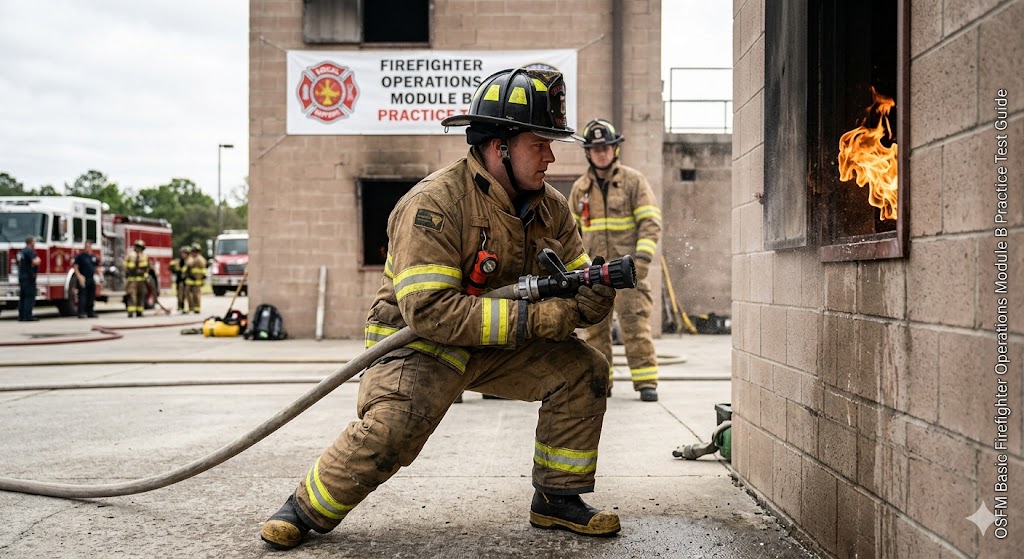
Additional Information
What the Course Entails and Exam Details
The course corresponding to this exam delves into a diverse range of essential firefighting subjects.
Core topics typically include building construction for fire progression, water supply systems, fire hose and appliance identification and use, water streams and nozzle techniques, fire control strategies for residential structures, and extensive practical skills in ladder operations.
Candidates must also master ventilation techniques, understanding how to control the flow of smoke and heat, and gain proficiency in search and rescue operations in hazardous environments.
The training emphasizes both theoretical understanding and hands-on application, ensuring firefighters can translate classroom knowledge into decisive action.
What to Expect in the Final Exam
The OSFM BFO Module B final assessment typically consists of a cognitive, written exam and a series of practical skills evaluations.
The written exam, often multiple-choice, assesses your understanding of the theoretical concepts covered throughout the course.
The practical evaluation requires candidates to demonstrate proficiency in various core skills, such as ladder deployment, hose advancement, and simulated search and rescue scenarios, often under the direct observation of qualified evaluators.
Passing scores are strictly adhered to and generally range around 70-80% for both the written and practical portions, with specific cut-offs determined by the Office of the State Fire Marshal.
How to Study and Exam Centers
Effective study strategies involve a balanced approach combining consistent review of textbooks and class notes with repetitive hands-on practice.
Utilize available study guides, online practice exams, and flashcards to reinforce key terms, equations, and procedural steps.
Candidates should seek out opportunities to physically practice essential skills, such as ladder carries, knots, and hose line management, ideally under the guidance of experienced instructors.
Regarding exam centers, the cognitive exam is often administered through secure online portals or at designated physical testing locations authorized by the State Fire Marshal’s office.
Practical exams are typically conducted at accredited fire academies, training facilities, or authorized regional testing centers equipped with the necessary apparatus and structures.
Job Opportunities from the Course
Earning the OSFM BFO Module B certification is a significant milestone that directly enhances eligibility for various roles within the fire service.
This qualification demonstrates commitment and proficiency, making candidates highly competitive for positions such as:
Entry-Level Firefighter (Career or Volunteer Departments)
Firefighter / EMT-Basic
Fire Department Safety Officer Trainee
Emergency Response Team Member
Private Sector Fire Protection Specialist
Municipal Fire Service Recruit
Frequently Asked Questions
Reviews
5.0
Based on 0 reviews
Leave a Review
No reviews yet. Be the first to review!