
OSFM BFO Module C Practice Exam
$69.00
- Buy to unlock unlimited access to all Quiz questions and Answers in this Quiz.
- After purchase you can print a PDF of the whole quiz at any point. The PDF will contain the questions and the correct answers.
About this Exam
The OSFM Basic Firefighter Operations (BFO) Module C Certification represents a critical milestone for aspiring firefighters within the state of Illinois. This certification verifies that candidates possess the fundamental knowledge and specialized skills required to operate safely and effectively in specific firefighting scenarios. The Module C Practice Test is an invaluable tool designed precisely for prospective firefighters, including career, part-time, and paid-on-call personnel, who are preparing for the final Office of the State Fire Marshal (OSFM) examination. It allows students to assess their readiness, identify critical knowledge gaps, and gain the confidence needed to succeed on testing day.
Ready to test your knowledge?
Buy Now to Access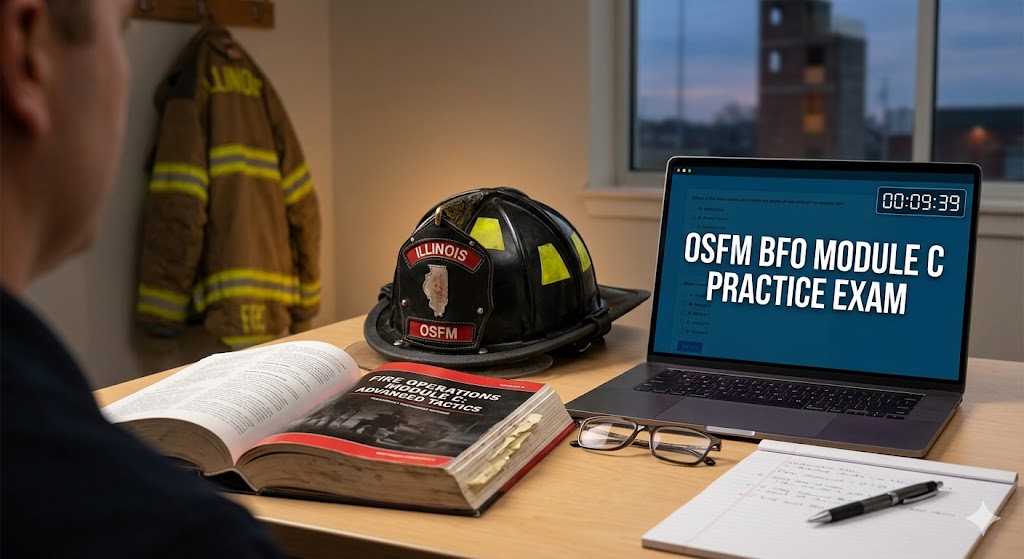
Additional Information
What the Course Entails and Exam Details
This course and its accompanying practice exam focus on the refined and technical components of the Basic Firefighter curriculum, building upon the foundational knowledge acquired in earlier modules. While exact curricula can vary by training academy, Module C generally mandates mastery in several key domains. You will delve into advanced ventilation techniques, salvage and overhaul operations, and the critical principles of fire control and loss control. Furthermore, candidates must demonstrate a comprehensive understanding of fire detection and suppression systems, such as sprinkler and alarm systems. The course also typically covers specialized areas like wildland and ground cover firefighting, public education and fire prevention, and technical rescue support awareness. Mastering these topics ensures you understand the complexities of the specialized duties inherent in the modern fire service.
What to Expect in the Final Exam
To achieve the official OSFM BFO Module C Certification, candidates must successfully navigate a rigorous standardized evaluation process composed of two primary components: a cognitive (written) examination and a practical skills demonstration. The written final exam is typically a multiple-choice assessment that tests your theoretical comprehension of all material covered within the module’s scope. To pass, candidates are usually required to achieve a minimum score of 70% or higher. The practical skills portion evaluates your ability to perform essential hands-on tasks safely and efficiently under supervision, covering competencies such as handling sprinkler systems or executing property conservation techniques. The final written examination is administered as a computer-based test at designated facilities, providing immediate scoring feedback.
How to Study and Exam Centers
Effective preparation requires a structured and dedicated approach. You should begin by thoroughly reviewing the primary training manuals, such as those provided by IFSTA (International Fire Service Training Association) or Jones & Bartlett, focusing explicitly on the designated Module C chapters. Utilizing this practice test multiple times is essential for becoming accustomed to the question format and testing your retention of specialized knowledge. For the practical skills evaluation, participate actively in hands-on training sessions provided by your academy or department, as physical repetition is key to mastery. The official computer-based final exams are proctored exclusively at state-approved testing facilities. The primary exam administrator is Pearson VUE, which hosts OSFM testing at various locations throughout Illinois. Candidates often register and schedule their exams through their fire department training officers or the authorized fire science academy where they are enrolled.
Job Opportunities from the Course
Successfully completing the entire OSFM Basic Firefighter Operations (BFO) certification process—of which Module C is a vital component—is the standard prerequisite for employment in almost all fire departments across Illinois. This foundational certification provides the direct pathway to several career options within the public safety sector. Key job opportunities that this progression unlocks include:
Municipal Career Firefighter
Part-Time or Paid-on-Call Firefighter
Volunteer Firefighter
Industrial Fire Brigade Member
Hazard Mitigation or Emergency Response Technician
Foundation for future certification as a Fire Inspector, Investigator, or Training Officer
Frequently Asked Questions
Reviews
5.0
Based on 0 reviews
Leave a Review
No reviews yet. Be the first to review!