
OSHA 510 Construction Practice Exam
$69.00
- Buy to unlock unlimited access to all Quiz questions and Answers in this Quiz.
- After purchase you can print a PDF of the whole quiz at any point. The PDF will contain the questions and the correct answers.
About this Exam
The OSHA 510 course, formally known as "Occupational Safety and Health Standards for the Construction Industry," is a fundamental program for personnel in the construction sector.
It is designed to provide comprehensive, foundational knowledge of OSHA’s safety standards specifically relevant to construction work sites.
Unlike courses that focus solely on the "how-to" of hands-on labor, the OSHA 510 provides a deep dive into the regulatory framework that governs safety policies.
This certification is specifically designed for foremen, superintendents, project managers, safety coordinators, and any construction professional who has responsibilities for maintaining safety and health standards on the job.
Completing this program demonstrates that a professional has advanced beyond basic safety training and is qualified to identify, predict, and regulate safety hazards in complex construction environments.
Ready to test your knowledge?
Buy Now to Access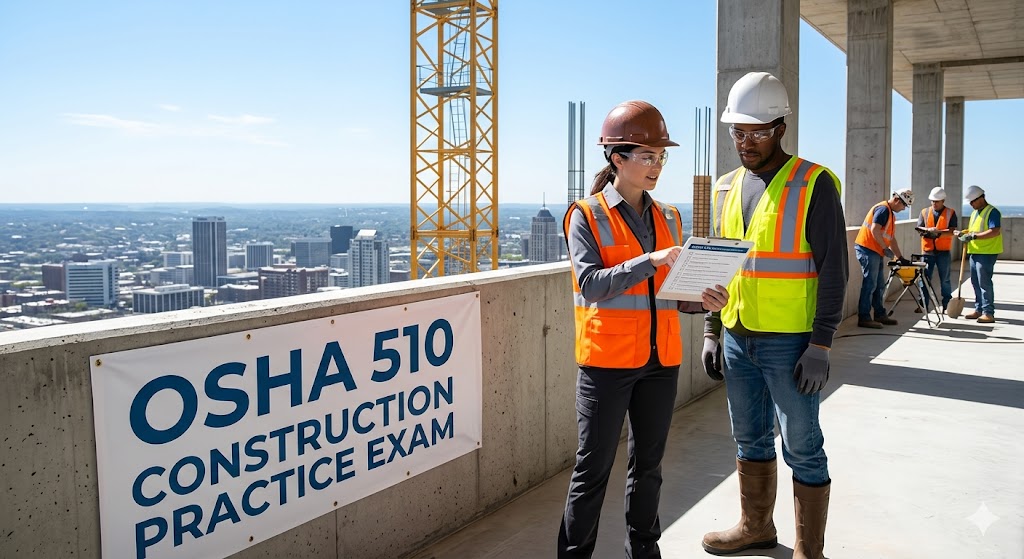
Additional Information
What the Course Entails and Exam Details
The OSHA 510 curriculum is a extensive deep-dive into standard 29 CFR 1926, which is the foundational document for all construction safety regulation in the United States.
The primary syllabus focuses on teaching students how to read, interpret, and effectively apply these specific federal standards to real-world scenarios.
Core topics covered in the course material typically include:
Introduction to OSHA standards, inspections, and recordkeeping.
Detailed breakdown of Focus Four Hazards: Falls, Caught-In or -Between, Struck-By, and Electrocution.
Personal Protective Equipment (PPE) requirements and selection criteria.
Fire protection and prevention protocols.
Rigging equipment for material handling.
Hand and power tool safety guidelines.
Welding, cutting, and brazing operations.
Scaffolding safety and inspection.
Excavation safety standards.
Stairways and ladders regulations.
Toxic and hazardous substances.
Confined space entry requirements.
Concrete and masonry construction specifications.
What to Expect in the Final Exam
Upon completion of the extensive classroom instruction, students must pass a final exam to receive their OSHA 510 certificate.
The final exam is typically administered in a multiple-choice format, designed to test the application of knowledge rather than simple memorization.
While specific question counts can vary slightly by the authorized trainer, the exam generally consists of 50 to 100 questions.
A passing score of 70% or higher is strictly required to successfully complete the course.
The exam is usually timed, often with a two-hour limit, depending on the training provider.
Students are allowed to use the CFR 1926 standards manual during the exam, as the test focuses on a student’s ability to find and interpret the relevant standard rather than recall a rule from memory.
How to Study and Exam Centers
The key to succeeding in the OSHA 510 exam lies less in memorization and more in navigating the CFR 1926 regulations efficiently.
The best study strategy is consistent, active engagement during the classroom training.
Make full use of the CFR manual during class. Highlight key sections, use index tabs for quick referencing of major chapters (like Subpart M for Falls or Subpart P for Excavations), and practice navigating the table of contents.
Participate actively in the class workshops, as these practical exercises often mirror the scenarios presented in the final exam.
Take comprehensive notes, focusing on the intent and application of specific regulations.
OSHA 510 is not administered through massive commercial testing centers like Pearson VUE.
Instead, it is offered through authorized training organizations. These include specialized professional safety schools, university extension programs, or authorized union training centers.
Classes are often offered in continuous, multi-day blocks (e.g., four consecutive days) and are available in both physical, in-person classrooms and, increasingly, via live, instructor-led online portals. You must register directly with these authorized providers to take the course and the associated exam.
Job Opportunities from the Course
Earning an OSHA 510 certificate is a powerful credential that signals advanced competence in construction safety regulations, opening doors to advanced roles.
The certification unlocks numerous career paths and advanced job opportunities within the construction and safety sectors, including:
Construction Safety Coordinator: Responsible for daily site inspections and ensuring overall regulatory compliance.
Project Superintendent: Oversees all on-site construction operations, where safety management is a critical priority.
Construction Project Manager: Manages the entire project lifecycle, including budget, scheduling, and ensuring a safe work environment.
Site Safety Health Officer (SSHO): A dedicated, high-responsibility role ensuring specific complex project safety plans are followed (essential for government contracts).
Assistant Safety Manager: A mid-level leadership role assisting a director of safety in managing company-wide safety programs.
Foreman / Crew Leader: Enhanced safety training allows for greater authority and supervision over specific trades and crews.
Safety Consultant: A pathway toward independent auditing and advising various construction firms on safety improvements.
Frequently Asked Questions
Reviews
5.0
Based on 0 reviews
Leave a Review
No reviews yet. Be the first to review!