
OSHA Health Science Practice Exam
$69.00
- Buy to unlock unlimited access to all Quiz questions and Answers in this Quiz.
- After purchase you can print a PDF of the whole quiz at any point. The PDF will contain the questions and the correct answers.
About this Exam
Preparing for a career in healthcare or laboratory research means prioritizing safety.
The OSHA Health Science Practice Test serves as a crucial evaluation tool.
It is for individuals seeking to demonstrate their knowledge of essential occupational safety and health standards.
This guide is designed for aspiring healthcare professionals, lab technicians, researchers, and students.
Our goal is to build confidence and excel in your safety training.
Ultimately, it helps ensure you can work safely and prevent workplace injuries and illnesses.
Ready to test your knowledge?
Buy Now to Access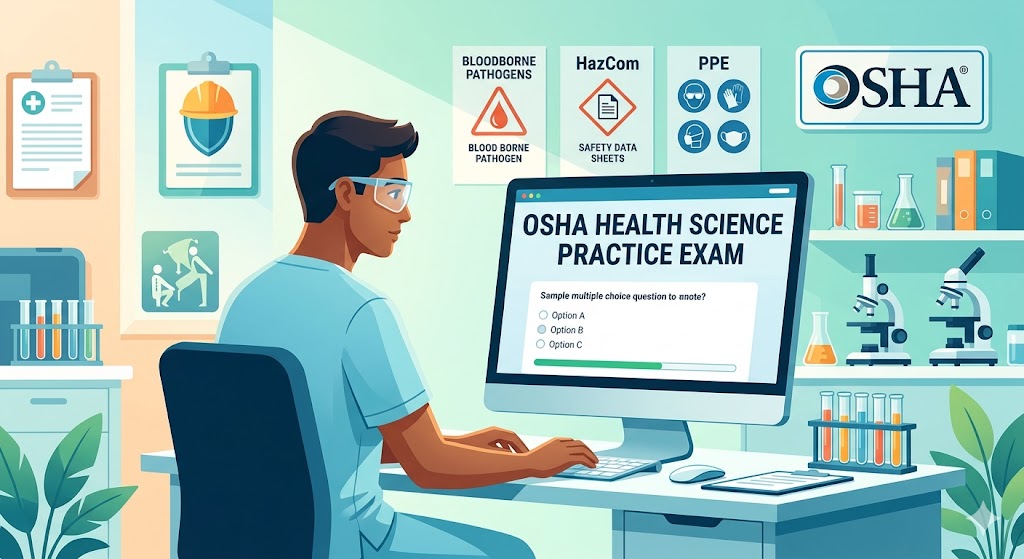
Additional Information
What the Course Entails and Exam Details
This comprehensive guide covers key safety topics crucial for anyone entering the health science field.
Engaging with a course of this nature or this practice test allows you to master the fundamental safety knowledge that can make a real difference in preventing accidents and maintaining a healthy work environment.
Here are the core areas you should expect to see in a robust study program and consequently in the practice material:
Core Topics Covered:
Introduction to OSHA: Understanding worker rights, employer responsibilities, and the role of OSHA.
Bloodborne Pathogens: Prevention, exposure control, and safe practices when handling potentially infectious materials.
Hazard Communication: Identifying and labeling hazardous chemicals, accessing Safety Data Sheets (SDS), and training.
Personal Protective Equipment (PPE): Selection, usage, maintenance, and limitations of proper protective gear.
Healthcare-Specific Hazards: Slips, trips, falls, needle sticks, workplace violence, and ergonomic considerations.
Emergency Planning and Response: Fire safety, evacuation procedures, and basic first aid concepts.
What to Expect in the Final Exam
While exact details can differ based on the specific provider or organization administering your actual final exam or certification assessment, this OSHA Health Science Practice Test is designed to provide a realistic experience.
Expect to encounter predominantly multiple-choice questions, which may include case studies or scenarios relevant to health science environments.
These tests are structured to evaluate both your direct knowledge and your ability to apply safety concepts.
A well-prepared candidate will understand not just the 'what' but the 'why' behind each safety standard.
Regarding test parameters, you can expect the following:
Question Type: Predominantly multiple-choice questions.
Duration: Practice tests typically range from 30 minutes to 1 hour, simulating timed exam conditions.
Passing Score: Though practice tests provide feedback, a common benchmark passing score for related actual exams is often around 70% to 80%.
Mode: Modern practice tests are delivered online via dedicated learning portals or authorized testing platforms.
How to Study and Exam Centers
Preparation is key to success on any test.
This section provides actionable study strategies and information on where you can typically access these practice assessments and relevant training programs.
How to Study Effectively:
Take Multiple Practice Tests: Engage with various online practice exams and sample questions.
Analyze Every Question: Understand why the correct answer is right and why other options are wrong.
Focus on Key Areas: Deeply understand Bloodborne Pathogens, HazCom, PPE, and core safety procedures.
Consult Official OSHA Materials: Use resources available directly on the official OSHA website (osha.gov).
Use Visual Aids: Create flashcards for definitions, hazards, and PPE types. Draw flowcharts for procedures.
Where to Take the Practice Test and Seek Relevant Training:
Practice Tests: There is no single central exam center for practice tests.
Numerous authorized training organizations, online platforms, and educational institutions offer comprehensive online portals.
You can access and take these practice tests conveniently from any computer with internet access.
Related Courses/Certifications: For complete certifications, you can enroll in courses through authorized training organizations.
These organizations may have physical training centers or fully approved online programs.
Job Opportunities from the Course
Earning knowledge and practice with OSHA health science standards demonstrates your commitment to safety and professionalism, making you a desirable candidate across many entry and mid-level roles within healthcare, research, and technical fields.
Below is a clear list of specific job titles and career paths this understanding can enhance:
Specific Job Titles:
Medical Assistant
Dental Assistant
Patient Care Technician
Lab Assistant/Technician
Pharmacy Technician
Phlebotomist
Veterinary Assistant/Technician
Medical Receptionist/Administrator (awareness is helpful)
Hospital/Clinic Aide
Safety Coordinator (entry level, within healthcare/lab setting)
Frequently Asked Questions
Reviews
5.0
Based on 0 reviews
Leave a Review
No reviews yet. Be the first to review!