
OSSF DR Practice Exam
$69.00
- Buy to unlock unlimited access to all Quiz questions and Answers in this Quiz.
- After purchase you can print a PDF of the whole quiz at any point. The PDF will contain the questions and the correct answers.
About this Exam
The On-Site Sewage Facility Designated Representative (DR) certification is a vital credential for professionals ensuring environmental and public health in areas not served by centralized sewer systems. This certification is typically required by state or local regulatory bodies for individuals who enforce OSSF rules, conduct critical site evaluations, review system designs and permit applications, and perform inspections of newly installed or modified septic and other on-site sewage systems. It is designed for environmental health specialists, sanitarians, engineers, inspectors, and individuals looking to advance their career in environmental regulatory compliance, specifically related to safe and effective wastewater management. Successfully navigating the official DR exam confirms an individual’s comprehensive understanding of complex regulations, soil science, system design, and inspection protocols, and using this practice test is a powerful step in that preparation.
Ready to test your knowledge?
Buy Now to Access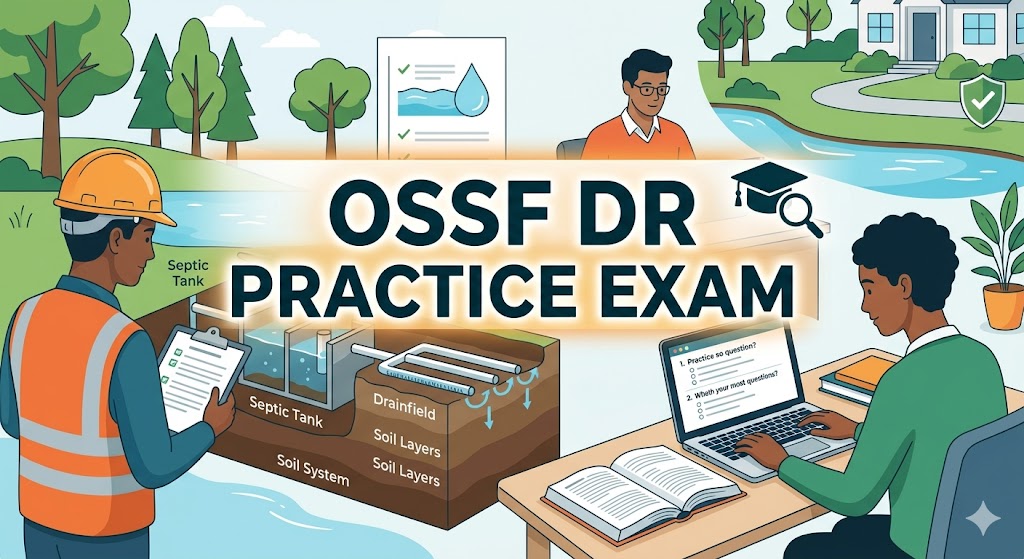
Additional Information
What the Course Entails and Exam Details
Preparing for the OSSF DR exam generally requires completion of an authorized training course and a deep dive into applicable state and local regulations. While the exact curriculum can vary by jurisdiction, the following core areas are typically covered and tested:
Regulatory Framework: A thorough knowledge of relevant statutes, administrative codes, and local ordinances governing On-Site Sewage Facilities.
Site Evaluation: Skills in conducting detailed soil analysis (including classification and texture), determining groundwater levels, assessing topography, considering flood hazards, and evaluating all other environmental factors critical to system functionality and compliance.
OSSF System Types & Design: Understanding the principles and components of various conventional and advanced treatment systems (e.g., standard septic tanks, aerobic treatment units, low-pressure dosing, drip irrigation), including design calculations, sizing, and proper component specification.
Installation & Inspection Protocols: Mastery of the procedures for inspecting new installations, ensuring adherence to design, permit conditions, and proper installation practices.
Maintenance & Operation: Understanding the long-term maintenance requirements for different system types and the roles of property owners and maintenance providers.
Enforcement & Administration: Knowledge of the permitting process, variance procedures, compliance strategies, and regulatory authority of the Designated Representative.
General Exam Details: (Please note that these can vary significantly by state/local body). The official OSSF DR exam is typically a challenging, proctored test.
Format: The exam format is usually closed-book, predominantly multiple-choice questions, and often delivered via computer. Some exams may include true/false or fill-in-the-blank questions and may contain sections that require technical calculations.
Number of Questions: The test typically consists of anywhere from 50 to over 100 comprehensive questions.
Duration: Candidates are generally given between 2 and 4 hours to complete the examination.
What to Expect in the Final Exam
On your test day, expect a rigorous assessment of your theoretical knowledge and practical application of OSSF principles. You should prepare to encounter a mix of straightforward recall questions on regulations and highly technical scenario-based problems requiring analysis, calculation, and regulatory interpretation.
Format Review: Confirm whether the final exam is multiple-choice, include other question types, or if any portion requires showing work for calculations.
Time Management: Allocate your time carefully. Be prepared to address complex questions that may require referencing multiple regulatory concepts or performing multi-step math problems.
Calculations: Bring a non-programmable calculator if permitted. You will need to calculate pipe sizing, tank volumes, absorption area needs, slope percentages, and other technical specifications.
Rules and IDs: Expect strict security protocols. Valid photo identification is usually mandatory. Check specific local rules regarding permitted items (such as scratch paper or water) and prohibited items (mobile phones, unapproved notes, etc.).
Environment: The official exam is administered in a controlled, supervised setting, either at a specific testing facility or via approved remote proctoring. Be prepared for a focused atmosphere.
How to Study and Exam Centers
Effective preparation is key to succeeding on the OSSF DR exam. A combined approach of rigorous study and structured practice is highly recommended:
Authorized Training: Enroll in and actively participate in the relevant state-approved OSSF DR training course. These courses often cover the core curriculum and often provide tailored study materials.
Regulatory Material Review: Make the official regulations and relevant administrative codes your primary study resources. Highlight key requirements, definitions, technical standards, and enforcement protocols. Creating detailed outlines can be immensely helpful.
Practice with this Practice Test! Utilize this "OSSF DR Practice Exam" extensively. These practice tests are invaluable for familiarizing yourself with the type and complexity of questions you will face, testing your recall of regulations, honing your technical calculation skills, and building stamina for a long, focused exam. Review not only your incorrect answers but also the rationale behind the correct ones.
Review Technical Skills: Ensure you are comfortable with relevant mathematical formulas, reading site plans, soil data interpretation, and understanding the operation of different OSSF systems. Create formula sheets for review.
Exam Centers and Formats: Check directly with your state's environmental, health, or licensing agency for details on where and how to take the final exam. Registration and testing locations can include:
State-operated physical testing centers.
Authorized third-party testing organizations (like Pearson VUE or similar, if applicable in your jurisdiction).
State environmental/health department offices.
Potentially, approved secure online proctoring portals. Always verify current procedures and approved locations with the local authority.
Job Opportunities from the Course
Earning your OSSF Designated Representative certification unlocks a range of rewarding career opportunities in environmental health and regulatory compliance. Potential job titles and paths include:
OSSF Inspector
Environmental Health Specialist
Sanitarian
Water Quality Inspector
Health Inspection Supervisor
On-Site Sewage Facility Program Coordinator
Development Services Engineer (OSSF focus)
County/City Environmental Compliance Officer
Private Consultant/Design Reviewer for On-Site Systems
Frequently Asked Questions
Reviews
5.0
Based on 0 reviews
Leave a Review
No reviews yet. Be the first to review!