
Osteopathic Structural Practice Exam
$69.00
- Buy to unlock unlimited access to all Quiz questions and Answers in this Quiz.
- After purchase you can print a PDF of the whole quiz at any point. The PDF will contain the questions and the correct answers.
About this Exam
The Osteopathic Structural Practice Exam is a crucial preparatory tool for osteopathic medical students and professionals seeking to validate their clinical skills in Osteopathic Manipulative Medicine (OMM). This comprehensive evaluation is specifically designed for candidates preparing for licensure examinations, such as the COMLEX-USA Level 2-PE, or board certification in Osteopathic Neuromusculoskeletal Medicine (ONMM). It assesses a candidate's ability to integrate osteopathic philosophy, perform precise palpatory diagnosis, and effectively apply Osteopathic Manipulative Treatment (OMT) techniques in a standardized clinical setting. Mastery of these structural skills is essential for demonstrating competency in delivering holistic, patient-centered care that addresses somatic dysfunction and enhances the body’s innate healing capabilities.
Ready to test your knowledge?
Buy Now to Access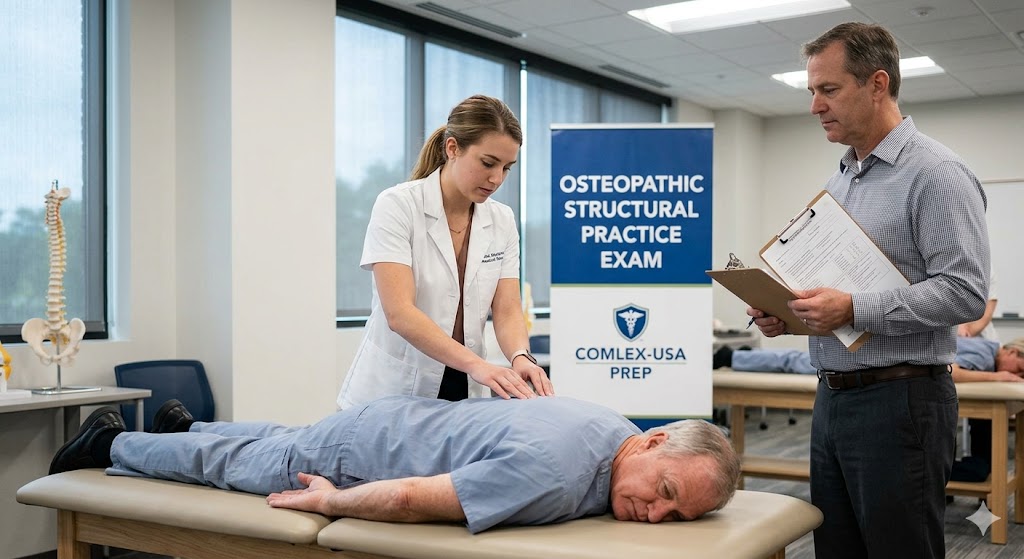
Additional Information
What the Course Entails and Exam Details
The practice exam covers the essential knowledge base and practical skills required for proficiency in the structural domain of osteopathic medicine. The core curriculum focuses heavily on the recognition of somatic dysfunction using the TART criteria: Tissue texture abnormality, Asymmetry, Restriction of motion, and Tenderness. Candidates must demonstrate competence in diagnosing and treating common conditions affecting various body regions, including the spine (cervical, thoracic, lumbar), pelvis, sacrum, rib cage, and extremities. The syllabus entails a deep understanding and application of diverse OMT modalities, including Direct Techniques (such as High Velocity Low Amplitude - HVLA, Muscle Energy, and Soft Tissue), Indirect Techniques (such as Strain-Counterstrain and Myofascial Release), and specialized approaches like Osteopathy in the Cranial Field.
What to Expect in the Final Exam
The actual examination, for which this practice exam prepares candidates, is typically a performance-based assessment. Candidates should expect to encounter standardized patients in simulated clinical scenarios. Within a specified time limit, usually ranging from 10 to 15 minutes per encounter, the candidate must perform a focused history and structural physical examination, arrive at an accurate osteopathic diagnosis, and select and perform appropriate OMT techniques. Evaluation criteria focus heavily on the safety, efficacy, and precision of the techniques performed, as well as the candidate's professional demeanor and patient communication skills. While specific passing scores vary depending on the licensing or certifying board, candidates must generally demonstrate an acceptable level of minimum competency across multiple structural stations.
How to Study and Exam Centers
Effective preparation for the Osteopathic Structural Practice Exam requires a blend of theoretical knowledge and extensive hands-on practice. It is highly recommended to study standard OMM textbooks and review the foundational principles and diagnostic criteria for somatic dysfunction. The most critical strategy, however, is practical repetition; students should actively practice the visual, palpatory, and kinetic skills required for various OMT techniques with partners or in study groups. Utilizing review courses, practice checklists, and instructional videos can further refine technical precision. The examination itself is typically administered at designated, authorized testing centers or specific osteopathic medical schools that possess the necessary facilities, such as the NBOME’s national testing centers or clinical skills laboratories equipped for standardized patient encounters.
Job Opportunities from the Course
Successfully passing licensure and board certification exams that utilize these structural skills is fundamental to launching a career in osteopathic medicine. This expertise opens diverse job opportunities and career paths, including:
Licensed Physician (DO) in Private Practice (Any Specialty)
Specialist in Neuromusculoskeletal Medicine (ONMM)
Integrative Medicine Physician utilizing OMT
Sports Medicine Physician with OMM expertise
Academic Faculty/Professor in Osteopathic Principles and Practice (OPP)
Osteopathic Physician in Hospital or Health System Settings
Team Physician for Professional or Collegiate Sports Teams
Frequently Asked Questions
Reviews
5.0
Based on 0 reviews
Leave a Review
No reviews yet. Be the first to review!