
OT 6220 OT Assessment and Measurement Practice Exam
$69.00
- Buy to unlock unlimited access to all Quiz questions and Answers in this Quiz.
- After purchase you can print a PDF of the whole quiz at any point. The PDF will contain the questions and the correct answers.
About this Exam
Welcome to your essential study guide for the OT 6220 – Assessment and Measurement in Occupational Therapy Practice Test. This exam is a critical component of professional occupational therapy education, designed for current students striving to become a licensed Occupational Therapist (OT) or a Certified Occupational Therapy Assistant (COTA). It measures your ability to synthesize foundational knowledge, select appropriate evaluation tools, and apply clinical reasoning to assess a client's occupational performance. Successfully passing the practice test and the subsequent official exam is a vital step toward a fulfilling career dedicated to helping individuals achieve independence.
Ready to test your knowledge?
Buy Now to Access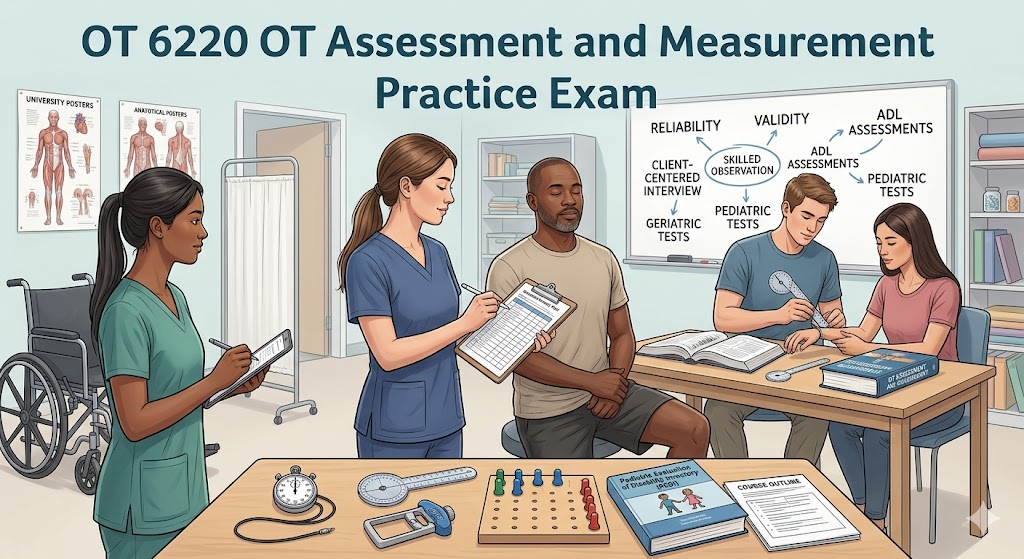
Additional Information
What the Course Entails and Exam Details
The OT 6220 course forms the backbone of the evaluation phase in the occupational therapy process. It provides in-depth instruction on how to systematically gather information about a client's needs and capabilities. Core topics and skills covered include:
Foundations of Assessment: Understanding the principles of measurement, including reliability, validity, and responsiveness of various assessment tools.
The Evaluation Process: Mastering the steps from conducting an initial screening and formulating an occupational profile to analyzing a client's occupational performance.
Client-Centered Approach: Learning techniques for formal and informal interviewing and active listening to understand the client's values, goals, and history.
Skilled Observation: Developing the ability to accurately observe and analyze performance in activities of daily living (ADLs), instrumental activities of daily living (IADLs), and other meaningful occupations.
Selection and Administration of Tools: Acquiring proficiency in choosing the right standardized and non-standardized assessments for diverse populations (e.g., pediatric, geriatric, physical disabilities, mental health). This includes specific tests for motor skills, cognitive function, visual-motor integration, and sensory processing.
Data Interpretation: Learning how to interpret assessment data to identify a client's strengths, limitations, and potential barriers to participation.
What to Expect in the Final Exam
As a final assessment for a university-level course, the format can vary, but it is typically comprehensive and designed to test both knowledge and application. You should be prepared for:
Format: A mix of question types, predominantly multiple-choice questions, which may include case-based scenarios demanding clinical reasoning. The exam may also contain short-answer or essay questions that require you to design an evaluation plan.
Passing Score: Requirements are specific to your academic program, but a common benchmark is a minimum score of 70% to 80%.
Time Limit: Expect a timed exam, often ranging from 1.5 to 3 hours, reflecting the pressure of real-world clinical decision-making.
Specific Rules: All standard academic integrity rules apply. The exam might be administered with specific restrictions on the use of outside materials, depending on whether it is open or closed book.
How to Study and Exam Centers
Effective preparation is the key to success. Here are actionable study strategies and information on where to take your test:
Actionable Study Strategies
Utilize Practice Questions: Create and use practice exam questions. Go through as many as possible, focusing on understanding the rationale for correct and incorrect answers.
Dissect and Deconstruct Questions: For each question, identify the core issue being assessed. Ensure your answer choice is safe, ethical, client-centered, and skilled, reflecting the actions of a licensed practitioner.
Simulate Exam Conditions: Take at least three timed practice exams to build stamina and focus, using a countdown timer in an environment similar to the actual testing location.
Study with Textbooks: Do not rely solely on study guides. Revisit your core textbooks to deepen your conceptual understanding and fill any knowledge gaps.
Teach the Material: Work with a study partner and take turns teaching complex concepts, which is one of the most effective ways to solidify and retain knowledge.
Exam Centers
For a course like OT 6220, the final exam is typically not administered at an external center like Pearson VUE unless it is being delivered as part of a multi-site university consortium. Instead, students will take it:
Authorized School or University: On-site in a designated classroom or a computer lab within your occupational therapy program’s facilities.
Online Portals: Remotely through your university's learning management system (e.g., Canvas, Blackboard), possibly using proctoring software to maintain academic integrity.
Job Opportunities from the Course
A strong performance in OT 6220 and mastering its content is fundamental to your future practice and unlocks key career opportunities. This knowledge is essential for every role in the occupational therapy field, including:
Licensed Occupational Therapist (OTR): Validating your capability to independently lead the evaluation and assessment process.
Certified Occupational Therapy Assistant (COTA): Enhancing your skills in contributing data to the evaluation process under the supervision of an OT.
Specialized OT Roles: Opening paths into specialized areas that heavily rely on precise measurement, such as a Pediatric Occupational Therapist, Geriatric Occupational Therapist, or a hand therapist.
Clinical Settings: Qualifying you to work in a diverse range of environments, including acute care hospitals, rehabilitation centers, outpatient clinics, skilled nursing facilities, home health agencies, and school systems.
Clinical Research and Academic Roles: Providing the foundational knowledge needed for roles involved in clinical data collection, case study analysis, or teaching in an OT/OTA program.
Frequently Asked Questions
Reviews
5.0
Based on 0 reviews
Leave a Review
No reviews yet. Be the first to review!