
OT Child Development & Intervention Strategies Practice Test
$69.00
- Buy to unlock unlimited access to all Quiz questions and Answers in this Quiz.
- After purchase you can print a PDF of the whole quiz at any point. The PDF will contain the questions and the correct answers.
About this Exam
The Occupational Therapy – Child Development, Documentation, and Intervention Strategies Practice Test is a specialized preparatory tool designed for aspiring and early-career Occupational Therapists (OTs) and Occupational Therapy Assistants (OTAs).
This simulation exam is specifically tailored for students preparing for the pediatric components of their national board exams, such as the NBCOT®, or for practitioners looking to validate their knowledge in the essential domains of child development, clinical documentation, and evidence-based pediatric intervention.
It offers a robust method to assess readiness and identify specific areas needing further study before taking the final licensing or certification exam.
Ready to test your knowledge?
Buy Now to Access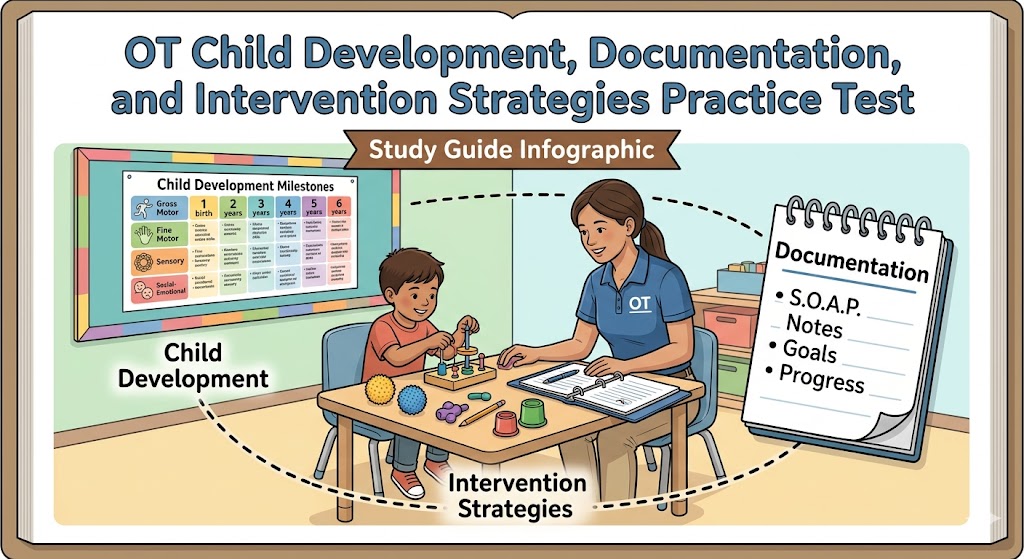
Additional Information
What the Course Entails and Exam Details
This practice test does not teach a course but rather measures your mastery across a curriculum focused on the lifecycle of pediatric care.
The core syllabus topics you can expect to be covered include:
Foundations of Child Development: Knowledge of major motor, cognitive, social-emotional, and sensory developmental milestones from birth through adolescence.
Legal and Ethical Standards in Pediatrics: Understanding regulations like the Individuals with Disabilities Education Act (IDEA), and ethical considerations specific to minors.
OT Documentation Standards: Proficiency in creating skilled, measurable documentation, including S.O.A.P. notes (Subjective, Objective, Assessment, Plan), evaluation summaries, and progress reports.
Pediatric Assessment: Understanding how to select, administer, and interpret both standardized and non-standardized evaluation tools.
Intervention Strategies: Knowledge of evidence-based methods for addressing deficits in areas such as sensory processing, fine and gross motor skills, visual perception, social participation, and activities of daily living (ADLs).
Clinical Reasoning and Scenario Analysis: The ability to apply knowledge to solve realistic client case scenarios.
What to Expect in the Final Exam
As a practice test, this does not result in a license or a final, official passing score in the same sense as the NBCOT®. Instead, its goal is to simulate the conditions of your actual licensing exam.
You should expect the following format:
Question Type: Predominantly multiple-choice questions, which may include some multi-select options.
Number of Questions: Standard practice tests typically range from 100 to 200 questions.
Scoring: Rather than a simple pass/fail, you will receive a detailed performance analysis, breaking down your score by domain (e.g., scoring 85% in Child Development and 60% in Intervention Strategies), allowing you to focus your study time efficiently.
Format: The exam is typically administered online, mirroring the computer-based testing
How to Study and Exam Centers
How to Study:
To maximize your performance on this practice test and the subsequent official exam, utilize these actionable strategies:
Active Recall with Flashcards: Create flashcards for developmental milestones, OT terminology, and common intervention techniques.
Simulate Test Day: Take the practice exam in a quiet room, with no outside materials, and time yourself to match the pacing of the real board exam.
Analyze Every Incorrect Answer: The real value is not just in taking the test, but in reviewing every question you got wrong or guessed on. Understand the clinical rationale for the correct answer.
Utilize Study Guides: Pair your practice test results with a comprehensive review of reputable OT textbooks focused on pediatrics, documentation, and intervention.
Exam Centers:
You can take the "Occupational Therapy – Child Development, Documentation, and Intervention Strategies Practice Test" entirely online. It is available through various sources, including:
Accredited Occupational Therapy schools' internal portals.
Reputable professional test preparation companies specializing in health sciences (e.g., TherapyEd, AOTA®'s NBCOT® Exam Prep).
Specific authorized online test portals.
(Note: This is a practice tool; official licensure exams are taken at dedicated testing centers such as Pearson VUE, which are separate from where you take practice tests.)
Job Opportunities from the Course
Passing the practice test is a crucial step that helps ensure you pass your final licensing exam. Once licensed, you are qualified for a wide array of specialized pediatric roles across multiple settings.
Job opportunities include, but are not limited to:
Pediatric Occupational Therapist
Certified Occupational Therapy Assistant (COTA) in Pediatrics
School-Based Occupational Therapist
Early Intervention Specialist
Children’s Hospital OT Practitioner
Outpatient Pediatric Clinic OT
Developmental Disabilities Specialist
Travel Pediatric OT
Frequently Asked Questions
Reviews
5.0
Based on 0 reviews
Leave a Review
No reviews yet. Be the first to review!