
OTCNINST 1530.6M RLP Practice Test
$69.00
- Buy to unlock unlimited access to all Quiz questions and Answers in this Quiz.
- After purchase you can print a PDF of the whole quiz at any point. The PDF will contain the questions and the correct answers.
About this Exam
The OTCNINST 1530.6M – Room, Locker, and Personnel Inspection (RLP) Appendix B Practice Test is a crucial, internal study tool designed for candidates at the Officer Training Command Newport (OTCN). This practice exam is specifically created to help future Navy Officers, including Officer Candidates (OC) and others in commissioning programs, master the required knowledge component of the high-stakes RLP event. The RLP is not a formal "certification" in the traditional sense, but it is an absolute, mandatory hurdle that all candidates must pass early in their training to continue their path toward a commission. This practice test focuses on the rote memorization and instant recall of naval traditions, regulations, and general orders required during the stressful physical inspection, emphasizing the intense attention to detail demanded of a United States Naval Officer.
Ready to test your knowledge?
Buy Now to Access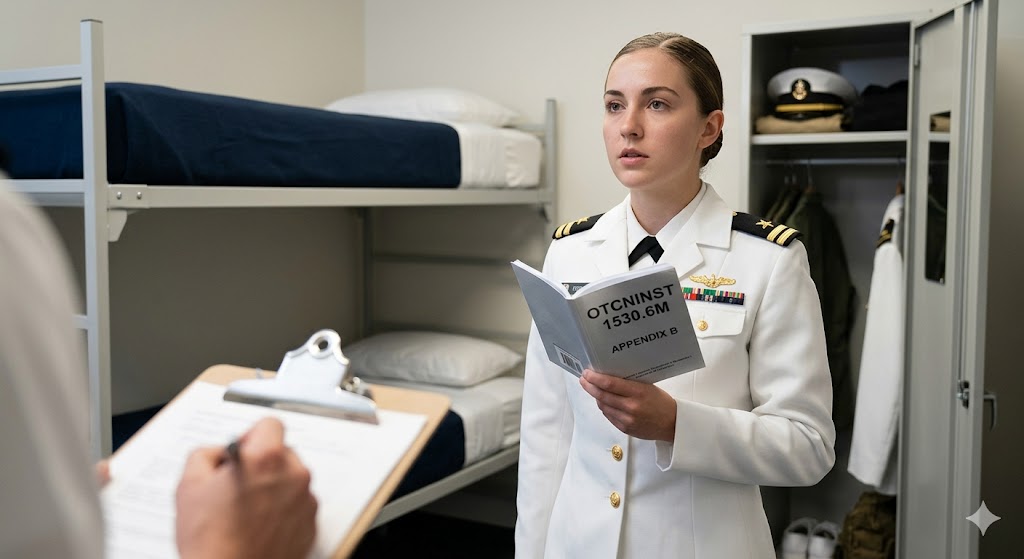
Additional Information
What the Course Entails and Exam Details
The OTCN RLP is a comprehensive test of a candidate’s discipline, time management, and ability to execute complex instructions under pressure. While the physical inspection covers the impeccable arrangement of the room and locker and the flawless condition of the uniform, the "Appendix B" portion of the practice test specifically isolates the verbal knowledge requirements. This includes, but is not limited to, the flawless recitation of the Mission of the Navy, all eleven General Orders of a Sentry, the Articles of the Code of Conduct, and fundamental Watchstanding Principles. Additionally, candidates are tested on identifying Naval officer and enlisted rank structures, uniform regulations, and basic naval chain of command. The RLP Appendix B Practice Test simulates the verbal questioning candidates will face while standing at attention in their sea-bag inspection uniform, ensuring they can recall critical information instantly without hesitation.
What to Expect in the Final Exam
It is important to understand that the final exam is not a written test; it is the formal Room, Locker, and Personnel Inspection itself, conducted on-site at OTCN in Newport, Rhode Island. During this multi-hour event, Class Chief Petty Officers, Class Officers, and other staff members will inspect every inch of a candidate's living space and uniform for minor discrepancies, known as "hits." Concurrently, they will conduct an intense, verbal examination based on the required knowledge in Appendix B. Candidates are expected to stand at flawless attention and project their answers with confidence and military bearing. A candidate must achieve a minimum overall score of 80% on the RLP to pass. Failure results in a immediate re-inspection within 24-48 hours. Failing the re-inspection usually results in being "rolled," meaning the candidate is moved to the next junior class and must repeat weeks of training.
How to Study and Exam Centers
The key to success on the RLP Appendix B knowledge portion is deliberate and consistent practice. Effective study strategies include creating flashcards for all general orders and articles, using active recall techniques, and forming study groups to conduct mock verbal examinations. Candidates should practice reciting their knowledge while standing at attention, ideally in a mock-up of an inspection room, to simulate the high-pressure environment. As this is an internal Navy training requirement, there are no public exam centers or commercial portals like Pearson VUE. The actual test occurs within the training facilities of Officer Training Command Newport. Access to the practice materials and the formal instruction is provided to candidates upon their arrival at OCS or their respective training track. Candidates are strongly encouraged to utilize all internal resources, study with their classmates, and seek feedback from their student chain of command.
Job Opportunities from the Course
Passing the OTCN RLP is a non-negotiable step in the rigorous path to becoming a commissioned Officer in the United States Navy. Successfully navigating this event, and ultimately graduating from Officer Candidate School, opens the door to countless leadership roles within the fleet. Here is a list of the primary career paths and job opportunities unlocked by completing this training and earning a commission:
Surface Warfare Officer (SWO): Leading divisions on Navy destroyers, cruisers, and amphibious ships.
Naval Aviator: Piloting fighter jets, maritime patrol aircraft, or helicopters.
Naval Flight Officer (NFO): Managing airborne weapon systems, sensors, and communications.
Submarine Officer: Operating and leading crews on the Navy's advanced nuclear-powered submarines.
Special Warfare Officer (SEAL): Leading elite, special operations teams in high-stakes missions.
Special Operations Officer (EOD): Specializing in explosive ordnance disposal and underwater operations.
Information Warfare Officer: Leading in fields like intelligence, cyber warfare, crypto-linguistics, and meteorology.
Supply Corps Officer: Managing the Navy's global logistics and supply chain operations.
Civil Engineer Corps (CEC) Officer: Leading construction projects and maintaining Navy shore infrastructure.
Medical, Dental, or Nurse Corps Officer: Providing critical healthcare services to sailors and marines.
Judge Advocate General's (JAG) Corps Officer: Providing legal services and counsel within the military justice system.
Chaplain Corps Officer: Providing spiritual guidance and support to service members and their families.
Frequently Asked Questions
Reviews
5.0
Based on 0 reviews
Leave a Review
No reviews yet. Be the first to review!