
Outdoor Emergency Care Technician Practice Exam
$69.00
- Buy to unlock unlimited access to all Quiz questions and Answers in this Quiz.
- After purchase you can print a PDF of the whole quiz at any point. The PDF will contain the questions and the correct answers.
About this Exam
The Outdoor Emergency Care (OEC) Technician certification, established and overseen by the National Ski Patrol (NSP), is the premier standard for medical training in the non-urban, outdoor environment. It is meticulously designed for individuals who are passionate about the outdoors and dedicated to providing immediate, high-quality pre-hospital care in challenging, often remote conditions. This comprehensive program is the essential qualification for aspiring and current ski patrollers, wilderness guides, search and rescue personnel, and outdoor recreation professionals. The OEC curriculum equips rescuers with the knowledge and practical skills necessary to manage a broad spectrum of medical and trauma situations that occur away from traditional emergency services, from alpine slopes to backcountry trails.
Ready to test your knowledge?
Buy Now to Access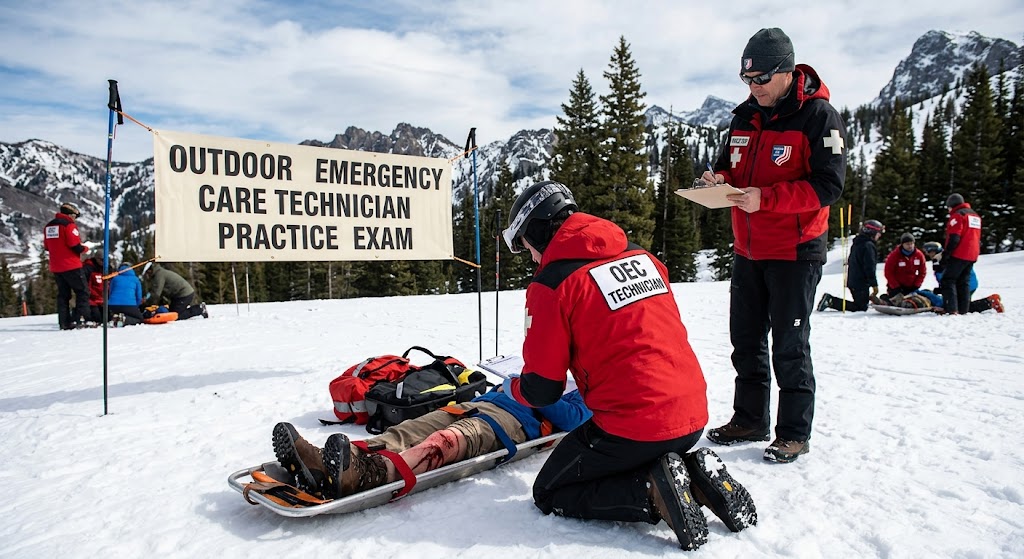
Additional Information
What the Course Entails and Exam Details
The OEC course provides a rigorous, competency-based education that prepares students for the non-urban environment. The comprehensive syllabus, based on the Outdoor Emergency Care textbook, covers essential topics including:
Patient assessment in a multi-force scenario.
Management of medical emergencies and atmospheric conditions.
Basic life support, including airway management and CPR.
Trauma care, including musculoskeletal, soft tissue, and head/spinal injuries.
Special operations and the Incident Command System.
Triage and mass-casualty incidents.
Rescue equipment and transportation techniques tailored for snowsports and rugged terrain.
The program consists of a didactic learning phase, often including a structured workbook, followed by intensive hands-on skills practice and scenario-based training to ensure practical proficiency.
What to Expect in the Final Exam
The final evaluation for the OEC Technician certification is a multi-part assessment designed to test both theoretical knowledge and practical application. Candidates must successfully navigate two distinct components:
Written Examination: A comprehensive multiple-choice exam that evaluates your understanding of the OEC curriculum. Questions will cover all domains of knowledge, from legal and ethical considerations to specific treatment protocols for outdoor injuries. You should be prepared for scenario-based questions that require you to synthesize information and select the best course of action. While the passing score can vary, it typically requires a strong demonstration of foundational knowledge across all critical areas.
Practical Scenario Evaluation: This is the heart of the OEC certification. Candidates must demonstrate proficiency through a series of hands-on scenarios designed to simulate real-world emergencies. You will work through realistic patient encounters in an outdoor setting, demonstrating assessment skills, appropriate interventions, and effective transportation techniques. This section is often graded on a pass/fail basis for key critical skills, with a focus on safety, communication, and decisive action.
How to Study and Exam Centers
Effective preparation for the OEC exam requires a balanced approach to both its written and practical components. Follow these actionable strategies to maximize your success:
Master the Textbook: The Outdoor Emergency Care textbook is your primary source of truth. dedicate time to thoroughly understanding each chapter.
Utilize a Practice Exam: Engaging with a comprehensive [Outdoor Emergency Care Technician Practice Exam] is one of the most effective ways to prepare. This allows you to identify knowledge gaps, practice time management, and become familiar with the structure and tone of the written questions. Use results to target your review, focusing extra effort on any domains where your accuracy falls below 70%.
Form Study Groups: Collaborating with fellow candidates is invaluable, especially for the practical component. Practice scenarios together, acting as both the rescuer and the patient to gain different perspectives and receive constructive feedback.
Attend All Hands-On Sessions: Do not miss a single chance to practice your physical skills. Hands-on scenarios build muscle memory and confidence.
Contact Your Patrol or Course Instructor: The National Ski Patrol administers OEC courses and evaluations through local patrols and authorized instructors. Your course instructor is your direct link to information on your specific written exam and practical scenario evaluation dates and locations.
The OEC exam is not typically taken at commercial testing centers like Pearson VUE. Instead, it is hosted by individual ski patrols or authorized outdoor organizations. You will receive specific information about your testing location, format, and scheduling from your OEC course coordinator.
Job Opportunities from the Course
A current Outdoor Emergency Care Technician certification is a powerful asset, unlocking numerous rewarding career and volunteer paths in the outdoor industry. This qualification is recognized and required by resorts, recreational facilities, and guiding services across all 50 states. Some of the specific roles and career paths available include:
Alpine Ski Patroller (Paid and Volunteer)
Nordic Ski Patroller
Snowboard Patroller
Mountain Bike Patroller
Wilderness Medical Technician
River Rafting Guide
Mountaineering and Climbing Guide
Search and Rescue Team Member (Professional and Volunteer)
Park and Recreation Employee
Industrial Health and Safety Officer for remote work sites
Frequently Asked Questions
Reviews
5.0
Based on 0 reviews
Leave a Review
No reviews yet. Be the first to review!