
Oxford, Cambridge and RSA (OCR) GCSE Computer Science Paper 2 Practice
$69.00
- Buy to unlock unlimited access to all Quiz questions and Answers in this Quiz.
- After purchase you can print a PDF of the whole quiz at any point. The PDF will contain the questions and the correct answers.
About this Exam
This comprehensive [OCR GCSE Computer Science Paper 2 Practice Exam] is expertly designed for students preparing for the final phase of their GCSE assessment.
It specifically targets individuals taking the Oxford, Cambridge and RSA (OCR) GCSE in Computer Science (J277/02).
This practice resource helps candidates consolidate their knowledge and practical skills across the entire Paper 2 specification, ensuring they are exam-ready.
Ready to test your knowledge?
Buy Now to Access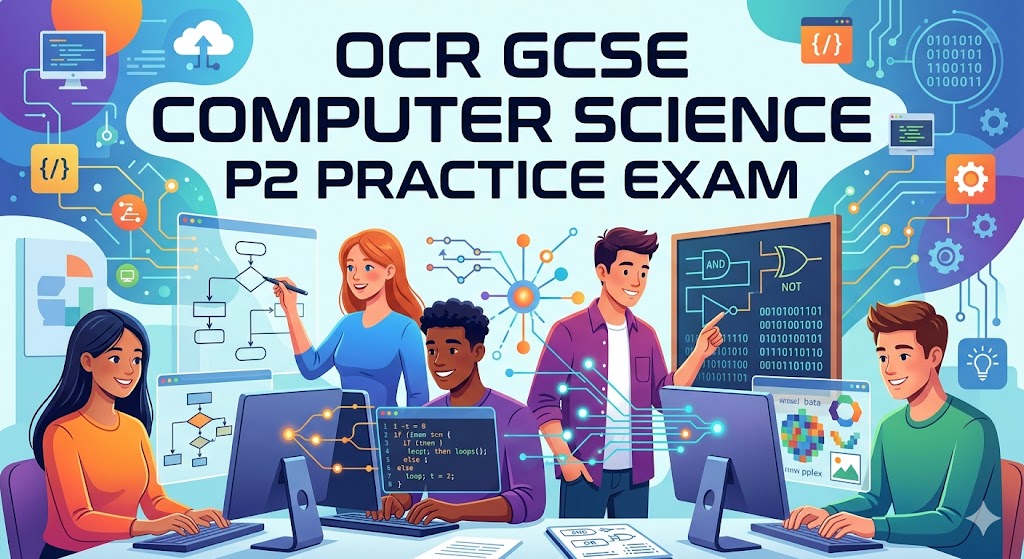
Additional Information
What the Course Entails and Exam Details
The J277/02 Paper 2 focuses on essential computational thinking and problem-solving methodologies.
Candidates will delve deeply into algorithms, covering their design, efficiency, and representation using tools like flowcharts and pseudocode.
Programming techniques form a core part of the curriculum, demanding proficiency in writing, tracing, and completing code to solve problems.
You will learn to create robust programs by managing input validation, handling errors, and designing effective testing strategies.
Data representation is critical, requiring a thorough understanding of binary, hexadecimal, character encoding, and image or sound storage.
Furthermore, students explore computational logic, boolean operators, and the physical architecture of computer systems, including key internal components.
This course balances theoretical knowledge with practical application, empowering students to apply their understanding to solve realistic problems.
What to Expect in the Final Exam
The actual OCR GCSE Computer Science J277/02 Paper 2 is a single written exam lasting 1 hour and 30 minutes.
It is worth a total of 80 marks and accounts for 50% of the overall GCSE qualification.
You must be prepared for a combination of question types, including short-answer, extended-response, calculation-based, and practical programming tasks.
Questions often require students to interpret algorithms from descriptions, flowcharts, or code snippets, then create or modify them.
Strong analytical skills are crucial for troubleshooting code and tracing algorithm execution steps accurately.
The exam assesses your ability to apply logical thinking and problem-solving techniques to complex computer science problems.
Candidates should feel confident handling data manipulation questions, converting numbers between bases, and explaining computing principles clearly.
How to Study and Exam Centers
Effective preparation for OCR GCSE Computer Science Paper 2 relies on consistent practice and a practical approach.
Begin by rigorously working through official past papers and mark schemes to familiarize yourself with the question styles and expectations.
Practice writing out algorithms in pseudocode and flowcharts, then test them by tracing variables through each step to spot errors.
Use reputable revision guides, interactive websites, and the official OCR specification to ensure full coverage of the curriculum.
Collaborate with peers to solve problems, explain concepts to each other, and review different approaches to the same coding challenge.
Focus on identifying and understanding any personal areas of weakness, addressing them through focused study and targeted practice.
For external candidates not registered at a school, you will need to find a suitable private exam center authorized to administer the OCR GCSE in Computer Science.
Contact local schools or established test providers to inquire about opportunities for private entry and associated deadlines well in advance.
Job Opportunities from the Course
A strong performance in GCSE Computer Science, particularly Paper 2, opens numerous exciting career pathways in the digital world.
Here are some of the diverse job opportunities this qualification can help you work towards:
Junior Software Developer
Web Developer
Data Analyst
IT Support Technician
Systems Analyst
Cyber Security Apprentice
Game Designer (Initial stages)
Network Engineer (Entry-level)
Cloud Engineer
Machine Learning Assistant
Frequently Asked Questions
Reviews
5.0
Based on 0 reviews
Leave a Review
No reviews yet. Be the first to review!