
PADI Open Water Diver Practice Exam
$69.00
- Buy to unlock unlimited access to all Quiz questions and Answers in this Quiz.
- After purchase you can print a PDF of the whole quiz at any point. The PDF will contain the questions and the correct answers.
About this Exam
The PADI Open Water Diver certification is the world's most popular and recognized scuba course. Millions of people have learned to scuba dive and explore the wonders of the aquatic world through this comprehensive program. This certification is designed for anyone who has ever dreamed of exploring the vibrant life of coral reefs, ancient shipwrecks, and the serene, weightless environment under the waves. It is your first major milestone on the path to becoming a qualified scuba diver.
This comprehensive guide, including our PADI Open Water Diver Practice Exam, is meticulously crafted to help aspiring divers like you prepare thoroughly. The practice exam serves as a simulation of the actual final knowledge review, focusing on critical safety information and key concepts that are essential for every responsible and confident diver.
Ready to test your knowledge?
Buy Now to Access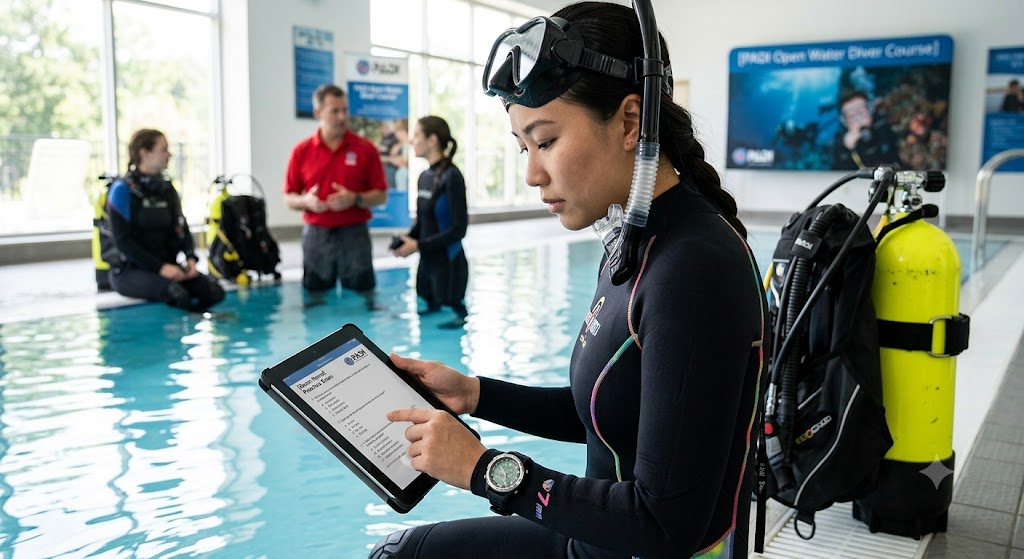
Additional Information
What the Course Entails and Exam Details
The PADI Open Water Diver course consists of three main phases: knowledge development, confined water dives, and open water dives. Your knowledge development is structured into five modules, each focusing on different aspects of scuba diving theory, including physics, physiology, equipment, safety, and the environment. These modules cover everything from how water affects light and sound to managing underwater problems.
Our PADI Open Water Diver Practice Exam is specifically designed to assess your understanding of these core knowledge areas. The practice test, like the real final exam, will challenge you on multiple choice questions drawn from the following topics:
Equipment selection, use, and maintenance
Understanding and using dive tables and computers
Underwater navigation basics
The aquatic environment and interacting responsibly
Standard diving procedures and safety protocols
Problem management and emergency procedures
The physical and physiological effects of diving
The practice exam typically mirrors the 50 multiple-choice questions you will encounter on the real PADI final. While not a replacement for the official course materials, it provides an invaluable check on your comprehension, allowing you to identify areas that need more study before you take the final assessment.
What to Expect in the Final Exam
The final PADI Open Water Diver knowledge review is an integral part of becoming a certified diver, typically taken after you complete all five modules of Knowledge Development. Here is what you can expect:
Format: The exam consists of multiple-choice questions, which are straightforward but require a clear understanding of the material.
Passing Score Requirements: To pass and complete your knowledge development, you must achieve a score of 75% or higher.
Time Limits: While PADI does not strictly enforce a universal time limit, most instructors and dive centers will complete the exam within a predefined session, typically lasting about 60-90 minutes. It is generally not a timed test, giving you the time to read and think through each question.
Rules: The exam is closed-book, meaning you cannot consult your manual, notes, or digital resources while taking the test. However, you will have access to any standard PADI dive tables or a calculator for question parts requiring calculation or table lookup, which your instructor will clarify.
Successful completion of the knowledge review is necessary before your instructor signs off on your qualification for open water dives. Our PADI Open Water Diver Practice Exam is the perfect rehearsal to prepare you for this significant step in your diving journey.
How to Study and Exam Centers
Preparation is key to succeeding on the PADI Open Water Diver exam, and here is how to maximize your study efforts:
PADI Open Water Diver Manual or eLearning: This is your primary resource. Go through each section thoroughly. Use the knowledge reviews at the end of every section to reinforce your learning, as these are the best indicators of the key information that will be on the final exam.
Dive Tables and Computers: Spend considerable time practicing with the Recreational Dive Planner (RDP) table. Learn how to calculate no-decompression limits, pressure groups, and required surface intervals for multi-level dives. This is a critical safety skill often featured prominently on the exam.
Instructor Guidance: Don't hesitate to ask your PADI Instructor for clarification on any concept you find confusing. They are there to help you succeed and can provide invaluable insights from their experience.
Practice, Practice, Practice: Utilize the practice exam questions multiple times. This helps with familiarity and understanding of question phrasing. However, remember to focus on understanding the concepts rather than just memorizing answers.
When it comes to taking the final exam, it must be administered by a PADI Instructor at an authorized PADI Dive Center or Resort. You cannot take the final exam online or in a remote center like Pearson VUE. These specialized PADI facilities are the only approved venues where your instructor can confirm your learning and safely evaluate your practical skills. You can find these authorized physical testing centers and schools globally using the PADI Dive Shop Locator tool on the PADI website.
Job Opportunities from the Course
Earning your PADI Open Water Diver certification is more than just a passport to underwater adventure; it's also a fundamental requirement for numerous exciting and fulfilling career paths. This foundational qualification opens doors to a variety of specialized roles:
Divemaster: After accumulating more experience, this certification is the starting point to eventually become a Divemaster, enabling you to lead and supervise other certified divers.
Instructor Assistant: Assist PADI Instructors during courses, gaining experience while sharing your love for diving.
Scientific Diver: Participate in marine biological research, underwater archaeology, and ecological surveys.
Public Safety Diver: Apply diving skills to support law enforcement and fire rescue operations.
Commercial Diver: Engage in professional diving for industries such as construction, oil and gas, and inspections.
Underwater Photographer/Videographer: Turn your passion for underwater imagery into a professional career.
Marine Conservationist: Utilize diving to support environmental protection, restoration projects, and education.
Frequently Asked Questions
Reviews
5.0
Based on 0 reviews
Leave a Review
No reviews yet. Be the first to review!