
PAEA OB-GYN End of Rotation (EOR) Practice Exam
$69.00
- Buy to unlock unlimited access to all Quiz questions and Answers in this Quiz.
- After purchase you can print a PDF of the whole quiz at any point. The PDF will contain the questions and the correct answers.
About this Exam
The PAEA OB-GYN End of Rotation (EOR) exam is a comprehensive, standardized evaluation designed for Physician Assistant (PA) students.
You will typically take this exam upon completing your core Supervised Clinical Practice Experience (SCPE) in Obstetrics and Gynecology.
Its primary purpose is to assess the medical knowledge you acquired during your rotation, ensuring you have met the required learning objectives.
This exam is crucial as it measures your readiness for both clinical practice and the PANCE, acting as a critical benchmark in your journey to becoming a certified PA.
Passing this exam demonstrates your competence in managing common conditions affecting women’s reproductive health and maternal care.
Ready to test your knowledge?
Buy Now to Access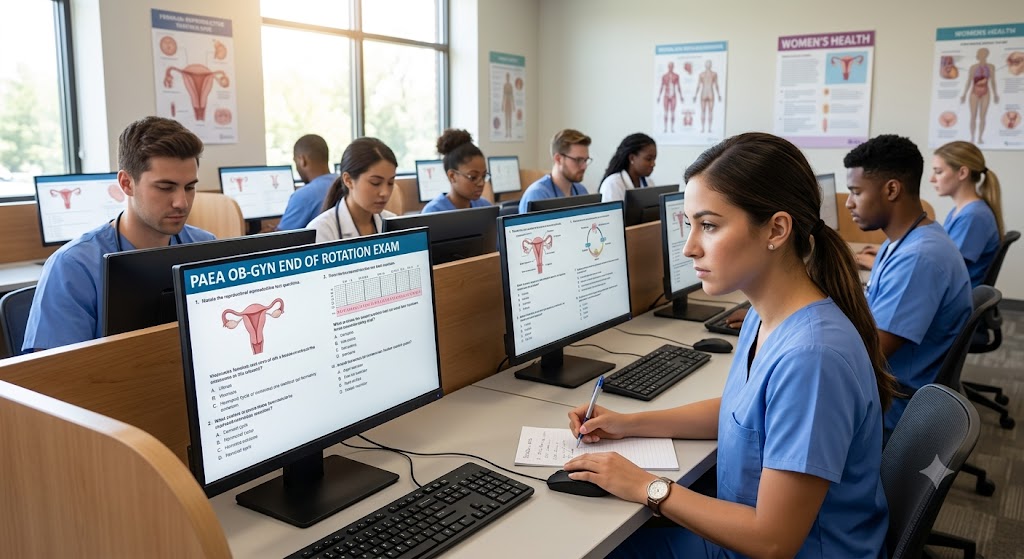
Additional Information
What the Course Entails and Exam Details
This examination is rigorously built upon the current PAEA Assessment Women’s Health End of Rotation Exam Blueprint and Topic List.
It does not just test your ability to recall facts; it evaluates your capacity to apply scientific concepts to real-world patient scenarios.
The core content is divided into two major domains: Obstetrics and Gynecology, covering the lifespan from adolescence through menopause and beyond.
On the Obstetrics side, you must master prenatal care, normal pregnancy, medical complications of pregnancy (such as preeclampsia or gestational diabetes), labor and delivery complications, and postpartum care.
The Gynecology component entails understanding menstruation disorders, breast conditions, infectious diseases, neoplasms, menopause, and contraceptive management.
Furthermore, your knowledge is categorized by clinical tasks.
These include taking a history and performing a physical exam, ordering and interpreting diagnostic studies, formulating primary and differential diagnoses, implementing health maintenance and screening strategies, clinical intervention, and managing therapeutics.
What to Expect in the Final Exam
The final PAEA OB-GYN EOR exam is a standardized, computerized multiple-choice test consisting of 120 questions.
It is important to note that only 100 of these questions are scored; the remaining 20 are pre-test questions used for future exam development and statistical validation.
The exam questions are almost exclusively vignette-based, presenting a clinical scenario and requiring you to make the next best medical decision, mimicking PANCE-style questions.
The entire examination is administered in two 60-question sections, and you will have a total of two hours to complete it, allowing exactly one minute per question.
A mandatory 10-minute break is scheduled between the two sections to give you a moment to recharge.
Passing score requirements are determined by your specific PA program based on national comparative data provided by PAEA.
You will not receive a raw percentage; instead, you are given a scaled score ranging from 300 to 500, which reflects your performance relative to the national average.
How to Study and Exam Centers
Effective studying requires a structured, multi-faceted approach.
Your primary resource should always be the official PAEA OB-GYN EOR Blueprint and Topic List.
You should categorize every topic on that list by your confidence level and focus your study time on your weakest areas first.
Since this exam is highly clinical, correlate your studying with the patients you are seeing on your rotation.
Active learning strategies are essential. Create flashcards for rare or complicated diseases, and draw out pathways for diagnostic algorithms.
Utilize high-yield review texts like "PANCE Prep Pearls" or "A Comprehensive Review for the PA Certification" for quick referencing.
However, the most critical part of your preparation is doing practice questions.
Use reputable question banks (such as Rosh Review, UWorld, or the official PAEA practice exams) that provide detailed explanations for both correct and incorrect answers.
Practice doing questions under a time constraint to improve your pacing.
Regarding Exam Centers, you do not register through an external vendor like Pearson VUE.
The EOR exams are administered directly by your Physician Assistant program using the safe and secure PAEA Assessment Center online platform.
Your program will schedule the exact date, time, and location of your exam.
They are typically proctored in person within your school’s computerized testing lab, though some programs may utilize secure remote proctoring browser technology.
Job Opportunities from the Course
Mastering the content for this exam doesn't just pass a test; it unlocks a diverse array of professional career paths specializing in women’s health.
After graduating and passing your PANCE, you can practice as a:
Obstetrics and Gynecology PA (Generalist) in outpatient clinics, private practices, or hospital systems.
Labor and Delivery PA, assisting in management of low-risk deliveries and triage.
Surgical OB-GYN PA, specializing as a first assist in the operating room for procedures like C-sections, hysterectomies, and laparoscopy.
Reproductive Endocrinology and Infertility PA, helping families navigate fertility treatments.
Maternal-Fetal Medicine (MFM) PA, caring for high-risk pregnancies and complex obstetrical cases.
Gynecologic Oncology PA, managing the care of patients with gynecological cancers.
Women’s Health Primary Care PA, focusing on preventive care, wellness exams, and contraception in an ambulatory setting.
Frequently Asked Questions
Reviews
5.0
Based on 0 reviews
Leave a Review
No reviews yet. Be the first to review!