
Paint Technology Practice Test
$69.00
- Buy to unlock unlimited access to all Quiz questions and Answers in this Quiz.
- After purchase you can print a PDF of the whole quiz at any point. The PDF will contain the questions and the correct answers.
About this Exam
The Paint Technology Certification validates the critical knowledge and skills required for professionals involved in industrial coatings, architectural finishes, product manufacturing, and inspection. This recognized program is specifically designed for coating applicators, field inspectors, manufacturing supervisors, quality control technicians, and engineers who specify or evaluate paint and coating systems. Successfully earning this certification demonstrates mastery of surface preparation, application techniques, material characteristics, safety standards, and defect analysis, establishing credibility within the paint and coatings industry.
Ready to test your knowledge?
Buy Now to Access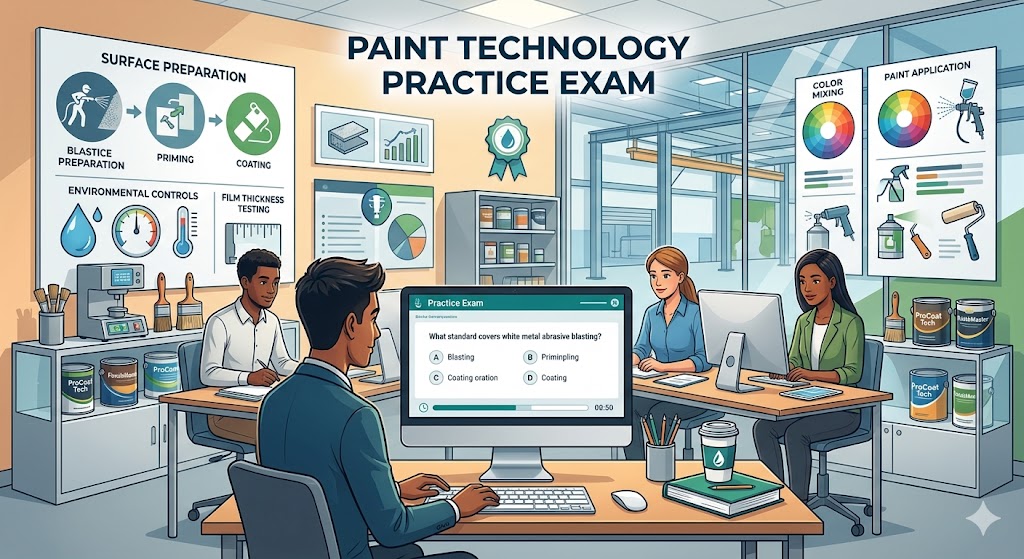
Additional Information
What the Course Entails and Exam Details
This comprehensive course covers foundational and advanced topics essential for modern coating practices. The curriculum typically includes detailed instruction on surface preparation techniques, such as abrasive blasting, chemical cleaning, and standardized methods like those from AMPP (formerly NACE/SSPC) or ISO. Students will master the selection and application of various coating types, including epoxies, urethanes, acrylics, and alkyds, understanding how factors like curing, film thickness, and environmental conditions (temperature, humidity, dew point) affect performance. Other critical areas encompass environmental regulations, safety protocols, hazardous material handling, and the use of inspection instruments like thickness gauges and adhesion testers. The practical knowledge gained prepares candidates for accurate decision-making in real-world scenarios.
What to Expect in the Final Exam
The final certification exam for Paint Technology is designed to test both theoretical understanding and practical problem-solving capabilities. It generally consists of multiple-choice questions, which may include case-study problems requiring analysis. The typical exam structure might involve 80 to 120 questions that must be completed within a specified time limit, such as 2 to 4 hours. Candidates may also encounter graphical questions or scenarios that ask for the assessment of surface defects or application failures. A passing score usually ranges between 70% and 80%, depending on the specific certifying body or program. Proctored exam environments are standard, often with closed-book policies ensuring the validity of the results.
How to Study and Exam Centers
Effective preparation for the Paint Technology Practice Exam involves a combination of theoretical study and practical exposure. Begin by thoroughly reviewing the provided course materials, industry standards, and relevant publications from organizations like AMPP or the Paint and Coatings Industry magazine. Practice tests are an essential tool; they help you familiarize yourself with the question formats, identify your weak areas, and build speed and accuracy. Consider joining study groups or workshops for collaborative learning and expert guidance. Regarding test centers, exams are typically offered in multiple formats: through authorized online proctoring services, global testing center networks (such as Pearson VUE, Prometric), and sometimes at authorized industrial training schools or corporate facilities following a hands-on training component. Verify the specific requirements and locations when registering for your final exam.
Job Opportunities from the Course
A certification in Paint Technology opens doors to diverse career paths across multiple sectors, confirming a professional’s expertise in coating selection, application, and inspection. The following job opportunities and career advancements are common for individuals holding this credential:
Coating Inspector (e.g., Level 1, 2, or higher)
Paint and Coatings Application Specialist
Quality Control Technician (Paint/Coatings)
Industrial Painter/Coating Applicator
Production Supervisor (Paint Manufacturing)
Coatings Engineer
Technical Service Representative (for paint manufacturers)
Maintenance Planner (with industrial coatings focus)
Paint Booth Operator and Technician
Architectural Coatings Consultant
Specification Writer (for coatings and finishes)
Frequently Asked Questions
Reviews
5.0
Based on 0 reviews
Leave a Review
No reviews yet. Be the first to review!