
Paramedic National Registry Practice
$69.00
- Buy to unlock unlimited access to all Quiz questions and Answers in this Quiz.
- After purchase you can print a PDF of the whole quiz at any point. The PDF will contain the questions and the correct answers.
About this Exam
The Paramedic National Registry certification is the apex credential for emergency medical services professionals in the United States. This rigorous examination is designed for Emergency Medical Technicians (EMTs) who have completed advanced training and seek to provide the highest level of pre-hospital care. Earning this certification validates your specialized knowledge and skills, proving you are prepared to manage complex medical and trauma emergencies under pressure. It is the essential standard for those committed to a career as a Paramedic.
Ready to test your knowledge?
Buy Now to Access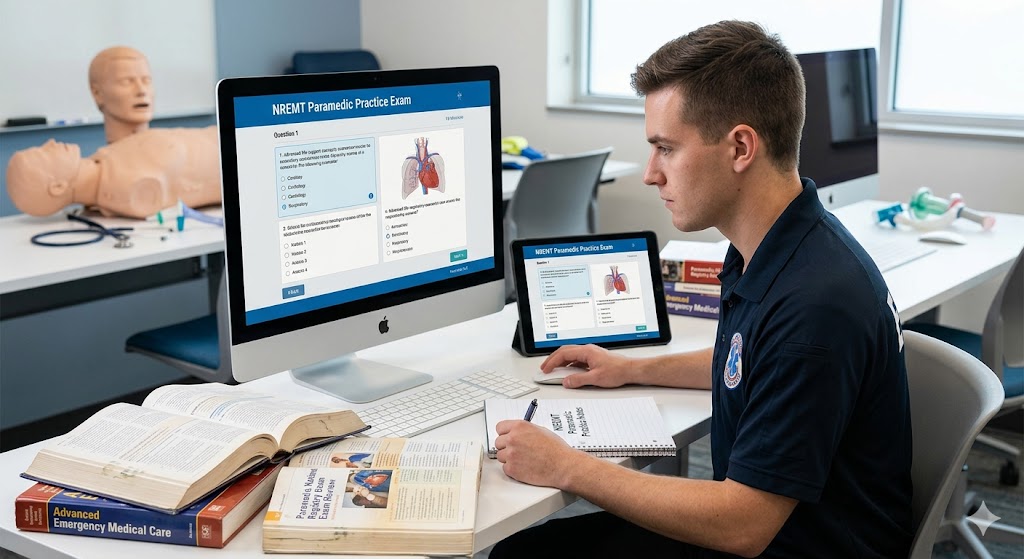
Additional Information
What the Course Entails and Exam Details
Preparing for the Paramedic National Registry exam requires mastering a deep and broad syllabus. The core topics align with the National EMS Education Standards and include complex subjects such as Advanced Airway Management, Cardiology (ECG interpretation and ACLS), Pharmacology, Medical Emergencies (neurology, endocrinology, immunology), Trauma Care, and Special Populations (pediatrics, geriatrics, obstetrics). The practical portion of your training, often completed prior to the cognitive exam, validates your hands-on skills in areas like patient assessment, dynamic cardiology, and static skills like IV therapy and medication administration.
What to Expect in the Final Exam
The final cognitive examination is a computer-adaptive test (CAT). This means the difficulty of the questions adjusts based on your performance. The exam consists of between 80 and 150 questions, and you will have a maximum of 2 hours and 30 minutes to complete it. The questions cover the entire spectrum of EMS care, including: Airway, Respiration & Ventilation; Cardiology & Resuscitation; Trauma; Medical; Obstetrics & Gynecology; and EMS Operations. A significant portion of the questions focuses on adult patients, with the remainder addressing pediatric care. The passing standard is a scaled score determined by the NREMT, designed to ensure entry-level competency.
How to Study and Exam Centers
Success on this exam demands a focused, multi-faceted study strategy. Focus on these actionable methods: First, utilize high-quality Paramedic National Registry practice exams to familiarize yourself with the CAT format and question style. Second, deeply review core textbooks and ACLS/PALS guidelines, focusing on pathophysiology and rationale rather than simple memorization. Third, form study groups to talk through complex scenarios. When you are ready to test, you will register through the NREMT website. The cognitive exam is administered at authorized Pearson VUE testing centers located throughout the country. You must schedule your exam in advance at one of these secure, proctored locations.
Job Opportunities from the Course
Earning your Paramedic National Registry certification unlocks a wide range of career paths in emergency services. Graduates are qualified for positions such as:
Flight Paramedic
Critical Care Paramedic
Firefighter/Paramedic
Tactical Paramedic
Industrial Paramedic
Emergency Department Paramedic
Community Paramedic
EMS Instructor
EMS Supervisor or Manager
Frequently Asked Questions
Reviews
5.0
Based on 0 reviews
Leave a Review
No reviews yet. Be the first to review!