
Paramedic Pharmacology Practice Test
$69.00
- Buy to unlock unlimited access to all Quiz questions and Answers in this Quiz.
- After purchase you can print a PDF of the whole quiz at any point. The PDF will contain the questions and the correct answers.
About this Exam
The Paramedic Pharmacology Practice Exam is a crucial stepping stone for emergency medical professionals aiming to master the administration of life-saving medications.
This assessment is specifically designed for paramedic students, working EMTs looking to upgrade their certifications, and current paramedics preparing for their national registry recertification.
It thoroughly tests your ability to make rapid, accurate, and safe pharmacological decisions in high-stress emergency environments.
By taking this practice test, candidates can identify their knowledge gaps and build the confidence required to safely deliver patient care in the field.
Ready to test your knowledge?
Buy Now to Access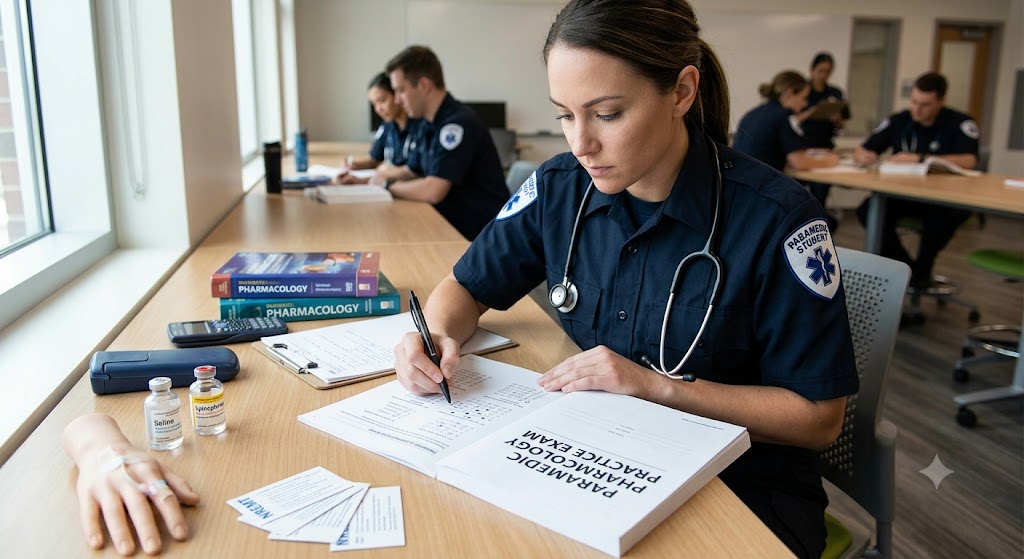
Additional Information
What the Course Entails and Exam Details
Paramedic pharmacology courses cover a rigorous and comprehensive syllabus centered around emergency medical interventions.
You will delve deeply into pharmacokinetics and pharmacodynamics, learning exactly how the body absorbs, distributes, metabolizes, and excretes various emergency drugs.
The core topics include mastering medical math and dosage calculations, which are absolutely vital for administering correct drug amounts in the field.
Students also study extensive drug classifications, focusing heavily on cardiovascular medications, respiratory drugs, analgesics, and neurological interventions.
Furthermore, the curriculum trains you to instantly recognize crucial drug contraindications, severe adverse reactions, and optimal therapeutic effects during patient transport.
What to Expect in the Final Exam
The final certification exam for paramedic pharmacology is designed to challenge your critical thinking and memorization skills under pressure.
You can generally expect a computer-based format consisting primarily of challenging multiple-choice questions (MCQs), often featuring complex scenario-based prompts.
When taken as part of the broader NREMT (National Registry of Emergency Medical Technicians) cognitive exam, the test is computer-adaptive, meaning the difficulty adjusts based on your previous answers.
While specific passing scores for internal program exams typically range between 70% and 80%, the national registry requires you to meet a standardized competency threshold across all topics.
Time limits are strictly enforced, normally allowing you between one to two hours to complete the pharmacology-specific modules.
A critical rule to remember is that you are often prohibited from using standard calculators, meaning you must be highly proficient at performing mental math for medication dosages.
How to Study and Exam Centers
Effective preparation requires a highly structured and disciplined study strategy.
We highly recommend creating custom flashcards to memorize complex drug classes, standard dosages, and absolute contraindications.
You must practice your medication calculation formulas daily until they become second nature, as medical math is a heavy component of the test.
Taking timed practice exams is one of the best ways to simulate the actual testing environment and reduce exam-day anxiety.
When you are ready to take the official exam, the NREMT cognitive tests are exclusively administered at authorized Pearson VUE testing centers located worldwide.
If you are taking a program-specific final, these are generally held at your local community college, university testing center, or authorized EMS training institute in a proctored environment.
Job Opportunities from the Course
Successfully mastering paramedic pharmacology and passing your certification exams unlocks a wide variety of advanced medical careers.
Here are some of the specialized job titles and career paths you can pursue:
Licensed Paramedic (Ground Ambulance)
Flight Paramedic (Aeromedical Evacuation)
Critical Care Transport Paramedic
Emergency Room Technician
Firefighter Paramedic
Offshore or Industrial Medical Medic
EMS Field Supervisor or Clinical Educator
Frequently Asked Questions
Reviews
5.0
Based on 0 reviews
Leave a Review
No reviews yet. Be the first to review!