
Paramedic School Entry Practice Exam
$69.00
- Buy to unlock unlimited access to all Quiz questions and Answers in this Quiz.
- After purchase you can print a PDF of the whole quiz at any point. The PDF will contain the questions and the correct answers.
About this Exam
Taking the step to become a paramedic is an exciting and highly rewarding career move in emergency medicine.
This entrance exam is designed specifically for certified Emergency Medical Technicians (EMTs) who are applying to accredited paramedic training programs.
It serves as a baseline assessment to ensure that candidates possess the foundational medical knowledge and critical thinking skills required to succeed in a rigorous paramedic school environment.
Whether you are a seasoned EMT or recently certified, this exam proves you are ready to handle the advanced responsibilities of paramedic training.
Ready to test your knowledge?
Buy Now to Access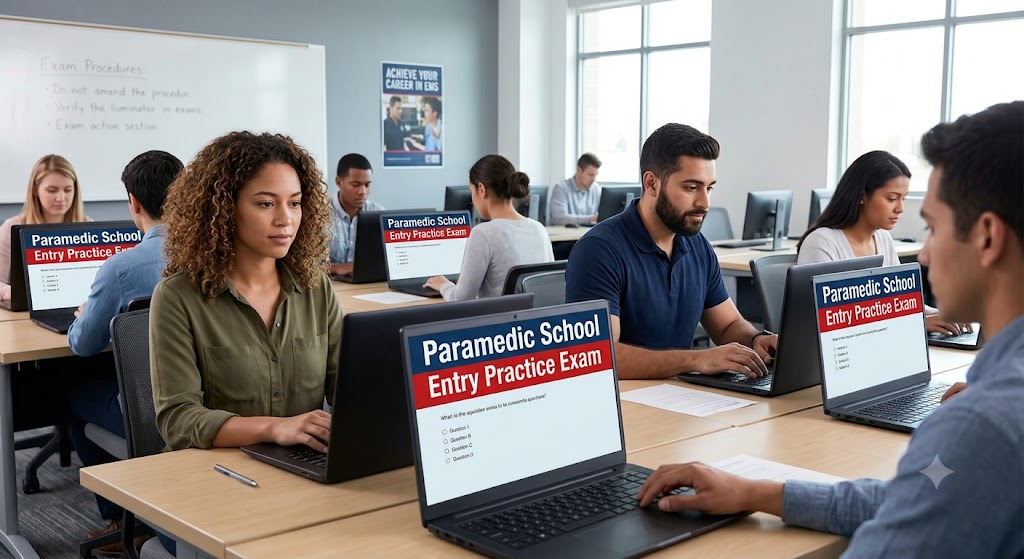
Additional Information
What the Course Entails and Exam Details
Paramedic programs are intensive, requiring a solid understanding of basic medical principles before you even attend your first lecture.
The entrance exam thoroughly evaluates your mastery of the EMT-Basic curriculum, ensuring you have retained critical life-saving protocols.
Core topics typically include basic anatomy and physiology, medical terminology, patient assessment, and basic life support (BLS) procedures.
You will also be rigorously tested on trauma care, airway management, cardiology basics, and pharmacology at the EMT level.
Furthermore, many of these exams assess core academic skills such as reading comprehension and basic mathematics, which are absolutely essential for calculating complex medication dosages in the field.
What to Expect in the Final Exam
While the exact structure varies depending on the specific school or testing vendor (such as Fisdap or HESI), the exam format is almost always multiple-choice.
Candidates can expect a computerized test consisting of anywhere from 100 to 150 scenario-based and factual questions.
Time limits are strictly enforced, usually giving you a window of two to three hours to complete the entire assessment.
The passing score requirements differ by institution, but a minimum score of 70% to 80% is generally expected to secure your admission.
Specific rules typically mandate a secure testing environment, prohibiting the use of personal calculators, cell phones, smartwatches, and outside reference materials.
How to Study and Exam Centers
Success on this exam requires a strategic combination of reviewing foundational material and mastering modern test-taking strategies.
Your most effective study method is to thoroughly review your primary EMT-Basic textbook and utilize online practice exams to identify your weak points.
Focus intensely on brushing up your basic math skills, particularly fractions, decimals, and basic algebra, as you will need to perform these calculations without a calculator.
When it comes time to take the actual test, exams are most frequently administered directly at the college or training institute's dedicated physical testing center.
However, some programs may utilize authorized third-party testing centers like Pearson VUE, or offer secure, live-proctored online testing portals for remote candidates.
Job Opportunities from the Course
Passing this entrance exam is your vital first step toward unlocking advanced, high-paying roles in emergency medical services.
Once you successfully complete your paramedic schooling and gain your national registry certification, a wide array of rewarding career paths becomes available to you.
You can pursue a dynamic role as a Lead Ambulance Paramedic, managing critical 911 calls and providing advanced life support in your community.
Many graduates successfully become Firefighter Paramedics, combining heavy rescue operations with advanced medical care within municipal fire departments.
There are also thrilling opportunities to work as a Flight Paramedic, providing elite critical care during helicopter and fixed-wing transport for severe trauma patients.
Additionally, hospital networks frequently hire trained paramedics as Emergency Room Technicians to assist nurses and doctors in fast-paced triage and trauma care environments.
Finally, Industrial, Tactical, and Offshore Paramedics are highly sought after to provide emergency medical coverage for SWAT teams, oil rigs, cruise ships, and remote construction sites.
Frequently Asked Questions
Reviews
5.0
Based on 0 reviews
Leave a Review
No reviews yet. Be the first to review!