
Patent Bar Practice Exam
$69.00
- Buy to unlock unlimited access to all Quiz questions and Answers in this Quiz.
- After purchase you can print a PDF of the whole quiz at any point. The PDF will contain the questions and the correct answers.
About this Exam
The Patent Bar Examination, officially known as the "Registration Examination for Admission to Practice in Patent Cases Before the United States Patent and Trademark Office" (USPTO), is a rigorous assessment for individuals seeking to practice patent law. Achieving this designation, either as a patent attorney or a patent agent, requires strong comprehension of United States patent laws and procedures. The Patent Bar is meticulously designed to assess a candidate's mastery of the USPTO Rules of Practice, as primarily defined within the Manual of Patent Examining Procedure (MPEP). This qualification is essential for individuals with specific scientific or technical backgrounds who aim to navigate complex patent application and prosecution processes effectively. Successfully navigating a dedicated Patent Bar Practice Exam is often the crucial final step in thorough preparation.
Ready to test your knowledge?
Buy Now to Access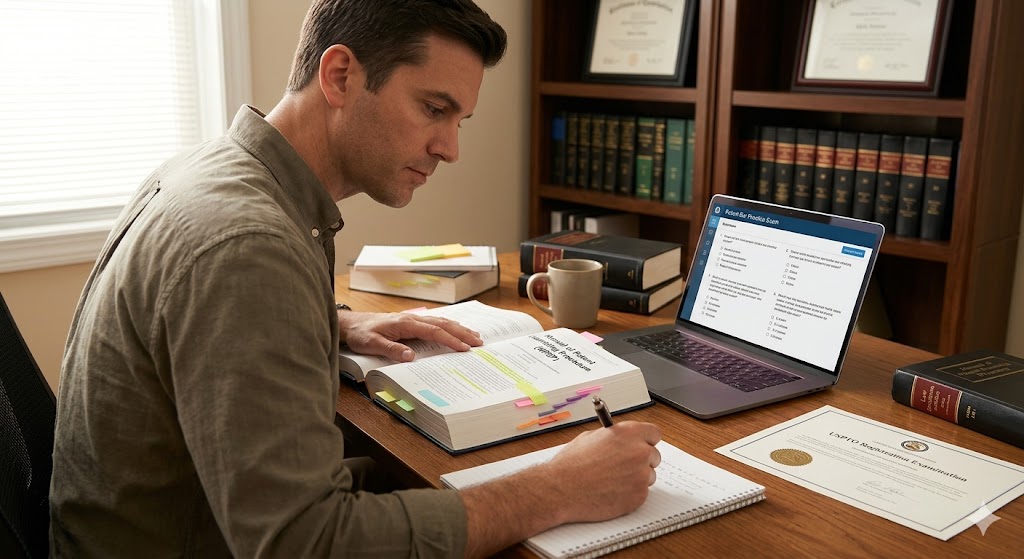
Additional Information
What the Course Entails and Exam Details
Preparing for the Patent Bar necessitates deep study into various areas of federal patent law and USPTO administrative practice. "Coursework" in this context typically refers to specialized prep courses or self-study modules that cover fundamental subjects outlined in the MPEP. Key areas include the following topics.
Candidates must understand patent eligibility requirements, including novelty and non-obviousness. The examination covers the preparation and filing of various patent applications, including utility, design, and plant patents. Participants learn the intricate process of patent prosecution, which involves corresponding with USPTO examiners and overcoming rejections. Mastering procedures for appeal, reissue, reexamination, and post-grant proceedings is also essential. Students gain a thorough understanding of the requirements for precise specification and claim construction. Specific parts of the MPEP form the core curriculum, and understanding how to navigate and apply these regulations is paramount.
What to Expect in the Final Exam
The Patent Bar is a comprehensive, computer-administered examination. Candidates can expect a multi-session format consisting of one hundred multiple-choice questions. These questions are split evenly into two distinct three-hour sessions, separated by a mandatory lunch break. The questions are designed to be challenging, often presenting complex scenarios that require a combination of legal analysis and MPEP-specific procedural knowledge.
The examination is open-book, meaning individuals have access to the USPTO's materials, primarily the MPEP, in electronic format during the test. However, relying solely on real-time lookups is highly inefficient due to the strict time constraints. The official passing score for the Patent Bar is seventy percent, meaning a candidate must answer seventy out of the one hundred questions correctly. Results are usually provided to the test-taker almost immediately upon completion of the second session.
How to Study and Exam Centers
Effective study for the Patent Bar is intensive and highly structured, frequently incorporating a professional preparation course. The single most vital strategy is to consistently utilize a reliable Patent Bar Practice Exam. These practice exams simulate the actual test environment and question formats, allowing candidates to identify areas of weakness, improve time management, and refine their ability to locate information quickly within the MPEP. Frequent practice helps build confidence and ensures you are accustomed to the structure of the official USPTO questions.
Candidates should focus on thoroughly reviewing key sections of the MPEP and understanding the nuances of current patent rules. Forming study groups can also be beneficial, providing opportunities to discuss complex topics and share insights. The actual Patent Bar examination is administered through Prometric testing centers throughout the United States and its territories. You must schedule your exam directly with Prometric after receiving an admission ticket from the USPTO Office of Enrollment and Discipline (OED). Ensure you review all USPTO and Prometric guidelines regarding scheduling, identification requirements, and permitted materials well in advance.
Job Opportunities from the Course
Passing the Patent Bar opens doors to diverse and rewarding career paths in the specialized field of intellectual property law. Successfully navigating this challenging exam—supported by targeted study and the use of a comprehensive Patent Bar Practice Exam—is the catalyst for significant professional advancement. Some of the specific job opportunities available include:
Patent Agent: Represents inventors and organizations in patent application and prosecution matters before the USPTO. (Requires passing the Patent Bar, even without a law degree.)
Patent Attorney: In addition to Patent Agent functions, can represent clients in patent litigation and other legal proceedings. (Requires passing the Patent Bar and admission to a state bar.)
Patent Examiner: Works for the USPTO to review patent applications for novelty, non-obviousness, and utility. (A specific technical background is usually required for examiners, and while passing the Bar isn’t mandatory for the job, it provides invaluable insights into the process from the other side.)
Corporate Intellectual Property (IP) Counsel: Advises corporations on IP strategy, manages patent portfolios, and handles IP-related agreements.
Technology Transfer Officer: Facilitates the commercialization of inventions and technologies developed within academic or research institutions.
Intellectual Property Litigation Associate: Focuses on defending or asserting patents and other intellectual property rights in court.
Frequently Asked Questions
Reviews
5.0
Based on 0 reviews
Leave a Review
No reviews yet. Be the first to review!