
PATH Train Engineer Recertification Practice Exam
$69.00
- Buy to unlock unlimited access to all Quiz questions and Answers in this Quiz.
- After purchase you can print a PDF of the whole quiz at any point. The PDF will contain the questions and the correct answers.
About this Exam
The PATH Train Engineer Recertification Practice Exam is an essential tool designed to help current Port Authority Trans-Hudson (PATH) train engineers prepare for their mandatory recertification assessments. This comprehensive practice exam ensures that engineers are up-to-date with the latest safety regulations, operational procedures, and technical knowledge required to safely and efficiently operate PATH trains in the busy New York-New Jersey metropolitan area. It is specifically tailored for experienced professionals seeking to validate their expertise and maintain their certification, demonstrating their commitment to public safety and operational excellence. By simulating the format and content of the actual recertification exam, this practice test allows engineers to identify areas for improvement and build confidence before the final assessment.
Ready to test your knowledge?
Buy Now to Access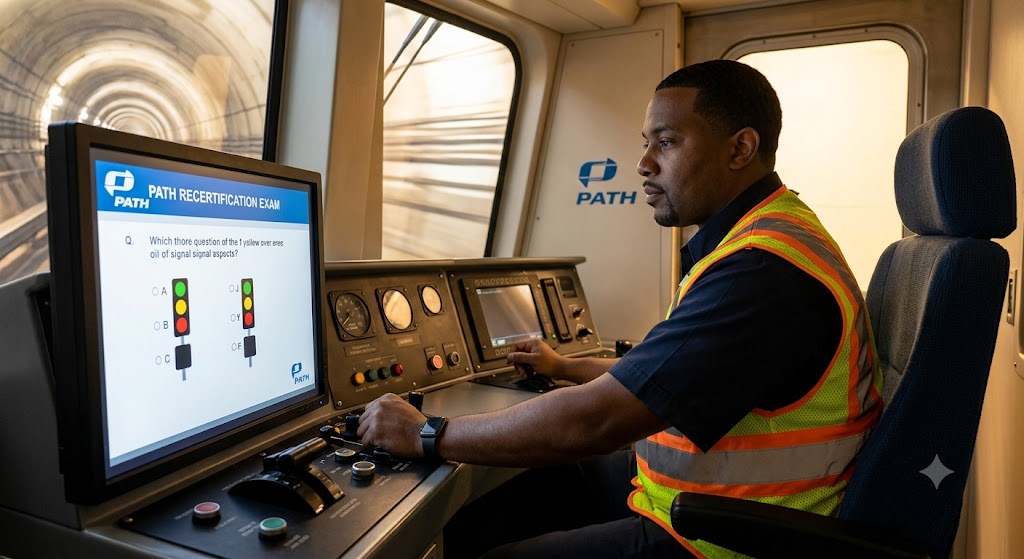
Additional Information
What the Course Entails and Exam Details
The recertification process and this accompanying practice exam cover a wide range of critical topics. Candidates can expect a thorough review of the PATH rules and regulations, focusing heavily on safety protocols, signal systems, and emergency procedures. The course and practice exam detail specific scenarios such as train handling under various track and weather conditions, breakdown procedures, and communication protocols with central control. Key areas include:
Comprehensive understanding of the PATH Rule Book.
In-depth knowledge of physical characteristics of the PATH system, including stations, interlockings, and speed restrictions.
Mastery of signal aspects and indications for both wayside and cab signaling.
Proficiency in train air brake systems, electrical systems, and troubleshooting.
Procedures for handling hazardous materials and interacting with emergency responders.
This practice exam is not a taught course but rather a rigorous self-assessment tool. It provides detailed explanations for both correct and incorrect answers, making it an invaluable resource for studying the core material required for recertification.
What to Expect in the Final Exam
The final PATH Train Engineer Recertification Exam is a high-stakes assessment that typically consists of two main components: a written knowledge test and a practical skills evaluation. The written portion is a comprehensive multiple-choice and short-answer exam that covers the topics outlined above. Engineers must demonstrate a very high level of proficiency, with a typical passing score set at 80% or higher. The exam is typically timed, adding an extra layer of challenge and requiring candidates to manage their time effectively.
The practical evaluation is a hands-on assessment where an examiner observes the engineer operating a PATH train in a simulated or real-world environment. This section evaluates the engineer's ability to apply their theoretical knowledge in a practical setting, focusing on:
Correct train start-up and shut-down procedures.
Smooth and precise train handling.
Accurate interpretation and response to all signal indications.
Proper communication with the conductor and control center.
Calm and correct execution of emergency procedures, if simulated.
Successful completion of both the written and practical components is required to achieve recertification, which must be renewed on a regular basis, usually every two to three years.
How to Study and Exam Centers
Effective preparation for the PATH Train Engineer Recertification Exam involves a combination of focused study, consistent practice, and hands-on experience. The most important resource is the current PATH Rule Book and associated operational manuals, which must be studied meticulously. This practice exam is designed to be used as a primary study aid, allowing you to regularly test your knowledge and identify specific areas that need further review.
Creating a dedicated study schedule and using spaced repetition techniques can significantly improve retention. Form a study group with colleagues to discuss challenging concepts and share operational experiences. If possible, utilize any available simulator time to practice train handling and emergency scenarios in a risk-free environment.
The final recertification exams are typically administered internally by the PATH Training Department at their dedicated training facilities or operational centers in the NJ/NY area. Specific testing locations and schedules are provided to engineers by their supervisors or the training department when they are scheduled for recertification. This ensures that the practical evaluations are conducted in the same real-world or high-fidelity simulated environments where the engineers work.
Job Opportunities from the Course
Successfully passing the PATH Train Engineer Recertification Practice Exam is the critical step toward maintaining your position as a PATH Train Engineer. This recertification confirms your qualified status and allows you to continue working in this essential role.
PATH Train Engineer: This is the primary role, responsible for the safe and timely operation of PATH trains, transporting thousands of passengers daily.
Locomotive Engineer: The expertise maintained through this certification is highly transferable, making you a qualified candidate for similar engineer positions at other commuter railroads and transit systems.
Train Dispatcher/Control Center Operator: Your in-depth knowledge of track layouts, signal systems, and operational procedures makes you well-suited for roles involved in managing the flow of train traffic.
Transit Operations Supervisor/Manager: Experienced and recertified engineers are prime candidates for leadership roles, supervising teams of engineers and conductors and overseeing daily transit operations.
Training Instructor: With a demonstrated mastery of the rule book and practical operations, you can transition into training the next generation of PATH engineers, helping to uphold the high standards of the organization.
Frequently Asked Questions
Reviews
5.0
Based on 0 reviews
Leave a Review
No reviews yet. Be the first to review!