
Pathfinder Written Sling Load Practice Test
$69.00
- Buy to unlock unlimited access to all Quiz questions and Answers in this Quiz.
- After purchase you can print a PDF of the whole quiz at any point. The PDF will contain the questions and the correct answers.
About this Exam
Welcome to your guide for preparing for the Pathfinder Written Sling Load Exam. This critical component of the renowned United States Army Pathfinder course tests the theoretical knowledge required to safely and effectively conduct helicopter sling load operations. This certification is designed for military personnel—officers and enlisted soldiers across various branches, including Infantry, Aviation, and Logistics—who need the specialized tactical and technical skills to manage complex, air-delivered supply and insertion missions. A Pathfinder is the expert on the ground ensuring that forces, equipment, and supplies are delivered accurately and safely by air, and this exam is the first step in demonstrating your expertise in one of their core competencies.
Ready to test your knowledge?
Buy Now to Access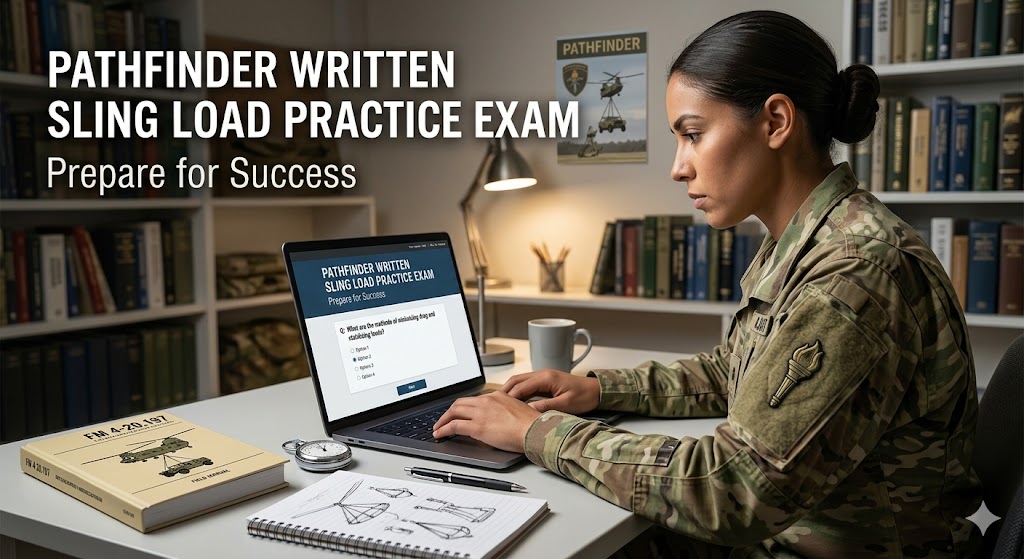
Additional Information
What the Course Entails and Exam Details
The official Pathfinder course is intensive and multi-phasic, with the Sling Load portion being a foundational element. This written practice test focuses specifically on the knowledge base you must master before progressing to the hands-on practical. Your learning will cover the fundamental principles of sling load operations, including:
Minimize Drag and Stabilize Loads: Understanding the four primary methods to minimize drag and stabilize a load, and knowing which method is the most and least preferred in various situations.
Equipment Identification and Strengths: Identifying a wide range of essential equipment from apex fittings (10K/25K with/without spacers, donut rings), cargo hook reach pendants, various slings (polyester round, specific sling sets), to different cargo nets (5K/10K color coding). Knowing the precise tensile strengths of these components is crucial.
Aircraft and Cargo Hook Capabilities: Specifics on common rotary-wing aircraft like the UH-60 series, CH-47 series, and CH-53 series. This includes knowing their cargo hook configurations (single, triple), and the precise tensile strengths for individual, center, and combined hooks for each helicopter and its variants.
Load Classifications: Understanding the classifications of sling loads: Certified, Suitable, Unique, and Prohibited, and the associated safety and approval procedures for each type (e.g., Block 11 of DA 7382).
Ground Crew Roles and Responsibilities: Detailed understanding of the composition and duties of the ground crew, including the Signalman and the Hookup Team (Static Probe Man and Hookup Man), and the safety protocols they must follow (such as always wearing proper PPE, including ID tags and goggles).
Safety Procedures and Equipment: Knowing the correct placement of personnel, such as the Signalman's location (20-25 meters in front of the load at a 45-degree angle), ensuring loads never fly overhead, and the critical use of the Static Discharge Wand (including referencing TM 4-48.09, Appendix D).
Relevant Regulations and Manuals: Understanding and referencing official multiservice helicopter sling load publications like FM 4-20.197 (FM10-450-3) and TM 4-48.09 is essential. The written exam within the Pathfinder course typically uses a multiple-choice format, requiring detailed, factually accurate knowledge rather than application at this stage. Success here is mandatory to advance to the practical phase, where you will demonstrate this knowledge by rigging actual loads.
What to Expect in the Final Exam
When you take the final Pathfinder Written Sling Load Exam as part of the official course, you can anticipate a challenging, closed-book test. It's not just about getting the general idea; it’s about knowing the precise details, figures, and procedures. Here’s what you should expect:
Format: The exam will contain a series of multiple-choice questions designed to test your mastery of all the topics outlined in the previous section. Questions can be highly detailed and specific.
Passing Score: A standard minimum passing score of 70% (or higher, depending on specific course adjustments and current standards) is required for this phase of the Pathfinder course. Failing to meet this threshold will prevent you from moving forward to the practical sling load examination and subsequent phases.
Time Limit: There will be a strict time limit to complete the exam. The time allotted is typically considered tight for the number and detail of the questions, meaning you must be confident and fluent in the material to succeed.
Specific Rules: This is a serious military test. Expect strict adherence to all exam rules, potentially including timed segments. It is almost always administered on an individual basis with no external assistance allowed.
How to Study and Exam Centers
Preparation for the Pathfinder Written Sling Load Exam is about intense, detailed, and structured study. You are not only preparing to pass a test but to operate safely in a high-stakes environment. Here are actionable study strategies:
Deep Dive into Manuals: Study the official regulations and handbooks meticulously. Key resources like FM 4-20.197 and TM 4-48.09 (especially the sections on equipment, safety, and procedures) are your Bible. Don’t just skim them; memorize key figures, definitions, and tensile strengths.
Create Visual Aids & Flashcards: Generate flashcards for every single equipment type, aircraft variant, tensile strength, crew role, and stabilizing method. The search results show questions that can be directly mapped to flashcards: "What color is the 25K sling set?", "What is the center hook capacity of a CH-53E/K?". Use diagrams of rigging and aircraft systems for visual learning.
Practice with Real Questions: Leverage any official or trusted practice test materials available within your unit or course resources. Repeatedly taking practice tests will help you identify weak areas and get accustomed to the question format and detail level.
Engage in Study Groups: Reviewing with fellow candidates can provide different perspectives, clarify difficult points, and build collective knowledge. Discuss and quiz each other on all aspects of the material.
Review Practical Context: While this is a written test, imagining the real-world application of each rule and equipment spec can aid memory retention. Consider how the knowledge of tensile strengths impacts rigging a specific vehicle.
Exam Centers and Availability
The official Pathfinder Written Sling Load Exam is taken only as part of the formal U.S. Army Pathfinder course and is generally administered by authorized military training centers and schools.
Authorized Military Schools: Primary locations for the Pathfinder course include Fort Moore (formerly Fort Benning, GA), National Guard training sites (like the Warrior Training Center), and specialized schools within divisions such as the 101st Airborne Division (Air Assault).
No Online/Pearson VUE Option: This specific, high-stakes military exam is not available on standard public testing portals or at civilian centers. Your test-taking will be integrated into your assignment and attendance of the overall Pathfinder course. Practice tests on public forums are study aids only, not a replacement for the final exam. If you are preparing, ensure you are linked into your military unit’s training resources or have been officially assigned to the course.
Job Opportunities from the Course
Earning your Pathfinder torch significantly expands your professional development and career paths within the military, demonstrating highly valuable, specialized skills in air assault, logistics, and ground guidance that are critical to modern operations. Specific career opportunities and job functions enhanced by Pathfinder qualification include:
Military Career Paths:
Pathfinder-Qualified Soldier/Officer: Direct assignment to a Pathfinder unit (though these are less common now as stand-alone units, the function remains vital). More typically, it becomes a crucial skill set and additional duty for personnel in existing units.
Pathfinder Instructor: Qualified individuals may be assigned as instructors at Pathfinder schools (like the "Black Hats" mentioned in search results), training the next generation.
Air Assault Unit Leaders: In divisions like the 101st, Pathfinder skills are critical for officers and NCOs in coordinating air insertions, supply drops, and specialized tactical movements.
Logistics & Supply Management: Within the Quartermaster Corps or Transportation branches, the ability to effectively plan and execute complex aerial resupply via sling load makes you an incredibly valuable asset in getting supplies to forces in contested environments. (Roles related to multifunctional logistics mentioned in the search for applicable officer branches).
Infantry & Armor Leaders: Enhanced tactical air-ground coordination skills, including drop zone and landing zone establishment, which are integral to Pathfinder training and crucial for maneuvering forces effectively. (Infantry, Armor branches directly mentioned for applicants).
Special Operations Support: Providing specialized advanced tactical logistics and air delivery leadership to SOF units requires the precise, detailed skills of a Pathfinder.
Transitioning to Civilian Life (Skills Translation):
While a direct civilian title "Pathfinder" is rare, the technical knowledge and leadership skills honed are highly sought after:
Logistics and Supply Chain Management: Planning complex, high-stakes air delivery operations translates to roles in managing specialized, fast-paced logistics in the private sector.
Emergency Services/Disaster Relief Logistics: Organizing the air delivery of aid and equipment to disaster-stricken areas requires the exact skills a Pathfinder possesses.
Air Cargo Operations: Knowledge of rigging, aircraft loading, and specialized air transport procedures is valuable in the air freight industry.
Commercial Helicopter Support: Coordinating specialized lift operations for construction, remote access logistics, or resource extraction using helicopters.
Frequently Asked Questions
Reviews
5.0
Based on 0 reviews
Leave a Review
No reviews yet. Be the first to review!