
Pathophysiology, Inflammation, and Tissue Healing for Medical Students Practice Test
$69.00
- Buy to unlock unlimited access to all Quiz questions and Answers in this Quiz.
- After purchase you can print a PDF of the whole quiz at any point. The PDF will contain the questions and the correct answers.
About this Exam
The Pathophysiology, Inflammation, and Tissue Healing for Medical Students Practice Exam is an essential tool for future healthcare professionals. It is designed to test and refine the fundamental knowledge required for diagnosing and treating a wide range of diseases.
This exam specifically targets medical students in their preclinical years, or those preparing for critical board examinations such as the USMLE Step 1. It serves as a rigorous self-assessment of the core concepts that underpin countless clinical conditions. By taking this practice test, students can identify critical knowledge gaps in the mechanisms of disease, the body's defensive inflammatory responses, and the complicated pathways of tissue regeneration and repair. Mastery of these subjects is non-negotiable for success in clinical rotations and subsequent medical practice.
Ready to test your knowledge?
Buy Now to Access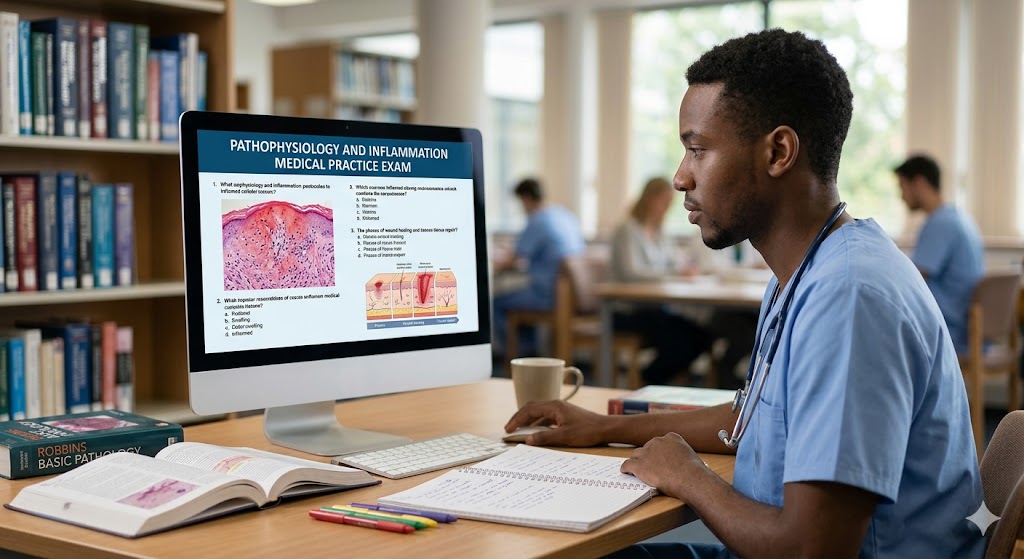
Additional Information
What the Course Entails and Exam Details
The course of study foundational to this exam delves deeply into the complex biology of how the body responds to injury and illness. Students will thoroughly cover cellular adaptation, injury, and death mechanisms, including necrosis and apoptosis. The inflammation module is extensive, detailing the vascular and cellular events of acute and chronic inflammation, the critical roles of chemical mediators, and the systemic effects like fever and the acute-phase response.
Furthermore, the syllabus includes a comprehensive overview of tissue healing and repair. This involves understanding regeneration, the mechanisms of wound healing, scar formation, and fibrosis, along with factors that either impair or facilitate this vital process. Hemodynamic disorders, thrombosis, shock, and basic concepts of immunology are also integral parts of the curriculum. Mastery of this material ensures students build a solid framework for interpreting clinical signs and symptoms.
What to Expect in the Final Exam
The final examinations that this practice test simulates typically follow a format of high-yield, clinically relevant Multiple Choice Questions (MCQs). These questions often require integrating knowledge across disciplines, pushing students to apply physiological and pathological principles to realistic patient scenarios.
While specific requirements vary by institution or standardizing board, final exams are almost always timed, often allowing for 1 to 2 hours depending on the number of questions. A passing score is set by the individual medical school or the licensing authority (e.g., USMLE). Rules are strict, requiring completion in a proctored environment, with academic integrity being paramount. This practice test mirrors that level of rigor to prepare students for the intensity of the actual examination.
How to Study and Exam Centers
Effective preparation demands active learning strategies. We strongly recommend students focus on active recall and spaced repetition to solidify memory. Reviewing key textbooks, such as "Robbins Basic Pathology," and using dedicated medical board review resources are crucial.
Utilizing practice question banks is one of the most effective ways to study. Practice timing yourself to simulate the exam environment and identify specific areas of weakness. For students preparing for the final comprehensive course exam, these are typically administered directly by their respective medical schools in designated lecture halls or testing labs. Students preparing for USMLE Step 1 will take their official exam at Prometric testing centers globally. For this specialized practice test, access is typically granted through online medical education portals or university learning management systems.
Job Opportunities from the Course
A strong grasp of pathophysiology, inflammation, and tissue healing does not lead directly to a specific job title, but it is a critical, foundational milestone in the long journey toward a medical career. This foundational knowledge is indispensable for success in all subsequent clinical years and the future physician’s medical career. Completing the associated course and mastering this content unlocks pathways to the following professional career titles:
Medical Doctor (MD or DO)
Specialist Physician (e.g., Cardiologist, Oncologist, Pulmonologist)
Surgeon
Medical Researcher / Scientist
Pathologist
Medical Educator / Professor
Clinical Trials Coordinator
Healthcare Administrator
Medical Content Writer
Frequently Asked Questions
Reviews
5.0
Based on 0 reviews
Leave a Review
No reviews yet. Be the first to review!