
Patient Care Skills Practice Exam
$69.00
- Buy to unlock unlimited access to all Quiz questions and Answers in this Quiz.
- After purchase you can print a PDF of the whole quiz at any point. The PDF will contain the questions and the correct answers.
About this Exam
The Patient Care Skills certification exam is designed for individuals seeking to enter or advance within the vital field of frontline healthcare. It targets aspiring Certified Nursing Assistants (CNAs), Patient Care Technicians (PCTs), and other unlicensed assistive personnel. The primary goal of this exam is to rigorously validate a candidate’s ability to provide safe, effective, and compassionate care to patients in various clinical settings. Certification signals to employers that you possess the necessary hands-on skills and theoretical knowledge to support patients with their daily needs and assist medical staff.
Ready to test your knowledge?
Buy Now to Access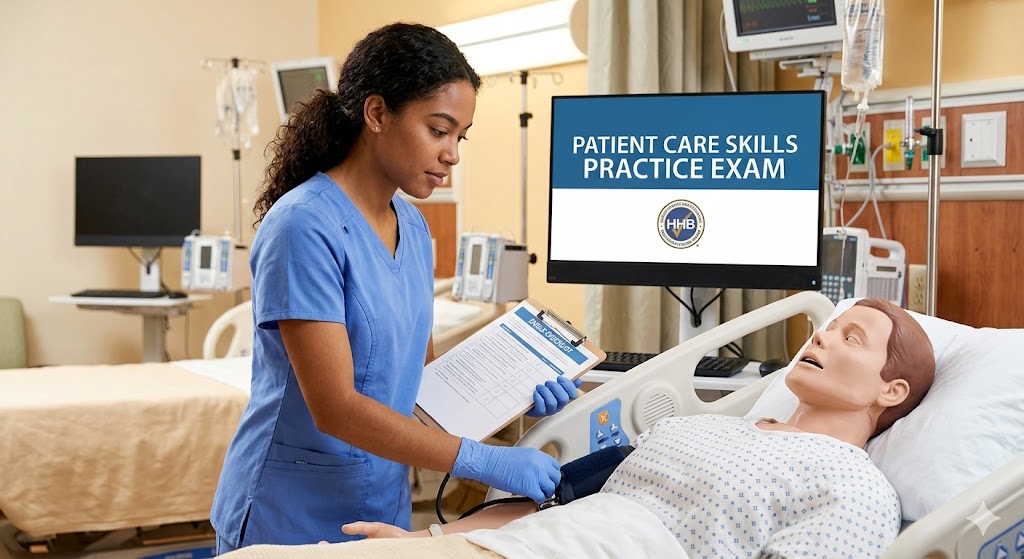
Additional Information
What the Course Entails and Exam Details
This comprehensive examination covers a wide spectrum of essential healthcare skills and knowledge areas. Candidates must demonstrate proficiency in several core domains.
The curriculum and assessment typically focus on the following pillars:
Basic Nursing Skills:
Accurately measuring and recording vital signs (temperature, pulse, respiration, blood pressure).
Understanding and documenting intake and output.
Assisting with examinations and treatments.
Recognizing abnormal changes in patient condition.
Personal Care Skills:
Assisting with Activities of Daily Living (ADLs) including bathing, grooming, and dressing.
Toileting and perineal care.
Safe feeding techniques and nutritional support.
Skin care and pressure ulcer prevention.
Safety and Emergency Procedures:
Infection control practices (handwashing, gloving, PPE use).
Correct patient identification.
Falls prevention protocols.
Basic emergency response and CPR (often as a separate but linked certification).
Patient Mobility:
Techniques for safe turning and positioning in bed.
Transfer skills (bed to chair, use of gait belts).
Assisting with ambulation.
Communication and Interpersonal Skills:
Effective communication with patients and healthcare teams.
Respecting patient rights and privacy (HIPAA compliance).
Understanding cultural competency and psychosocial needs.
What to Expect in the Final Exam
The final certification exam for patient care skills is a high-stakes assessment that generally consists of two distinct, mandatory components. Both parts must usually be passed to achieve certification.
Component 1: The Written (Knowledge) Exam
Format: This section usually consists of multiple-choice questions.
Content: Questions cover theoretical knowledge related to all the domains mentioned in Section 2, such as legal considerations, medical terminology, safety principles, and basic anatomy.
Delivery: Typically administered via computer at a secure testing location.
Time Limit: Usually ranges from 90 to 120 minutes.
Passing Score: Set by the certifying body, often around 70-75%.
Component 2: The Skills (Practical) Exam
Format: A hands-on demonstration of specific patient care tasks in a simulated clinical environment.
Process: Candidates are asked to perform several randomly selected skills (e.g., 3 to 5 skills like handwashing, measuring blood pressure, and making an occupied bed) in front of an evaluator or "skills evaluator."
Evaluation: Evaluators use a checklist to score performance based on critical steps that must be performed correctly for safety.
Passing Score: Candidates must pass all selected skills. Failing a critical step in any skill usually results in failing the entire practical component.
How to Study and Exam Centers
Preparation for this two-part exam requires a dedicated approach that balances theoretical learning with hands-on practice.
Effective Study Strategies:
Utilize the Practice Exam: Engaging with a comprehensive [Patient Care Skills Practice Exam] is essential. Practice tests help familiarize you with the wording of written questions and highlight areas where your knowledge is weak.
Review Your Textbook: Base your study on the official curriculum provided by your training program or the certifying body. Pay close attention to definitions, safety principles, and sequences of care.
Master the Skills Checklists: Obtain the exact checklists used by evaluators for the practical exam. Practice every skill repeatedly, exactly as outlined, until the sequence is automatic.
Simulate the Skills Environment: Practice skills with classmates, friends, or family members. If possible, use the equipment you will encounter during the test (e.g., specific blood pressure cuffs or hospital beds). Ask for feedback from instructors or experienced peers.
Study Groups: Collaborating with peers can help reinforce knowledge and provides a supportive environment for practicing practical skills.
Exam Centers and Registration:
The patient care skills certification exam is generally administered by state-approved testing vendors or recognized national organizations.
Common testing administrators include:
State-Specific CNA Registries: Many states manage their own CNA testing.
National Certifying Agencies: Organizations like the National Healthcareer Association (NHA) for PCTs.
Pearson VUE and Prometric: Major testing vendors often host the written component at their secure, physical computer-based testing centers nationwide.
Authorized Schools and Facilities: Many accredited healthcare training schools, community colleges, and some long-term care facilities are authorized "in-facility" testing sites for both the written and practical components, allowing students to test in a familiar environment. Candidates usually register through their training program or directly with the state’s approved testing vendor.
Job Opportunities from the Course
Earning certification in Patient Care Skills unlocks several crucial entry-level positions in healthcare, offering strong job security and a foundation for career advancement.
Completing this certification prepares you for roles such as:
Certified Nursing Assistant (CNA)
Patient Care Technician (PCT)
Nursing Aide / Nursing Assistant
Home Health Aide (HHA)
Resident Care Associate (RCA) in Assisted Living
Hospital Attendant
Geriatric Aide
Frequently Asked Questions
Reviews
5.0
Based on 0 reviews
Leave a Review
No reviews yet. Be the first to review!