
Patrol Officer Practice Test
$69.00
- Buy to unlock unlimited access to all Quiz questions and Answers in this Quiz.
- After purchase you can print a PDF of the whole quiz at any point. The PDF will contain the questions and the correct answers.
About this Exam
The Patrol Officer Exam (also known as the Police Officer Selection Test or POST) is the essential, mandatory first step toward a career in law enforcement. It is not a certification itself, but rather the standardized entrance examination used by municipal police departments, county sheriff’s offices, and state agencies to identify capable candidates.
This rigorous exam is specifically designed for aspiring law enforcement professionals who want to demonstrate their potential for success in a police academy setting and on the street. It evaluates the critical cognitive abilities, reasoning skills, and aptitude necessary to handle the daily, high-pressure responsibilities of a patrol officer.
Ready to test your knowledge?
Buy Now to Access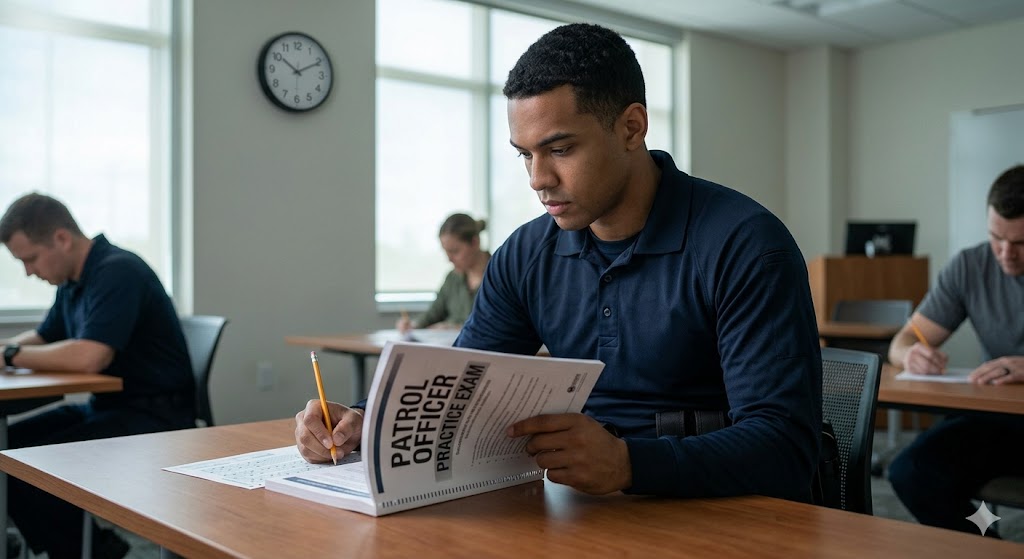
Additional Information
What the Course Entails and Exam Details
While the specific test format (such as the NCJOSI, POST, or agency-specific civil service exams) varies by jurisdiction, they all target the same core competencies. The exam does not test specific legal knowledge, but rather the aptitude to learn and apply that knowledge. The primary skills covered include:
Reading Comprehension: Your ability to read, understand, and interpret complex written directives, police reports, and legal procedures.
Written Communication: Assessing vocabulary, grammar, spelling, and clarity essential for writing accurate and effective incident reports.
Arithmetic and Math Reasoning: Fundamental math skills, including addition, subtraction, multiplication, and division, required for tasks like accident reconstruction and ticket issuance.
Deductive and Inductive Reasoning: Your capacity to analyze scenarios, apply general rules to specific situations, and identify logical conclusions from incomplete data.
Spatial Orientation and Observation: The ability to navigate via maps, visualize spatial relationships, and recall specific details from visual stimuli (like identifying a suspect or vehicle).
What to Expect in the Final Exam
Candidates should prepare for a traditional standardized testing environment, which is often conducted either by paper-and-pencil or via a secure computer-based terminal. The final exam is almost entirely comprised of multiple-choice questions designed to assess cognitive ability efficiently.
The exact time limit varies depending on the agency, but the exam typically takes between two and four hours to complete. A minimum passing score, often 70% or higher, is required to move forward. However, because law enforcement hiring is highly competitive, simply "passing" is often not enough; candidates must strive for the highest possible score to rank well on the eligibility list. Specific rules regarding the use of scratch paper, break times, and electronic devices are strictly enforced.
How to Study and Exam Centers
Effective preparation requires more than passive studying. We highly recommend using a high-quality Patrol Officer Practice Test to familiarize yourself with the question formats, timing, and logic used.
Actionable study strategies include:
Take Full-Length Practice Exams: Simulate the actual test conditions by timing yourself to build stamina and improve time management.
Focus on Your Weakest Areas: If logic puzzles or arithmetic are difficult, dedicate more study time specifically to those skill sets.
Refine Your Report Writing: Practice identifying errors in grammar and sentence structure, as these are common pitfalls.
Exam Centers: This exam is not typically scheduled independently by the student. You do not sign up at a national testing center. Instead, you must apply to a specific police agency or civil service commission first. That agency will then notify you of the specific location where the examination will be administered. This is almost always an in-person, proctored event, often held at a municipal center, a college, a military base, or the agency’s own training facility.
Job Opportunities from the Course
Successfully passing the initial Patrol Officer Exam and the subsequent background and physical requirements unlocks a wide array of career paths in the law enforcement and public safety sectors. While the initial role is generally that of a uniformed patrol officer, this fundamental test is the barrier of entry for dozens of specialized careers:
Municipal Police Officer (City)
Sheriff’s Deputy (County)
State Trooper / Highway Patrol Officer
Transit Police Officer
University Police Officer
Airport Police Officer
Natural Resources/Game Warden
Detective/Investigator (Promotional path after patrol)
SWAT or Specialized Tactician (Promotional path)
Frequently Asked Questions
Reviews
5.0
Based on 0 reviews
Leave a Review
No reviews yet. Be the first to review!