
Patrol Skills B Practice Exam
$69.00
- Buy to unlock unlimited access to all Quiz questions and Answers in this Quiz.
- After purchase you can print a PDF of the whole quiz at any point. The PDF will contain the questions and the correct answers.
About this Exam
The Patrol Skills B Certification is a comprehensive, intermediate-level program designed to elevate the expertise of private security professionals. This certification is ideal for individuals who have already completed basic security training and are seeking to advance their careers into more specialized patrol roles. It is also suitable for experienced security guards looking to validate their skills and open new opportunities for promotion. This course bridges the gap between basic observation and the proactive, advanced patrol techniques required to secure complex environments such as corporate campuses, residential communities, and industrial sites.
Ready to test your knowledge?
Buy Now to Access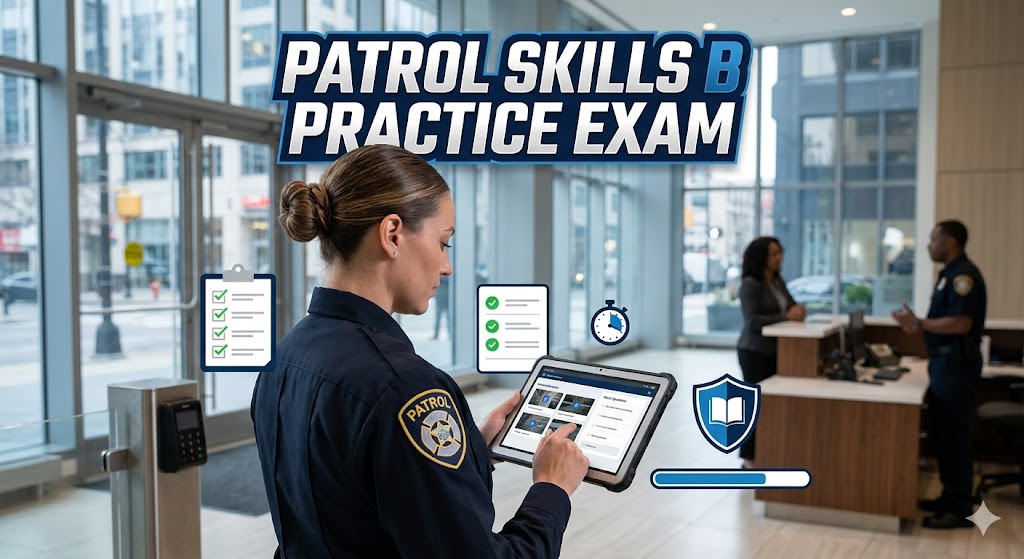
Additional Information
What the Course Entails and Exam Details
This in-depth course covers a spectrum of critical skills required for effective and professional patrol operations. Students can expect a thorough exploration of topics including:
Advanced Patrol Techniques: Mastering both foot and mobile patrol strategies, including variable patterns, building searches, and perimeter security.
Observation and Reporting: Enhancing the ability to detect anomalies, accurately recall details, and produce professional, legally defensible incident reports.
Legal Powers and Limitations: A deep dive into the specific legal authority and restrictions governing private security in their jurisdiction, including search and seizure, use of force, and citizen's arrest.
Conflict Resolution and De-escalation: Acquiring practical verbal and non-verbal skills to manage aggressive behavior, defuse tense situations, and maintain public order.
Emergency Response and First Aid: Training in initial response protocols for medical emergencies, fires, natural disasters, and other critical incidents.
Technology in Patrol: Understanding the use of modern security tools, including GPS patrol tracking systems, body-worn cameras, and access control technologies.
What to Expect in the Final Exam
The final examination for the Patrol Skills B Certification is a rigorous assessment of both theoretical knowledge and practical application. Students should be prepared for:
The Written Examination: A computer-based, multiple-choice exam typically consisting of 100 questions. This part evaluates your understanding of the core concepts, laws, and procedures. Candidates generally have a time limit of two hours to complete this section.
Passing Score: Achieving a passing score, often 75% or higher, is required to demonstrate proficiency.
Practical Evaluation: Many certifying bodies also require a practical, hands-on demonstration of skills. This may involve scenarios such as conducting a proper building search, de-escalating a staged conflict, or producing a complete incident report from a video scenario.
How to Study and Exam Centers
Preparation is the key to success for the Patrol Skills B Exam. Our comprehensive [Patrol Skills B Practice Exam] is a cornerstone study tool, designed to simulate the format and content of the actual test. Other recommended study strategies include:
Reviewing Training Manuals: Thoroughly study the course materials and training manuals provided by your training provider.
Online Study Groups and Forums: Engage with fellow students to discuss complex topics and share study tips.
Practical Application: If possible, practice patrol patterns and reporting on the job, under the guidance of a supervisor.
Exam Centers and How to Take the Exam:
The exam is typically administered through the certifying body or an authorized testing partner. Once you are prepared, you can register through:
Authorized Private Security Schools: Many training schools that offer the course are also authorized to administer the final exam at their physical locations.
Proctored Online Portals: Depending on the jurisdiction and certifying body, online proctoring may be available, allowing you to take the written portion from a secure location.
Testing Center Networks: Larger, national certification programs may utilize extensive testing center networks, such as Pearson VUE, which have locations in most major cities.
Job Opportunities from the Course
A Patrol Skills B Certification is highly valued by employers in the private security industry and is often a prerequisite for more advanced and higher-paying roles. Completing this course unlocks a variety of career paths, including:
Security Patrol Officer
Armed Security Officer (often in combination with firearm certification)
Intermediate Security Guard
Mobile Patrol Officer
Lead Security Officer
Field Supervisor
Site Supervisor
Loss Prevention Specialist
Event Security Coordinator
Corporate Security Officer
Frequently Asked Questions
Reviews
5.0
Based on 0 reviews
Leave a Review
No reviews yet. Be the first to review!