
Payment Card Industry (PCI) Data Security Standards Practice Test
$69.00
- Buy to unlock unlimited access to all Quiz questions and Answers in this Quiz.
- After purchase you can print a PDF of the whole quiz at any point. The PDF will contain the questions and the correct answers.
About this Exam
The Payment Card Industry Data Security Standard (PCI DSS) is a rigorous set of policies and procedures developed to enhance payment account data security and prevent credit card fraud.
This comprehensive practice test is designed for IT professionals, security analysts, compliance officers, and anyone involved in the handling, processing, or storage of cardholder data. Whether you are preparing for an official PCI qualification (such as ISA or QSA) or aim to solidify your knowledge of compliance requirements for your organization, this resource provides essential preparation. This practice exam helps validate your understanding of the standards required to safeguard sensitive financial information in today’s complex digital landscape.
Ready to test your knowledge?
Buy Now to Access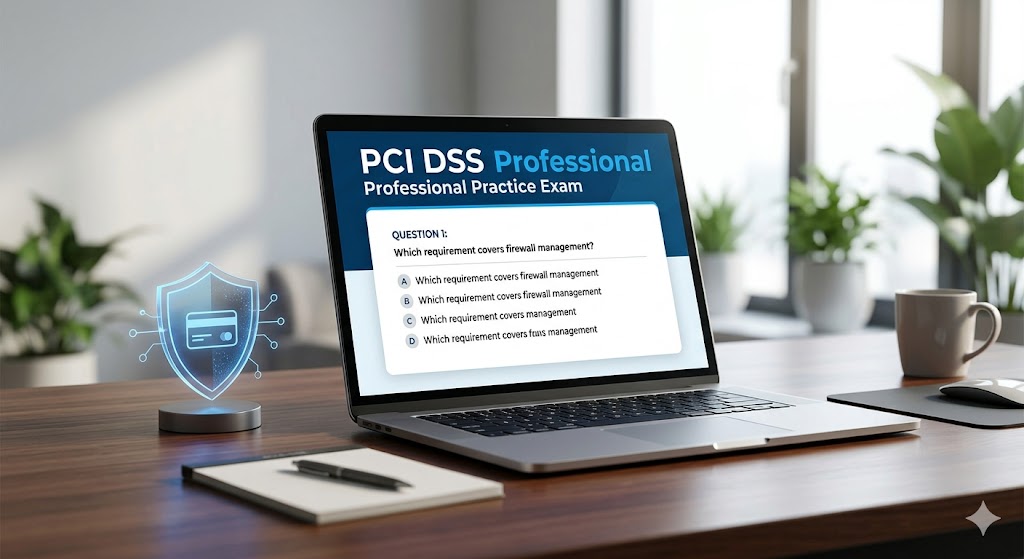
Additional Information
What the Course Entails and Exam Details
The core syllabus covers the 12 specific technical and operational requirements established by the PCI Security Standards Council (SSC). A course focused on this material ensures candidates can navigate the detailed standards required for robust payment security.
Key topics covered include:
Building and Maintaining Secure Networks and Systems: Detailed knowledge of firewall configurations and avoiding vendor-supplied defaults for system passwords.
Protecting Cardholder Data: Understanding encryption methods for stored data and secure transmission across open, public networks.
Maintaining a Vulnerability Management Program: Implementing regular anti-virus updates and developing secure systems and applications.
Implementing Strong Access Control Measures: Restricting access to cardholder data by business need-to-know, assigning unique IDs, and restricting physical access.
Regularly Monitoring and Testing Networks: Tracking and monitoring all access to network resources and cardholder data, and regularly testing security systems.
Maintaining an Information Security Policy: Addressing information security for all personnel within an organization.
What to Expect in the Final Exam
While "PCI DSS" refers to the standard itself, the "final exam" usually pertains to specific certifications like the Internal Security Assessor (ISA) or Qualified Security Assessor (QSA), or an internal foundational knowledge assessment.
Typically, candidates can expect the following exam format:
Format: The exam usually consists of multiple-choice questions.
Content: Questions are designed to test both technical understanding of the 12 requirements and practical application scenarios (e.g., assessing a specific network architecture for compliance).
Duration: The time limit varies but is generally between 60 to 90 minutes for foundational internal exams. Official council-level certification exams may be longer.
Passing Score: The passing score is typically set around 75% or higher, reflecting the need for a strong grasp of compliance nuances.
Language: The primary language for these exams is English.
How to Study and Exam Centers
Preparation is key to succeeding on a PCI DSS related assessment. We recommend a multi-faceted study strategy:
Review the Official Standards: Begin by thoroughly reading the full, current PCI DSS designated standard document available directly from the PCI Security Standards Council (SSC) website.
Take Practice Tests: Utilize comprehensive practice exams like this one to identify knowledge gaps and familiarize yourself with the question phrasing.
Hands-on Application: If possible, map the 12 requirements to your own organization's infrastructure to understand how theoretical compliance translates to practical implementation.
Official Training: For those pursuing official QSA or ISA designations, official training courses provided directly by the PCI SSC are often required and highly recommended.
Regarding Exam Centers: If you are taking an internal assessment, this is typically administered via a secure company learning management system (LMS). For official certifications (like QSA or ISA), the exams are proctored and often administered online through Pearson VUE testing centers or other authorized physical locations globally.
Job Opportunities from the Course
A strong understanding of PCI DSS requirements is in high demand as organizations prioritize data security and regulatory compliance. Achieving proficiency in this standard unlocks various career paths in cybersecurity and IT audit, including:
PCI Compliance Security Manager: Leading an organization's continuous compliance efforts.
Qualified Security Assessor (QSA): External auditor authorized by the PCI SSC to perform external assessments.
Internal Security Assessor (ISA): Internal professional responsible for managing an organization's compliance and self-assessments.
Information Security Auditor: Conducting broad security audits, with a specific focus on financial data.
Compliance Analyst: Reviewing business processes and IT controls against the standard.
Network Security Engineer: Designing and implementing secure network architectures that meet PCI requirements.
Frequently Asked Questions
Reviews
5.0
Based on 0 reviews
Leave a Review
No reviews yet. Be the first to review!