
PBCFR Driver Standard Operating Guidelines (SOGs) Practice Test
$69.00
- Buy to unlock unlimited access to all Quiz questions and Answers in this Quiz.
- After purchase you can print a PDF of the whole quiz at any point. The PDF will contain the questions and the correct answers.
About this Exam
The PBCFR Driver SOGs Practice Exam is a specialized tool designed specifically for aspiring Driver Operators and Engineers within Palm Beach County Fire Rescue. This comprehensive practice test is engineered to help candidates master the mandatory department-specific Standard Operating Guidelines (SOGs). Understanding these local protocols is absolutely crucial, as general knowledge of fire hydraulics is insufficient to pass the PBCFR examination. This practice exam is essential for probationary firefighters, recruits, and those seeking promotion within the department, ensuring they can operate heavy fire apparatus safely, efficiently, and in strict compliance with local policy.
Ready to test your knowledge?
Buy Now to Access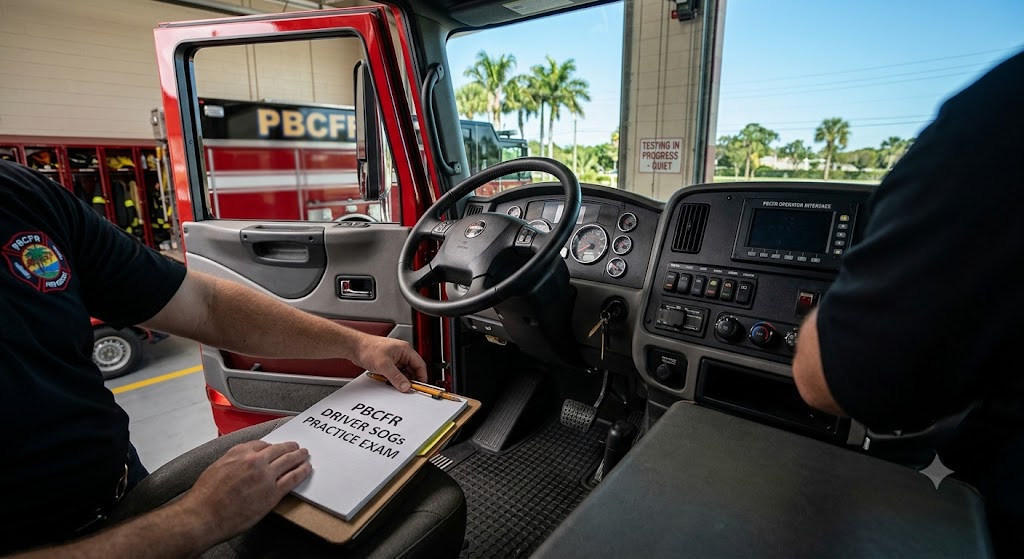
Additional Information
What the Course Entails and Exam Details
This examination does not merely test general vehicle operations; it requires rote memory and precise application of the internal regulations of Palm Beach County Fire Rescue. Candidates must achieve total fluency in several key areas of the department’s SOGs.
The practice modules and subsequent final exam are deeply focused on the following specific topics:
Departmental safety regulations during emergency and non-emergency responses.
Protocols for driving through intersections and managing unique traffic situations.
Mandatory procedures for backing apparatus and required ground guide responsibilities.
Hydraulics calculations specific to PBCFR engine pump operations, nozzle pressure, and water supply.
Standard Operating Procedures for aerial ladder placement, stabilization, and safe operating envelopes.
Incident command system interaction from the driver's perspective and communication protocols.
Department-specific maintenance schedules, daily vehicle checks, and defect reporting guidelines.
What to Expect in the Final Exam
The final SOG examination is known for being rigorous and detail-oriented. The format is typically a written, multiple-choice, and true/false exam consisting of numerous questions pulled directly from the text of current PBCFR Standard Operating Guidelines.
Candidates should expect a tight time limit, forcing them to recall specific data points, such as maximum speeds for tire chains, exact hydraulic formulas used by the department, or precise parking distances. The department demands a high standard of precision; therefore, the passing score is usually very strict, often set at 80% or higher. A failure on the written component usually restricts candidates from progressing to the required practical skills evaluation, where they must demonstrate hands-on mastery of driving and pumping operations.
How to Study and Exam Centers
Effective preparation is the key to passing this exam. Rote memorization of the SOG documents is mandatory. Experts recommend that candidates create detailed flashcards focusing on numerical data, definitions, "SHALL" versus "MAY" statements, and specific operational requirements.
Candidates should form study groups with colleagues to test each other on rapid-fire SOG recall. Repeatedly taking the PBCFR Driver SOGs Practice Exam is one of the most effective methods, as it helps identify specific SOGs that require further review before the test day.
The actual written exam is typically administered internally by the Palm Beach County Fire Rescue Training & Safety Division. The testing takes place at the Herman W. Brice Fire Rescue Complex, the department’s primary training academy, or through an authorized internal learning management system portal, depending on the current department protocol for promotional testing.
Job Opportunities from the Course
Successfully mastering the SOGs and passing the requisite testing is not just a requirement; it unlocks significant career advancement and specialized roles within Palm Beach County Fire Rescue. Completing this process makes you eligible for several critical and respected job titles.
Gaining your Driver Operator or Engineer certification is mandatory for those seeking to hold these specific job titles:
Fire Driver/Operator (Engine, Rescue, or Aerial units)
Fire Engineer
Probationary Firefighter (as a required developmental checkpoint)
Relief Driver/Operator (temporary assignment for out-of-class pay)
Future candidate for promotion to Lieutenant, as driver experience is a prerequisite.
Frequently Asked Questions
Reviews
5.0
Based on 0 reviews
Leave a Review
No reviews yet. Be the first to review!