
PDHPE Higher School Certificate (HSC) CORE 2 Practice Exam
$69.00
- Buy to unlock unlimited access to all Quiz questions and Answers in this Quiz.
- After purchase you can print a PDF of the whole quiz at any point. The PDF will contain the questions and the correct answers.
About this Exam
The PDHPE Higher School Certificate (HSC) CORE 2 Practice Exam is an essential tool for students preparing for the concluding examination of their Stage 6 Personal Development, Health, and Physical Education course in New South Wales, Australia. This certification path, known as the HSC, is the final qualification for secondary school students. The practice exam specifically targets Core 2 of the syllabus, "Factors Affecting Performance," and is designed to provide a realistic testing experience, helping students assess their readiness, identify knowledge gaps, and build the confidence necessary to excel in the final written exam. It is primarily designed for Year 12 students enrolled in PDHPE but is also invaluable for anyone seeking to master the principles of human movement and elite athletic performance.
Ready to test your knowledge?
Buy Now to Access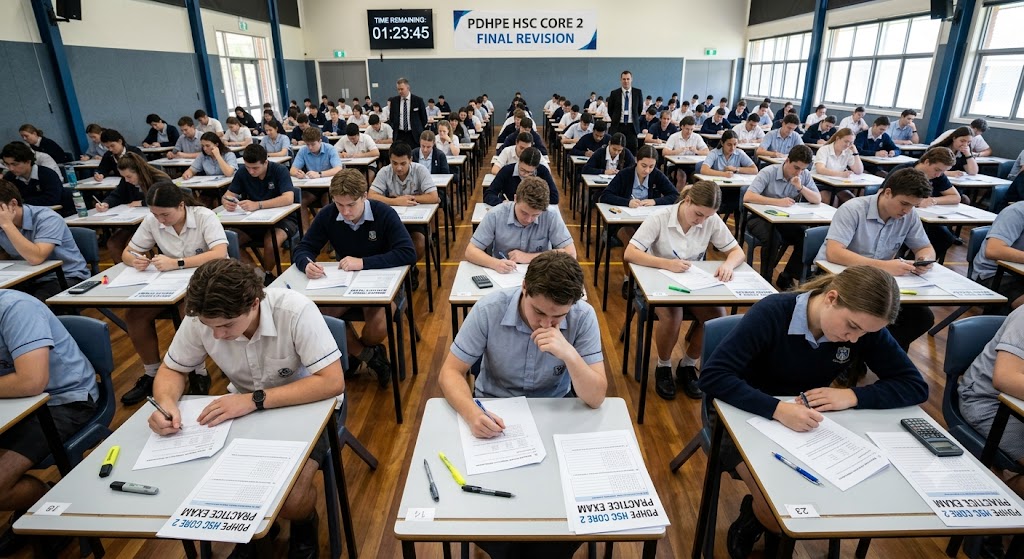
Additional Information
What the Course Entails and Exam Details
This section of the course investigates the physiological, psychological, and biomechanical factors that influence an athlete's potential to perform at their peak. It shifts the focus from population health (covered in Core 1) to individual and elite athletic development. The syllabus covers four critical questions:
1. How does training affect performance? You will study energy systems (ATP/PC, lactic acid, and aerobic), types of training and training methods, and the application of physiological principles of training to improve performance.
2. How can psychology affect performance? This topic explores motivation, anxiety and arousal, and essential psychological strategies (such as goal setting, visualization, and relaxation) to enhance an athlete's mental state and focus.
3. How can nutrition and recovery strategies affect performance? Students learn about the role of macronutrients and micronutrients, hydration, pre-, during-, and post-performance nutritional requirements, and supplementation. You will also examine various recovery strategies, including physiological, neural, and tissue damage strategies.
4. How does the acquisition of skill affect performance? This covers the stages of skill acquisition (cognitive, associative, and autonomous), the characteristics of the learner, and performance elements (such as decision making and strategic development). You will also study the design of skill practice sessions.
The real HSC PDHPE exam is a comprehensive 3-hour written paper that covers the entire two-year preliminary and HSC course content.
What to Expect in the Final Exam
The actual HSC PDHPE final examination is composed of multiple sections, but the Core 2 content typically contributes significantly to the written component.
The general structure of the entire 100-mark HSC paper is:
Section I (60 Marks): Core content (Core 1: Health Priorities in Australia, and Core 2: Factors Affecting Performance). This includes both multiple-choice questions and short-answer questions with a higher mark value (e.g., 5, 8, 10, or 12 marks). The marks are split evenly between Core 1 and Core 2, meaning approximately 30 marks are allocated to each.
Section II (40 Marks): Students answer questions on the two options they have studied (e.g., Sports Medicine, Improving Performance, Equity and Health). Each option is worth 20 marks and typically includes both shorter and extended response questions.
To pass the HSC, a student must meet the minimum standard required for all their courses. While there isn't a single 'passing score' for a single exam in the same way as a certification, a final HSC mark of 50 or above (Band 2 and above) is generally considered to be achieving the minimal requirement. Performance in Band 5 and Band 6 (marks of 80–100) are considered high results and are often the goal of university-bound students. Time management is crucial, as students have 3 hours plus reading time for the entire paper.
How to Study and Exam Centers
Effective study for Core 2 must be highly strategic.
Practice with Purpose: Do not just read your notes. You must apply your knowledge. Use past HSC papers and specific Core 2 practice exams. Focus on answering the questions within the suggested time limits to build exam-day stamina and time management skills.
Master Key Verbs: NESA (the curriculum authority) uses specific "glossary of key words" in their questions (e.g., Analyze, Discuss, Compare, Contrast, Evaluate, Critically Analyze). Your responses must match the level of detail required by that verb. A Critical Analysis requires you to look at the positive, negative, and alternative views and make a judgment, whereas Describe only requires you to state the characteristics of a concept.
Structure Your Answers: For extended responses, always plan a logical flow with an introduction, well-structured body paragraphs with clear topic sentences and supporting evidence/examples, and a concise conclusion. Use Australian sporting examples wherever possible to demonstrate application.
Access Practice Exams: Students can find official past HSC papers and marking guidelines on the NESA website. They can also use proprietary practice exams and online portals provided by educational companies and their schools.
The final HSC exams are taken in official, physical examination centers. Most students will sit their exams at their own local high school. Special exam centers can be arranged for students who are unable to sit at their own school due to specific, recognized conflicts (e.g., representing Australia in an elite sport). Your school will coordinate the registration and location details for your official exams. Practice exams, conversely, can often be accessed through school internal assessments or online portals.
Job Opportunities from the Course
A strong performance in HSC PDHPE, particularly in Core 2, lays an excellent foundation for numerous rewarding career paths, although many of these will require further vocational (VET) or university (tertiary) study.
Specific career paths unlocked by further study include:
Physical Education (PE) Teacher
Sports Coach (community to elite levels)
Exercise Physiologist
Physiotherapist
Sports Scientist
Fitness Centre Manager
Personal Trainer
Strength and Conditioning Coach
Recreation Officer
Sports Administrator
Dietitian or Sports Nutritionist
Sports Psychologist
Health Promotion Officer
Frequently Asked Questions
Reviews
5.0
Based on 0 reviews
Leave a Review
No reviews yet. Be the first to review!