
Pedagogy and Professional Responsibilities (PPR) Domain 1 Practice Test
$69.00
- Buy to unlock unlimited access to all Quiz questions and Answers in this Quiz.
- After purchase you can print a PDF of the whole quiz at any point. The PDF will contain the questions and the correct answers.
About this Exam
The Pedagogy and Professional Responsibilities (PPR) exam, often part of the Texas Examinations of Educator Standards (TExES), is a critical step in becoming a certified educator in Texas. It is designed to evaluate whether a candidate possesses the requisite knowledge and skills of an entry-level teacher in Texas public schools.
This specialized PPR Domain 1 Practice Exam is a focused study tool, specifically built to help aspiring teachers master the initial and most critical part of the core exam.
This certification is for individuals who have completed a bachelor's degree and are looking to fulfill the state's requirement for professional pedagogy, confirming they are ready to plan, implement, and assess instruction effectively.
Ready to test your knowledge?
Buy Now to Access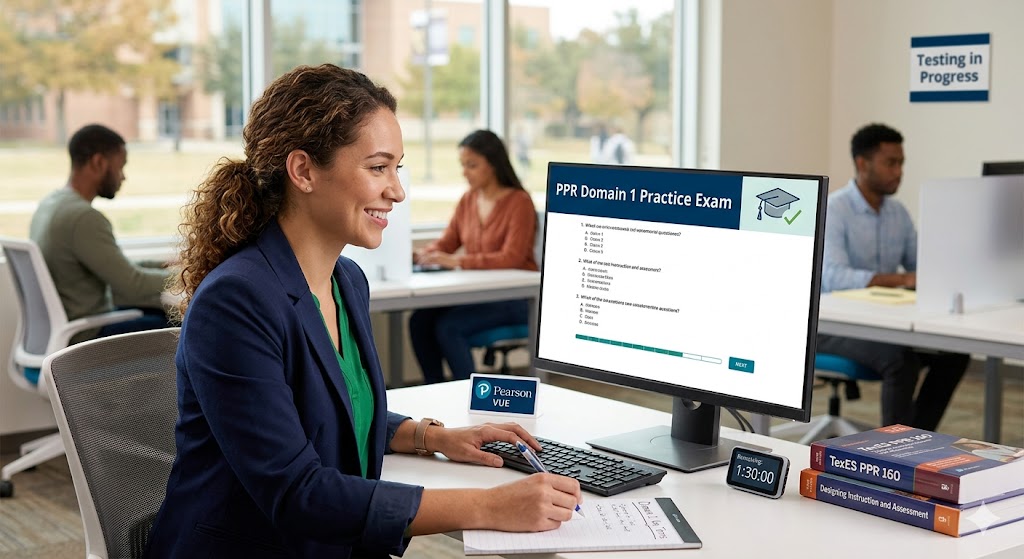
Additional Information
What the Course Entails and Exam Details
This practice test is entirely dedicated to Domain 1: Designing Instruction and Assessment to Promote Student Learning.
As the name suggests, this domain focuses on the "science" behind successful teaching. It covers four major competencies that represent about 34% of the total PPR exam. While this practice tool focuses on that knowledge, the final, full PPR exam includes all four domains.
The areas you will cover include:
Competency 1: Human Developmental Processes: Understanding how students learn and develop, and creating instruction that is both motivating and responsive to their diverse needs.
Competency 2: Student Diversity: Recognizing and respecting student diversity and designing assessments and learning experiences that promote the learning of all students.
Competency 3: Effective Instruction and Assessment Design: Mastering the procedures for designing effective, coherent instruction and assessment based on learning goals (such as the TEKS in Texas).
Competency 4: Factors Affecting Student Learning: Knowing the internal and external factors that affect learning and planning instruction that is engaging and appropriate.
What to Expect in the Final Exam
It is essential to understand that this PPR Domain 1 Practice Exam is a tool to prepare you for a significant section of the final certification exam, the full TExES PPR (160). You will not receive a standalone certification for Domain 1, but mastering it is essential for overall success.
Here is what you need to know about the final TExES PPR (160) exam, which you will be prepared for:
Exam Format: The full exam consists of 100 multiple-choice questions (also known as selected-response questions).
Time Limit: You will be given a total of 4 hours and 45 minutes to complete the entire exam.
Passing Score: To pass the PPR exam and move forward in your certification, you must achieve a scaled score of at least 240.
Question Type: The multiple-choice questions can be "single-question" (a standalone question) or part of a "clustered question" set (multiple questions based on a common scenario or stimulus, such as a lesson plan or a case study).
How to Study and Exam Centers
Preparation is the key to confidence. Here are actionable strategies for mastering Domain 1 and the full PPR exam:
Actionable Study Strategies:
Focus on the Competencies: Use the specific Domain 1 competency statements as your checklist. For every question you get wrong on a practice test, trace it back to the specific competency to find your knowledge gap.
Take Full-Length Practice Tests: Do not just study Domain 1. Take several full-length, timed PPR practice tests to build stamina and understand how to manage your time across all four domains.
Understand the "Why": For multiple-choice questions, analyze why the correct answer is right and why the incorrect answers are wrong. The PPR is often about choosing the best answer among several good options.
Use Scenario-Based Study: Practice analyzing case studies and lesson plans, as many PPR questions are rooted in real classroom situations.
How to Take the Exam:
Register Online: To take the final PPR exam, you must create an online account through the official Texas Educator Certification Examination Program website.
Schedule with Pearson VUE: The exam is administered via computer-based testing (CBT) through Pearson VUE. You can schedule your test appointment at one of the many Pearson Professional Centers located throughout Texas and the United States. In some cases, your educator preparation program (EPP) may be authorized to administer the test.
In-Person Testing: You will typically take the exam in a secure, proctored computer lab environment. Be prepared to show valid identification and follow all testing center rules.
Job Opportunities from the Course
Passing the full PPR exam is a requirement for Texas teacher certification. Successfully navigating this process unlocks a wide range of career paths within the Texas public school system. Here are specific job titles and opportunities that this certification can make possible:
Certified Texas Public School Teacher (EC-12)
Instructional Specialist / Instructional Coach
Curriculum Developer
Grade Level or Department Chair
Educational Diagnostician (with additional certification)
School Administrator (Principal/Assistant Principal, with additional certification and experience)
Adult Education Instructor
Frequently Asked Questions
Reviews
5.0
Based on 0 reviews
Leave a Review
No reviews yet. Be the first to review!