
Pedagogy and Professional Responsibilities (PPR) TExES Practice Exam
$69.00
- Buy to unlock unlimited access to all Quiz questions and Answers in this Quiz.
- After purchase you can print a PDF of the whole quiz at any point. The PDF will contain the questions and the correct answers.
About this Exam
The TExES Pedagogy and Professional Responsibilities (PPR) EC-12 (160) exam is a cornerstone requirement for anyone seeking initial educator certification in the state of Texas. This comprehensive, computer-administered test is designed to measure whether an entry-level educator possesses the necessary knowledge and skills to teach effectively in Texas public schools across all grade levels, from early childhood (EC) through grade 12. The exam does not focus on specific subject matter content, but rather on essential pedagogical principles, classroom readiness, student development, and the professional and ethical duties of a teacher. If you are an aspiring teacher enrolled in an approved Texas Educator Preparation Program (EPP), passing this exam is a critical step toward unlocking your classroom. It validates your readiness to create a positive learning environment, plan and implement instruction, assess student progress, and fulfill your role within the broader educational community.
Ready to test your knowledge?
Buy Now to Access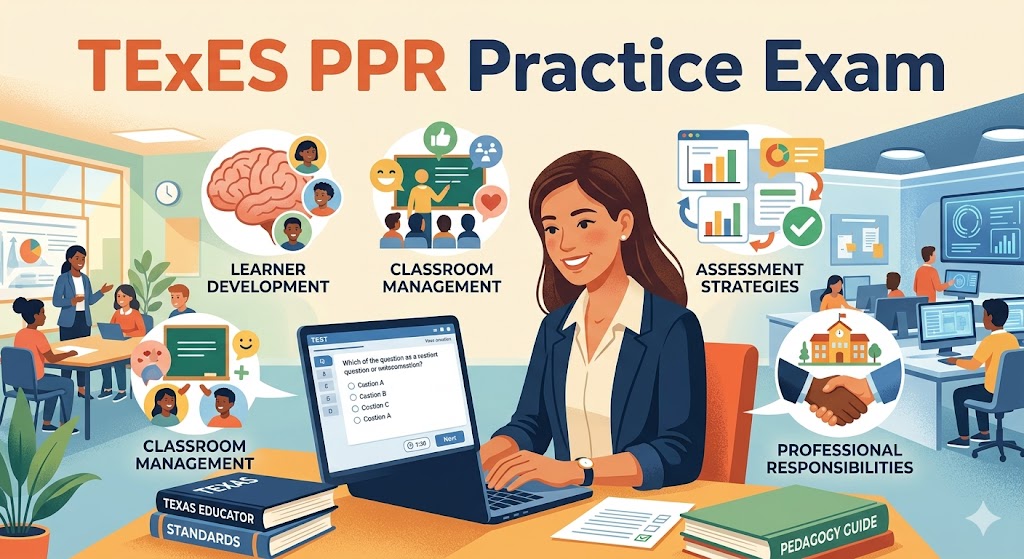
Additional Information
What the Course Entails and Exam Details
The PPR exam content is organized into four major domains, each containing specific competencies that define the knowledge and skills of a beginning teacher. These domains are designed to be relevant to all teaching fields and grade levels. The core topics and areas covered include:
Domain I: Designing Instruction and Assessment to Promote Student Learning. This domain assesses understanding of human development, student diversity, learning processes, and effective instructional design. You must know how to plan lessons that are responsive to student needs, align with state standards (TEKS), and use a variety of assessment strategies to monitor and guide learning.
Domain II: Creating a Positive, Productive Classroom Environment. This domain focuses on classroom management, physical organization, establishing high expectations for all students, and fostering a safe, respectful, and inclusive learning community. You will be tested on strategies for managing student behavior, promoting equity, and motivating learners.
Domain III: Implementing Effective, Responsive Instruction and Assessment. This area evaluates your ability to deliver engaging and developmentally appropriate instruction. It covers effective communication, the use of varied teaching methods and technology, problem-solving, critical thinking, and providing timely, constructive feedback to students.
Domain IV: Fulfilling Professional Roles and Responsibilities. This domain examines your understanding of the teacher's role within the educational system. Key topics include legal and ethical requirements, family-school relationships, professional development, and collaboration with colleagues, administration, and support staff to support student success.
What to Expect in the Final Exam
The TExES PPR EC-12 (160) exam is a criterion-referenced, Computer-Administered Test (CAT). This means you will take the test at a secure testing center using a computer. Here is a breakdown of what to expect:
Exam Format: The test consists of 100 selected-response questions (multiple-choice). While most questions stand alone, some may be arranged in clusters and based on real-world situations, including visual, audio, or scenario-based prompts.
Passing Score: To pass, you must achieve a scaled score of 240 out of 300. Your score is based on the number of questions you answer correctly; there is no penalty for guessing.
Time Limit: The entire testing session is 5 hours long. This includes 15 minutes for reading the nondisclosure agreement and a test-taking tutorial, and 4 hours and 45 minutes for actual testing.
Specific Rules: You must register in advance through the official Texas Educator Certification Examination Program website. On test day, you are required to bring two forms of valid identification, one of which must be government-issued with a photo and signature. No calculators, cell phones, or personal items are allowed in the testing room.
How to Study and Exam Centers
Effective preparation is key to success on the TExES PPR. Here are actionable study strategies and information on how to take the exam:
Actionable Study Strategies:
Understand the Competencies: Begin by thoroughly reviewing the official PPR Prep Manual. Study each domain and its associated competencies, as they provide the blueprint for all exam questions.
Use Official Practice Tests: Pearson offers full-length, interactive practice tests for a small fee ($10). These are invaluable for familiarizing yourself with the CAT interface, the types of questions, and the time limit. Treat these as diagnostic tools.
Focus on Key Concepts: Develop a deep understanding of core pedagogical theories, child and adolescent development stages, differentiated instruction, and Texas legal and ethical standards for educators. Reviewing the Texas Essential Knowledge and Skills (TEKS) can also provide context.
Create Flashcards and Study Guides: Utilize third-party study guides and online resources (e.g., 240tutoring, CertifyTeacher, Quizlet) to find practice questions, flashcards, and summary explanations.
Time Management: During your practice, learn to pace yourself so you can address all 100 questions within the time allotment. Don't linger too long on any single question.
Taking the Exam and Exam Centers:
Registration: The Texas Education Agency (TEA) contracts with Pearson to administer TExES exams. You must first create an account and register on the Texas Educator Certification Examination Program website ([www.tx.nesinc.com](https://www.tx.nesinc.com)).
Exam Locations: The PPR is administered at Pearson VUE test centers and other authorized Educator Preparation Program (EPP)-affiliated testing centers located across Texas. You will select your preferred date and location during the registration process.
Confirmation: After scheduling, you will receive a confirmation email from Pearson VUE with the date, time, and specific address of your test center.
Job Opportunities from the Course
Successfully passing the TExES PPR exam is a mandatory milestone that, along with your content area exam(s) and other EPP requirements, unlocks initial educator certification in Texas. This certification qualifies you to apply for a wide range of rewarding teaching positions within public and charter schools, including:
EC-12 Generalist Teacher
Content-Area Teacher (e.g., Mathematics, Science, English, Social Studies, 4-8 or 7-12)
Special Education Teacher (EC-12)
Bilingual Education Teacher (EC-12)
English as a Second Language (ESL) Teacher (EC-12)
Career and Technical Education (CTE) Teacher
Fine Arts Teacher (Music, Art, Theater)
Physical Education (P.E.) Teacher
Reading Specialist
Instructional Coach
Frequently Asked Questions
Reviews
5.0
Based on 0 reviews
Leave a Review
No reviews yet. Be the first to review!