
Pediatric Advanced Life Support (PALS) Instructor Practice Test
$69.00
- Buy to unlock unlimited access to all Quiz questions and Answers in this Quiz.
- After purchase you can print a PDF of the whole quiz at any point. The PDF will contain the questions and the correct answers.
About this Exam
Welcome to your comprehensive guide for the Pediatric Advanced Life Support (PALS) Instructor Practice Exam. If you are a dedicated healthcare professional already holding a current PALS Provider certification and are passionate about teaching, this course is your path to becoming an authorized PALS Instructor. This certification equips you with the advanced pedagogical skills and knowledge required to educate other healthcare providers in life-saving pediatric advanced life support techniques. Your role will be critical in shaping the skills of future life-savers, from doctors and nurses to emergency responders. This article, though structured with sections for your journey, is not the exam itself, but a powerful preparation tool. We understand that practice is essential for success, so we will highlight the importance of practice exams and other study tools in our guide. This journey will refine your understanding of PALS protocols and empower you to teach them effectively and confidently.
Ready to test your knowledge?
Buy Now to Access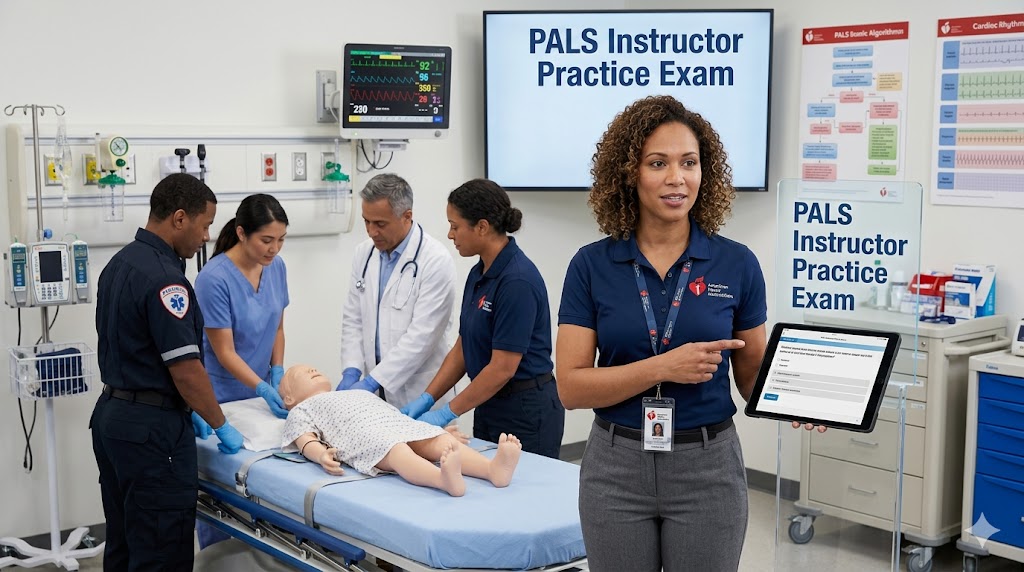
Additional Information
What the Course Entails and Exam Details
The PALS Instructor course is more than just a review of PALS Provider material. It is a comprehensive deep dive into the American Heart Association (AHA) or American Red Cross teaching methodologies. Here’s a detailed breakdown of what to expect:
Teaching Principles and Methodologies: You will master educational concepts, including different learning styles, the instruction cycle, and classroom management techniques.
PALS Algorithm Mastery: You must possess an expert-level understanding of all PALS algorithms, including bradycardia, tachycardia, cardiac arrest, and post-cardiac arrest care. The course emphasizes your ability to not just recall but to teach these complex workflows.
Skill Performance and Evaluation: A significant portion is dedicated to mastering the core skills of PALS, including advanced airway management, IO insertion, defibrillation, and team dynamics. Crucially, you will learn how to evaluate other students' performance objectively and provide constructive feedback.
Megacode Scenarios: You will lead and participate in realistic, complex team resuscitation scenarios (Megacodes). As an instructor candidate, you will be expected to critique these scenarios and facilitate debriefing sessions.
Practice and Feedback Cycle: Throughout the course, you will practice teaching lessons and skill sessions, receiving direct feedback from experienced instructors and your peers. This cycle of practice and critique is essential for your professional growth.
Administrative and Policy Understanding: You will learn the specific policies and administrative requirements of the issuing body (e.g., AHA Training Center rules, Red Cross guidelines), including course scheduling, roster submission, and keeping certifications current.
What to Expect in the Final Exam
The culmination of your PALS Instructor course is a multi-part final assessment designed to prove your readiness to teach. While specific formats can slightly vary by organization and training center, here is a general overview:
Written Examination: Expect a rigorous multiple-choice exam that tests your knowledge of both the current PALS scientific guidelines and the specific instructor course material (e.g., teaching principles, administrative policies). This test often has a high passing score requirement, commonly around 80% or 84%, reflecting the expertise required of an instructor.
Practical Skills Evaluation: You will be required to demonstrate proficiency and, more importantly, evaluate a student's performance (often a peer acting as a student) in core PALS skills and in leading a Megacode scenario. You will be assessed on your ability to spot deviations from guidelines and provide accurate feedback.
Teaching Presentation: You may be asked to present a specific PALS lesson or skill station to a small group, demonstrating your understanding of educational techniques and confidence as an instructor.
Time Limits and Specific Rules: There will be set time limits for different portions of the exam, and it must be completed individually. The practical portion emphasizes your communication skills and ability to use official evaluation tools correctly.
How to Study and Exam Centers
Preparing for the PALS Instructor certification requires a multi-pronged approach that goes beyond simply reading the course manual. Here’s how you can prepare effectively:
Utilize Practice Tests and Question Banks: One of the most effective strategies is to take multiple PALS practice exams and work through question banks. Seek out reputable sources, including official materials from your certifying body (AHA or Red Cross) and high-quality educational platforms. Treat these practice sessions seriously, analyzing both correct and incorrect answers. These will help you internalize the format and identify your knowledge gaps. We encourage you to seek out and engage with separate, formal practice tests like the one suggested in the title of this article.
Review Official Instructor Manuals: Thoroughly study the official Instructor Manual and any online pre-course work provided. These materials are your blueprint for both the scientific content and the teaching methodologies.
Form a Study Group: Collaborate with other instructor candidates to practice teaching lessons to each other, facilitate Megacode scenarios, and critique skill performance. This collaborative learning is invaluable.
Attend Hands-on Sessions: Participate actively in all required hands-on sessions. These provide crucial practice in a supported environment and help you refine your practical teaching and evaluation skills.
Review PALS Provider Material: Although you are a current provider, a complete review of the base-level PALS algorithms, medication dosages, and pediatric assessment tools is essential to ensure your knowledge is current and comprehensive.
Exam Centers and Where to Take the Exam: The entire PALS Instructor certification process, from pre-course work to the final evaluation, is usually managed through authorized training centers or schools.
American Heart Association (AHA): Complete the online PALS Instructor Essentials portion and then find an authorized AHA Training Center to complete the required in-person course and final evaluation.
American Red Cross: Complete their combined online and in-person instructor course and evaluation, often available at Red Cross chapters or authorized schools.
Authorized Training Schools: Many private and hospital-affiliated training schools are authorized by the AHA or Red Cross to conduct these courses. They usually host both the training and all necessary evaluations. Check the official websites of the AHA or Red Cross to find authorized training centers in your area.
Job Opportunities from the Course
Becoming a certified PALS Instructor opens doors to dynamic career paths and additional income opportunities within the healthcare sector. Your new credential unlocks roles that combine clinical expertise with educational leadership. Potential job opportunities include:
PALS Course Instructor (Contract or Staff)
Lead PALS Instructor/Faculty Member
CPR and First Aid Educator (with additional certifications)
Continuing Education Coordinator for Healthcare Professionals
Curriculum Development Specialist (for medical simulation or life support training)
Medical Simulation Center Instructor
Faculty at Nursing and Paramedic Schools
Lead Instructor at Authorized Training Centers
In-house Life Support Educator at hospitals or clinics
AHA/Red Cross Faculty Member (Conducting instructor-level training)
Frequently Asked Questions
Reviews
5.0
Based on 0 reviews
Leave a Review
No reviews yet. Be the first to review!