
Pediatrics Developmental Milestones Practice Test
$69.00
- Buy to unlock unlimited access to all Quiz questions and Answers in this Quiz.
- After purchase you can print a PDF of the whole quiz at any point. The PDF will contain the questions and the correct answers.
About this Exam
The Pediatric Developmental Milestones Practice Exam is a powerful tool meticulously designed for healthcare professionals, students, and childcare specialists dedicated to child development. This comprehensive practice test is your strategic companion for mastering the critical skills and knowledge required in the vital field of pediatrics. Whether you are a medical student specializing in pediatrics, a nurse practitioner, a registered nurse, an early childhood educator, or a developmental specialist, this practice exam offers a deep-dive opportunity to validate and enhance your ability to accurately assess child growth and milestones from infancy through early childhood. It serves as an essential preparation step for formal certifications, ensuring you are confident and capable in real-world professional scenarios.
Ready to test your knowledge?
Buy Now to Access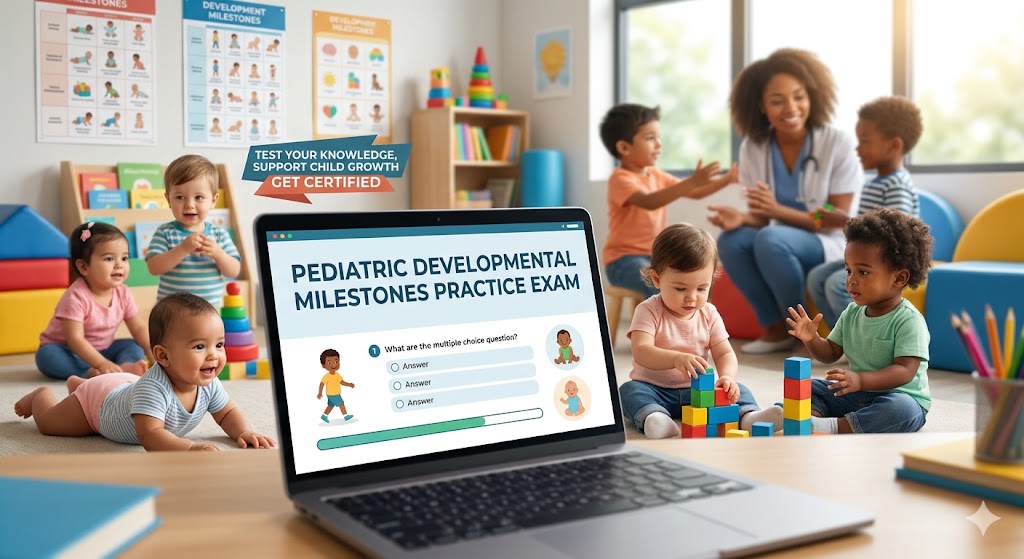
Additional Information
What the Course Entails and Exam Details
This specialized practice exam is constructed to mirror the rigorous content and structure of professional-level certification tests. It covers all essential developmental domains to provide a thorough assessment of your knowledge. The practice course and subsequent exam details encompass:
Gross Motor Skills: Comprehensive questions on foundational movements like lifting the head, rolling, sitting, crawling, walking, as well as complex actions like running, jumping, and balancing at different ages.
Fine Motor Skills: Assessment of dexterity, from early grasping and manipulating objects to refined skills like drawing, writing, and dressing.
Language and Communication: Focus on receptive and expressive language development, including vocalizations, understanding words, forming phrases, and clear speech progression.
Cognitive Development: Evaluation of problem-solving skills, memory, imaginative play, cause and effect, object permanence, and understanding concepts like shapes, colors, and numbers.
Social and Emotional Development: Coverage of social interactions, emotional expression, attachment formation, self-regulation, empathy, and early relationships.
Age-Specific Milestones & Timelines: Detailed knowledge of expected milestones at crucial age intervals (neonate, 1 month, 3 months, 6 months, 9 months, 1 year, 18 months, 2 years, 3 years, 4 years, and beyond).
Assessment & Red Flags: Recognition of typical progression, subtle delays, critical warning signs (red flags) requiring immediate professional evaluation, and standard assessment methods.
What to Expect in the Final Exam
While the exact final certification exam can vary, you can generally anticipate the following structure, which this practice exam accurately simulates:
Format: The final exam typically consists of a set number (often 100 or more) of high-quality, computer-administered multiple-choice questions. These questions may incorporate realistic clinical vignettes, pediatric scenarios, and illustrative images (e.g., developmental posters, patient photographs) to test practical application.
Passing Score: Most professional certifications require a minimum score in the range of 70% to 80% to demonstrate proficiency.
Time Limit: Expect a strict time limit (e.g., 90 minutes to 2 hours) to simulate real-world time pressure. Efficient time management is crucial.
Rules: Standard examination procedures apply, including valid ID verification and a secure, proctored environment for physical or online testing. No external resources are permitted during the actual final test.
How to Study and Exam Centers
Effective preparation is key to your success. Here are actionable study strategies and information on where to take the formal exam:
Strategic Study Methods:
Active Recall & Flashcards: Actively test your knowledge with flashcards mapping specific milestones to precise ages. Repeated active recall strengthens memory.
Study Guides & Textbook Review: Dig deep into official study materials, pediatric nursing or developmental textbooks, and credible online resources. Pay attention to charts, illustrations, and comprehensive milestone lists.
Study Groups: Collaborate with peers, quiz each other on detailed scenarios, and discuss complex cases to broaden your perspective.
Simulation & Observation: If possible, observe children of different ages in professional or supervised settings, practicing your assessment skills (respecting privacy and professional guidelines).
Use This Practice Exam: This is your primary resource. Take it multiple times to:
Familiarize yourself with the question types and difficulty level.
Practice managing your time under simulation.
Review detailed explanations for both correct and incorrect answers to reinforce your learning and identify critical knowledge gaps.
Finding Exam Centers:
Formal certification exams are administered through recognized professional organizations and credible testing providers. Here’s how you generally find exam centers and procedures:
Certified Bodies: The specific organization offering the certification (e.g., nursing boards, pediatric associations, child development institutes) will provide details on exam registration and testing procedures on their official website.
Online Portals: Many contemporary certifications use secure online testing portals, allowing you to take the proctored exam remotely from a suitable computer and location, after verification.
Authorized Testing Centers: Large established testing services like Pearson VUE, Prometric, or organization-specific centers provide secure physical locations with standard testing conditions across various cities.
Educational Institutions: Some university or specialized programs might be authorized to administer exams for their students or affiliated professionals. Always check directly with the certifying entity for the latest, accurate exam delivery information.
Job Opportunities from the Course
A strong command of pediatric developmental milestones is incredibly valuable across numerous fulfilling career paths, providing essential skills for assessing children and advising families:
Pediatric Nurse Practitioner (PNP): Advanced nursing role requiring deep knowledge to diagnose and treat pediatric patients.
Registered Nurse (RN) - Pediatrics / Child Health: Provides essential care, conducts initial assessments, and educates families on child health and development.
Certified Childcare Provider / Director: Vital expertise for ensuring optimal development in early childhood education settings and supervising staff.
Early Childhood Educator (Preschool Teacher, Special Education Teacher): Informs effective teaching strategies and allows for early identification of developmental needs.
Developmental Therapist: Specializes in identifying and supporting children with developmental delays through therapy and intervention programs.
Family Support Specialist / Case Manager: Helps families navigate resources and support systems based on a comprehensive understanding of children's needs.
Healthcare Administrator (Pediatric Focus): Management role overseeing pediatric services, benefiting from a foundational clinical understanding.
Child Development Researcher: A deep knowledge base to contribute to the field's ongoing research into early child growth and development.
Parent Educator / Developmental Coach: Professionals who educate and support parents on nurturing their child’s unique developmental journey.
Frequently Asked Questions
Reviews
5.0
Based on 0 reviews
Leave a Review
No reviews yet. Be the first to review!