
Pedorthic Certificate Program Practice Exam
$69.00
- Buy to unlock unlimited access to all Quiz questions and Answers in this Quiz.
- After purchase you can print a PDF of the whole quiz at any point. The PDF will contain the questions and the correct answers.
About this Exam
The Pedorthic Certificate Program is a specialized educational pathway designed for allied health professionals aiming to become Certified Pedorthists (C. Ped.). A pedorthist is an expert trained in the management of comprehensive pedorthic patient care, which involves the design, manufacture, fitting, modification, and repair of shoes and foot orthoses to alleviate painful or disabling conditions of the foot and ankle.
This practice exam is specifically curated for students who have completed their pre-certification coursework from an authorized school and are preparing for the final hurdle: the national certification exam, typically administered by the American Board for Certification in Orthotics, Prosthetics & Pedorthics (ABC). It serves as a vital diagnostic tool, mirroring the structure and content of the real test to build competence and confidence.
Ready to test your knowledge?
Buy Now to Access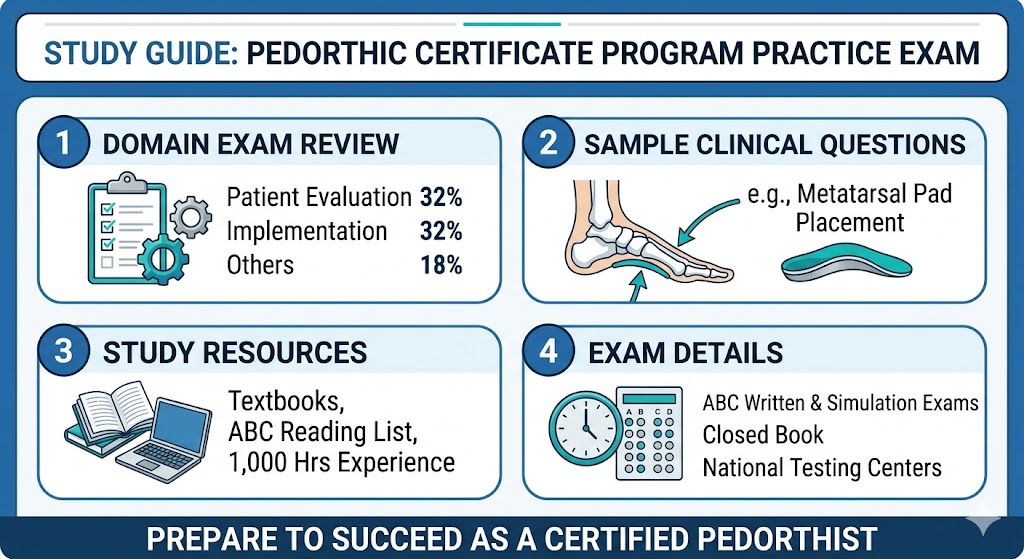
Additional Information
WHAT THE COURSE ENTAILS AND EXAM DETAILS
The core pedorthic pre-certification course provides a deep dive into the following domains of practice. The practice exam covers these areas comprehensively:
Patient Evaluation (32%): Includes reviewing prescriptions, taking comprehensive histories, performing biomechanical evaluations, assessing range of motion, muscle strength, gait analysis, skin integrity, and sensation.
Formulation of the Treatment Plan (19%): Developing a diagnosis-specific plan that incorporates appropriate pedorthic devices, such as custom-molded shoes, foot orthoses (prefabricated or custom), and subtalar control foot orthoses (SCFO).
Implementation of the Treatment Plan (32%): The practical application—designing, fabricating, fitting, and modifying devices. This includes expertise in shoe construction theory, fitting techniques (using tools like the Brannock device), and material science for diabetic and geriatric foot care.
Continuation of the Treatment Plan (12%): Providing follow-up care, assessing device efficacy, and adjusting treatment as the patient's condition changes.
Practice Management (5%): Familiarity with federal and state regulations, professional responsibility, the code of ethics, and documentation standards.
The national exam typically consists of two main components: a written examination and a simulation/practical examination. The Written Exam uses multiple-choice questions to test your theoretical knowledge across the domains listed above. The Simulation Exam is a computer-based component that uses a variety of interactive questions to assess your clinical decision-making skills.
WHAT TO EXPECT IN THE FINAL EXAM
The national Pedorthist certification exam is rigorous and designed to ensure you can practice independently and safely. While exact details can vary by year and testing body (ABC or BOC), the following are standard guidelines for the American Board for Certification (ABC) Pedorthist Exam:
Format: The primary test is a multiple-choice written exam. This is followed by a clinical simulation exam.
Time Limit: You are typically given a generous window (e.g., several hours) to complete the written portion, allowing time for careful analysis of clinical scenarios. The clinical simulation has separate time constraints per scenario.
Passing Score: The exam is criteria-referenced, meaning the passing score is determined by a panel of experts who evaluate the difficulty of the questions. Scores are typically reported on a scaled range.
Rules: The exam is closed-book. You must complete an authorized pre-certification education program and, for ABC certification, accumulate 1,000 hours of directed pedorthic patient care experience before you can sit for the exam.
A typical question on the written exam might ask about the correct placement of a metatarsal pad, the normal range of motion for the ankle during gait, or the appropriate goal of treatment for a patient with diabetic neuropathy.
HOW TO STUDY AND EXAM CENTERS
Preparation is the key to success. This practice exam is your starting point, not your end point. Here is an actionable strategy:
Utilize the Test Content Outline: Focus your study time proportionally based on the weighting of each domain. (e.g., Patient Evaluation and Implementation are the largest sections).
Review Core Textbooks and Reading Lists: Go back to the specific texts used in your authorized pre-certification course. ABC provides an official reference list.
Use Practice Exams as Diagnostic Tools: Take this practice exam under timed conditions. Then, analyze your incorrect answers to identify weak areas. Don’t just memorize answers; understand the rationales.
Hands-on Experience is Crucial: Leverage your 1,000 hours of clinical experience. Connect theoretical concepts (like "posterior tibial tendonitis") with the patients you have seen and the devices you have fabricated for them.
Exam Centers: The national certification exams are usually not taken at your school. Instead, they are administered at secure, computer-based testing (CBT) centers nationwide, such as Prometric or Pearson VUE. You will register with the certifying board (ABC or BOC), pay the required fees, and then receive authorization to schedule your test at a location convenient for you. Online proctoring may be an option for some written components.
JOB OPPORTUNITIES FROM THE COURSE
Earning your C. Ped. credential unlocks a range of rewarding career paths. With a growing aging population and increased awareness of diabetic foot care, the demand for pedorthic expertise is on the rise. Certified Pedorthists work in varied settings, including private practices, specialized shoe stores, hospitals, rehabilitation centers, and medical product manufacturing companies.
Specific job titles and career paths this certification unlocks include:
Certified Pedorthist (C. Ped.) in Private Practice
Footwear and Orthosis Fabrication Specialist
Orthotic Fitter (often requiring a brief supplementary course)
Therapeutic Shoe Fitter
Medical Sales Representative (Footcare and Orthotics)
Orthotic technician (Manufacturing)
Clinic Manager or Pedorthic Department Lead
Specialist in the Care of the Diabetic Foot
Frequently Asked Questions
Reviews
5.0
Based on 0 reviews
Leave a Review
No reviews yet. Be the first to review!