
Penn Foster Anesthesia Practice Exam
$69.00
- Buy to unlock unlimited access to all Quiz questions and Answers in this Quiz.
- After purchase you can print a PDF of the whole quiz at any point. The PDF will contain the questions and the correct answers.
About this Exam
The Penn Foster Anesthesia Practice Exam is a crucial, expertly designed preparatory tool created for students enrolled in the Penn Foster Veterinary Technician Associate Degree program and related veterinary specializations. Mastering veterinary anesthesia is a cornerstone of professional practice, and this exam is specifically structured to help aspiring veterinary technicians and veterinary assistants build the knowledge, confidence, and speed required to excel in this highly technical field.
This practice test is not a stand-alone certification but serves as a vital bridge, allowing students to gauge their understanding of complex concepts before attempting their final proctored examination. By using this resource, students can simulate the official testing experience, identify areas for improvement, and significantly enhance their chances of success on their path to becoming credentialed veterinary professionals. It is the ultimate checkpoint for anyone seeking to comfortably navigate the nuances of patient care and safety under anesthesia.
Ready to test your knowledge?
Buy Now to Access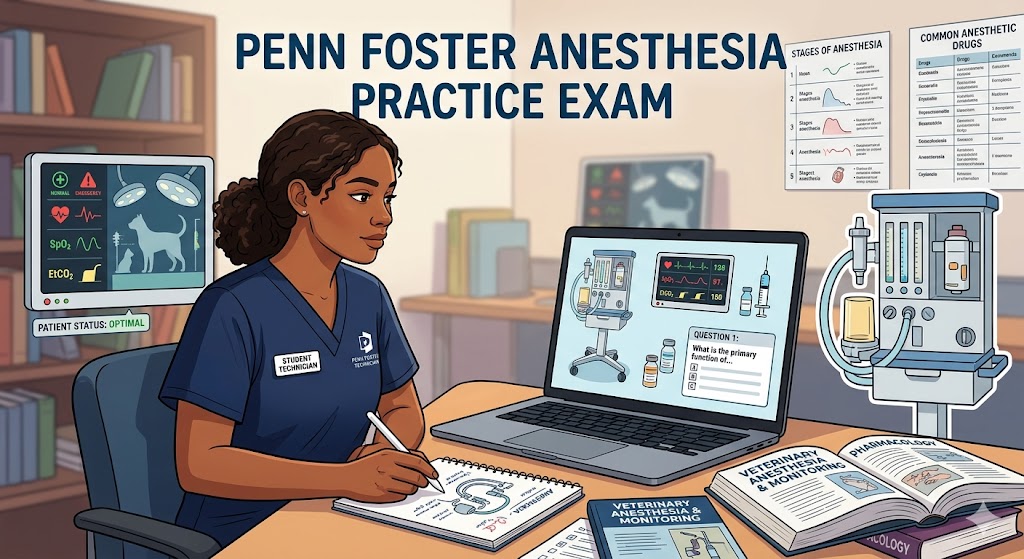
Additional Information
What the Course Entails and Exam Details
Penn Foster’s anesthesia course provides a comprehensive deep dive into all aspects of the anesthesiology process within a veterinary setting. The curriculum covers foundational principles, equipment mastery, pharmacological applications, patient management throughout all phases, and critical safety protocols. The core areas covered, which are also reflected in the structure of the practice exam, include:
Anesthesia Principles & Physiology: Understanding the mechanisms of different anesthetic states, effects on vital organ systems, and relevant physiological processes.
Equipment Set-up and Monitoring: Mastering the operation of anesthesia machines, vaporizers, breathing systems, intubation equipment, and advanced monitoring devices (ECG, pulse oximetry, capnography, blood pressure).
Pharmacology of Anesthetics and Adjuncts: In-depth knowledge of various drug classes (pre-anesthetics, induction agents, inhalants, analgesics, muscle relaxants), dosages, routes of administration, and adverse effects.
Patient Evaluation & Preparation: Procedures for thorough pre-anesthetic assessments, patient stabilization, protocol development, and owner communication.
Phases of Anesthesia: Detailed study and practice protocols for induction, maintenance, monitoring, and the critical recovery phase.
Emergency Procedures and Complications: Recognizing and managing anesthetic emergencies, trouble-shooting equipment, and responding to unexpected patient reactions.
Safety and Regulations: Understanding workplace safety, waste gas management, and legal/ethical considerations in veterinary anesthesiology.
The specific "Practice Exam" typically mirrors the format of the official proctored test, which is likely part of the larger Veterinary Technician course. For the actual official course final, students can expect a proctored, online examination. Details for the official final typically include:
Format: Proctored, primarily multiple-choice questions, accessible via the Penn Foster student portal. A practical component might be included in externship requirements but not generally the written/online final on this topic.
Passing Score: Students should strive for a high level of proficiency. The passing score for individual courses or semesters within the Vet Tech program can vary, but generally hovers around the 70% mark for successful completion. (It is essential to check specific program guidelines).
Time Limit: Similar to the practice exam and in line with distance learning standards, a specific time limit (typically around 1.5 to 2 hours for the course-specific final) will be imposed for the official proctored test to ensure focus and time management.
What to Expect in the Final Exam
While the practice exam is an invaluable simulation tool, it's important to understand the typical requirements of the official, final, proctored Penn Foster Anesthesia course exam to ensure you are fully prepared:
Secure Proctored Setting: The final, official exam on this critical topic will be proctored to ensure integrity. For Penn Foster programs, this is typically done online using secure proctoring software, meaning you will take the exam from your computer under virtual supervision.
Comprehensive Assessment: Expect questions to cover the entirety of the anesthesia curriculum with a strong emphasis on clinical application and critical thinking, not just rote memorization. You may be presented with scenario-based questions requiring you to formulate plans or identify complications.
Strict Time Constraints: Time management skills are essential. You must complete the set number of questions within the allocated time limit. The practice exam helps you build this pace.
Passing Requirement: You must achieve a score at or above the program’s required passing threshold (typically 70% or higher) in this specific course to successfully progress towards your diploma or degree.
Externship Component: The Penn Foster Vet Tech program also requires externships where practical, hands-on skills—including assisting with anesthesia and surgical monitoring—are assessed in a real veterinary hospital. The online anesthesia exam tests the theoretical and critical knowledge that supports these practical skills.
How to Study and Exam Centers
Successfully preparing for the Penn Foster Anesthesia final exam requires a structured, multi-faceted approach. Your path to mastery should involve:
Diligent Review of Penn Foster Materials: Thoroughly study all course modules, textbooks, and supplemental materials provided in your Penn Foster portal. Take detailed notes and create summary sheets.
Active Learning with Practice Exams: The Penn Foster Anesthesia Practice Exam is not just for assessment—it is a learning tool! Take the practice exam early and often.
Review every incorrect answer: Understand why you got it wrong.
Review correct answers too: Confirm that you understood the reasoning, not just made a lucky guess.
Simulate exam conditions by taking full-length, timed practice tests without notes to build stamina and identify your true knowledge baseline.
Flashcards and Memorization: Create flashcards for critical information: drug names, dosages, equipment functions, monitoring parameters (normal ranges for different species), and stages/planes of anesthesia. Spaced repetition is your best friend.
Study Groups and Peer Discussion: Engage with fellow students through Penn Foster discussion boards or create online study groups. Explaining concepts to others is one of the most effective ways to solidify your own understanding.
Consistent Study Schedule: Dedicate specific, consistent times each week to studying for this course, prioritizing it alongside other curriculum components.
Visual Aids and Diagrams: Draw and label anesthesia machines, breathing circuits, and monitoring diagrams to build strong visual models of the equipment and processes.
Exam Access & Location:
Practice Exam: The Practice Exam itself is an online resource typically integrated directly into your course content on the Penn Foster Student Portal. You can access it anytime, from any computer with an internet connection, making it highly flexible.
Official Final Exam: The official, final, proctored exam is also primarily completed online. You do not need to travel to a physical Pearson VUE center for a typical course-specific proctored exam. Penn Foster utilizes secure online proctoring services, allowing you to take the exam remotely while being monitored via webcam and microphone to maintain academic integrity. All specific instructions on how to schedule and access this proctored exam will be provided within your Penn Foster account when you become eligible.
Job Opportunities from the Course
Upon completion of this course and the broader Penn Foster program, and after achieving relevant state licensure (which typically requires passing the Veterinary Technician National Exam - VTNE), diverse and rewarding career paths with specialized anesthesia knowledge become accessible. While not exhaustive, potential job titles and specializations include:
Veterinary Technician
Anesthesia Veterinary Technician
Surgical Veterinary Technician
Emergency and Critical Care Veterinary Technician
Exotics/Zoo Animal Technician
Veterinary Technologist (requires further education, but this course is a foundation)
Equine/Large Animal Technician (with potential large animal anesthesia specialization)
Research Technician in facilities requiring anesthesia knowledge
Frequently Asked Questions
Reviews
5.0
Based on 0 reviews
Leave a Review
No reviews yet. Be the first to review!