
Penn Foster Radiology Proctor Practice Test
$69.00
- Buy to unlock unlimited access to all Quiz questions and Answers in this Quiz.
- After purchase you can print a PDF of the whole quiz at any point. The PDF will contain the questions and the correct answers.
About this Exam
Welcome to your essential resource for conquering the Penn Foster Radiology proctored exam. This final assessment is a critical component of Penn Foster’s healthcare-focused career programs, most notably within the Veterinary Assistant Career Diploma and the Veterinary Technician Associate Degree.
It is designed for aspiring allied health professionals, particularly those training to support veterinary teams, who need to prove their competence in medical imaging.
Successfully passing this proctored exam demonstrates your foundational understanding of radiographic principles, equipment operation, and, crucially, the safety protocols required to work in a clinical environment. For many students, this test represents the transition from academic learning to professional practice in veterinary medicine.
Ready to test your knowledge?
Buy Now to Access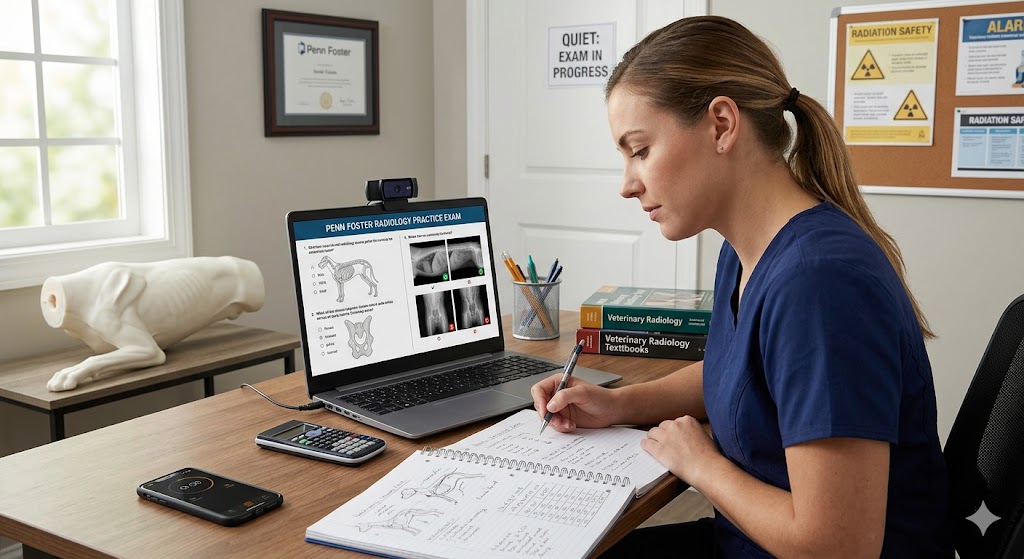
Additional Information
What the Course Entails and Exam Details
This comprehensive practice tool prepares you for the final, comprehensive proctored exam of your radiology course.
The core syllabus and skills covered within the program include:
Introduction to Radiology: History of X-rays, the science of electromagnetic radiation, and the properties of X-ray beams.
X-Ray Production: Components of the X-ray tube (anode and cathode), x-ray machine circuitry, and the function of the control panel (kVp, mA, time settings).
Radiation Safety: The biological effects of radiation, principles of ALARA (As Low As Reasonably Achievable), personal protective equipment (PPE), and legal safety regulations.
Radiographic Technique: Factors affecting image quality (density, contrast, detail), calculating exposure settings, and using technique charts.
Image Processing: From traditional film (darkroom procedures, chemical processing) to modern digital radiography (CR and DR systems, PACS).
Radiographic Positioning: Comprehensive training on how to position small animals, large animals, avians, and exotics for specific views (e.g., ventrodorsal, dorsoventral, lateral, cranial, caudal, and dental radiographs).
Quality Control and Troubleshooting: Identifying artifacts, performing equipment checks, and ensuring diagnostic quality images.
Contrast Media: Types and applications of contrast agents for specialized studies (e.g., barium enemas, IVPs).
What to Expect in the Final Exam
The actual final exam is a proctored assessment, meaning a neutral third party must supervise your testing session to verify your identity and ensure academic integrity. Here is what you need to prepare for:
Exam Format: The exam typically consists of multiple-choice questions. These questions test both your theoretical knowledge and your ability to apply concepts to clinical scenarios, such as interpreting an image artifact or determining the correct setting.
Passing Score: The required passing score can vary slightly by program. For many career programs, a minimum of 65–70% is required, but it’s crucial to check your specific Penn Foster Student Handbook for the precise threshold for your course.
Time Limit: You will be allocated a specific time frame, often between 60 to 90 minutes, to complete the exam. Once you start, you cannot pause the timer.
Proctoring Requirements: You must arrange for a proctor. Penn Foster offers a convenient online virtual proctoring option (often through services like Examity) using your webcam, but you also have the option to nominate an eligible in-person proctor (e.g., a professional educator or librarian) to oversee you at a physical location.
How to Study and Exam Centers
Preparation is the key to confidence. While this practice test is a vital tool, a holistic study plan is essential for success:
Leverage the Practice Test: Use this Penn Foster Radiology Proctor Practice Test multiple times. Do not just look for correct answers; understand why each answer is correct and why the alternatives are incorrect. This simulates the critical thinking needed for the final exam.
Complete All Course Assignments: Review every lesson, quiz, and project in your Penn Foster learning portal. Do not skip any material.
Create Flashcards: Flashcards are powerful for memorizing key terms, equations, normal anatomical landmarks, and, critically, the various positions for common radiographic views.
Teach the Material: Explaining complex concepts, like the mechanism of X-ray production or radiation safety measures, to someone else is an excellent way to solidify your own understanding.
Where to Take the Exam: The vast majority of Penn Foster students take their proctored exam from the comfort of their home using Penn Foster's authorized online proctoring service. This requires a reliable internet connection and a webcam. Alternatively, you can choose to take the exam in person by coordinating with an approved proctor at a location like a library or a local testing center. Students do not need to visit a dedicated Pearson VUE center for this specific exam.
Job Opportunities from the Course
Upon completion of your full Penn Foster program, this radiology expertise becomes a foundation for numerous rewarding career paths in the veterinary field. The comprehensive knowledge of radiology you demonstrate prepares you for roles such as:
Veterinary Assistant in a companion animal hospital, specialized clinic, or emergency center.
Veterinary Technician (requires full Associate Degree completion and passing the VTNE).
Veterinary Radiology Assistant specializing in supporting the imaging team.
Lab Animal Caretaker utilizing imaging within research facilities.
Veterinary Orthopedic Assistant.
Shelter Medicine Assistant.
Wildlife Rehabilitation Assistant working with injured exotic species.
Frequently Asked Questions
Reviews
5.0
Based on 0 reviews
Leave a Review
No reviews yet. Be the first to review!