
Pennsylvania DOH Basic Vehicle Rescue Practice Exam
$69.00
- Buy to unlock unlimited access to all Quiz questions and Answers in this Quiz.
- After purchase you can print a PDF of the whole quiz at any point. The PDF will contain the questions and the correct answers.
About this Exam
The [Pennsylvania DOH Basic Vehicle Rescue Practice Exam] serves as a critical step for Pennsylvania’s dedicated first responders, including fire, rescue, and emergency medical services (EMS) personnel, seeking certification in essential vehicle rescue operations. This comprehensive program, developed by the Pennsylvania Department of Health (DOH) in coordination with the Pennsylvania State Fire Academy (PSFA), provides individuals with the specialized knowledge and practical skills required to safely and effectively disentangle and extricate patients from vehicles involved in accidents. The certification focuses on prioritizing scene safety, minimizing patient harm during the rescue process, and facilitating the rapid, controlled delivery of pre-hospital emergency medical care. It is designed for personnel who are first to arrive on a scene and must operate as part of a technical rescue team.
Ready to test your knowledge?
Buy Now to Access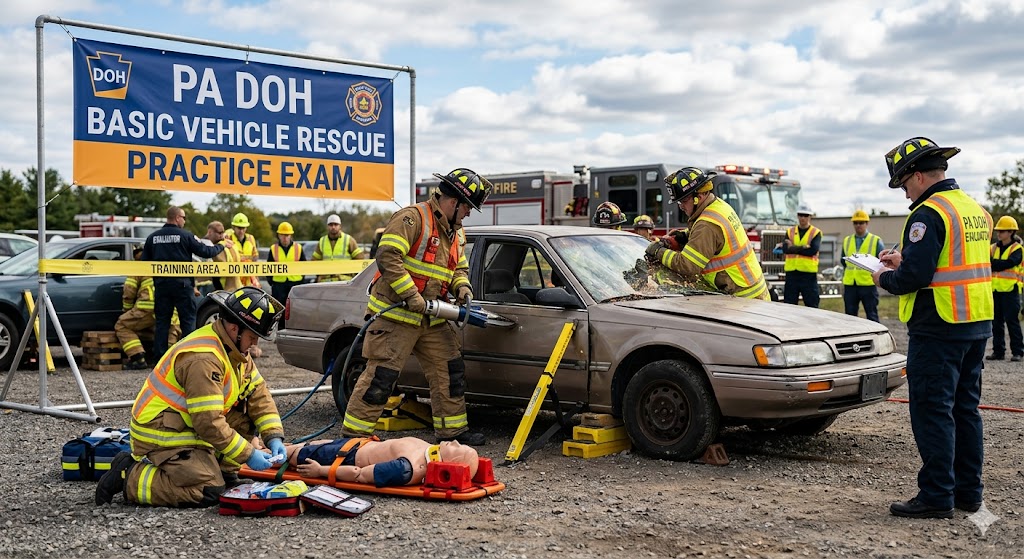
Additional Information
What the Course Entails and Exam Details
A Pennsylvania DOH Basic Vehicle Rescue course is typically an intensive program, often lasting 48 hours, balancing classroom instruction with significant hands-on, field practice. The course syllabus is standardized across the state and covers a wide range of critical technical and tactical skills. Candidates for certification will become proficient in:
Scene Safety and Management: Assessing hazards, establishing incident command, and securing the rescue area.
Vehicle Anatomy and Construction: Understanding the structural components, materials, and safety systems (like airbags) of modern passenger vehicles to inform rescue strategies.
Stabilization: Employing a variety of techniques, including cribbing, struts, and step chocks, to prevent movement of an unstable vehicle on all types of terrain and in various orientations.
Tool Operations: Mastering the safe and efficient use of essential vehicle rescue equipment, including hand tools, pneumatic systems, and powerful hydraulic rescue tools (often referred to as the "Jaws of Life") for cutting, spreading, and ramming.
Patient Access and Disentanglement: Identifying and executing various techniques to create access to entrapped patients, such as door removal, roof removal, and dashboard displacement (dash rolls).
Patient Care and Packaging: Simulating the stabilization and removal of injured individuals while maintaining essential medical protocols, like cervical spine mobilization, during the entire extrication process.
What to Expect in the Final Exam
The final certification exam for the PA DOH Basic Vehicle Rescue program is a two-part evaluation, consisting of a cognitive (written) examination and a psychomotor (practical) skills evaluation. This "Joint Rescue Program" format ensures that a certified individual possesses both the foundational knowledge and the physical competence to perform lifesaving tasks on a real-world scene.
The Written Examination:
Format: A multiple-choice test.
Number of Questions: Typically consists of 100 questions.
Content: Questions are derived directly from the standard Pennsylvania Basic Vehicle Rescue curriculum and text, covering safety protocols, tool application, vehicle structures, and disentanglement logic.
Passing Score: While specific passing thresholds can be set by the testing authority and may be subject to change, a score of at least 70% or 80% is often required to demonstrate proficiency.
Time Limit: Candidates are usually provided a generous time limit, such as 1 to 2 hours, to complete the written component.
The Practical Skills Evaluation:
Format: A hands-on test conducted in a controlled field environment.
Skill Stations: Candidates are required to successfully demonstrate specific extrication and stabilization techniques at multiple stations, including, but not limited to, using cribbing for primary stabilization, performing a door removal, and operating a hydraulic spreader.
Passing Criteria: This part is evaluated on a pass/fail basis. Candidates must complete all mandatory skills without critical failures to pass.
Evaluators: Evaluations are conducted by PA DOH-certified instructors and evaluators who use standardized checklists to ensure consistency.
How to Study and Exam Centers
Preparation is the key to success in the PA DOH Basic Vehicle Rescue exam. Active participation in an approved 48-hour course is mandatory and provides the vast majority of required learning. However, students should go beyond just attendance. Here are effective study and practice strategies:
Study Strategies:
Master the Textbook: Diligently study the official “Pennsylvania Basic Vehicle Rescue” text. Every question on the written exam will be sourced from this material.
Use Practice Exams: Maximize your use of the [Pennsylvania DOH Basic Vehicle Rescue Practice Exam]. Practice exams help to familiarize you with the multiple-choice format and identify areas where your knowledge needs reinforcement. Look for realistic, up-to-date practice material.
Focus on Key Terms and Concepts: Pay close attention to definitions, safety checklists, and operational sequences (e.g., stabilization comes before cutting).
Visual and Actionable Learning: Many people learn by doing. For practical skills, mentally and physically rehearse the steps for each technique (cribbing, cutting, spreading) until the motion becomes second nature. Utilize visual aids or videos to reinforce correct form.
Work as a Team: Practical scenarios require team coordination. Practice communicating effectively and efficiently with your crew.
Exam Centers and Registration:
Course-Based Testing: Unlike national registry exams taken at third-party test centers, the PA DOH Basic Vehicle Rescue examination is administered at the conclusion of the approved training course. It is not an "on-demand" test you take at a place like Pearson VUE.
Authorized Sites: The exam will be given at an authorized training facility. This could be a regional fire school, a community college with a public safety program, or a dedicated training center. Your course instructor will guide you on the specific logistics for the final day, which will serve as your testing event.
Prerequisites: Ensure you have met all course requirements, including attendance and minimum age, before the test day.
Job Opportunities from the Course
Earning the PA DOH Basic Vehicle Rescue certification is a valuable credential that enhances employability and opens diverse career paths in public safety. In Pennsylvania, this certification is often a required or highly preferred qualification for numerous roles. Examples include:
Career Firefighter: Professional fire departments universally require vehicle rescue certification to operate on rescue engines or heavy rescue squads.
Volunteer Firefighter: Most volunteer fire companies in PA consider basic vehicle rescue knowledge essential for their operational members.
Emergency Medical Technician (EMT): An EMT with this certification can significantly contribute to safe patient management during extrication and move into specialized rescue medic roles.
Paramedic: Like EMTs, paramedics use this certification to gain advanced skills and better manage complex technical rescue scenes.
Rescue Specialist: Dedicated rescue units in both public and private sectors (such as industrial rescue teams or private ambulance services) look for this standard of certification.
Emergency Management Personnel: Individuals involved in incident response coordination can benefit from this hands-on understanding of field operations.
Law Enforcement: Certain specialized police units, like tactical or highway patrol rescue teams, may find this certification necessary.
Frequently Asked Questions
Reviews
5.0
Based on 0 reviews
Leave a Review
No reviews yet. Be the first to review!