
Pennsylvania DOT Driver’s License Knowledge Practice Test
$69.00
- Buy to unlock unlimited access to all Quiz questions and Answers in this Quiz.
- After purchase you can print a PDF of the whole quiz at any point. The PDF will contain the questions and the correct answers.
About this Exam
The Pennsylvania DOT Driver’s License Knowledge Practice Test is an essential stepping stone for any aspiring driver in the Keystone State. This exam is specifically designed for new drivers, including teenagers applying for their learner’s permit and adults seeking their first driver’s license.
Its primary purpose is to ensure that you possess a thorough understanding of Pennsylvania’s traffic laws, road signs, and safe driving practices before you get behind the wheel for your practical training. Passing this exam demonstrates you have the foundational knowledge necessary to begin learning to drive safely on public roads.
Ready to test your knowledge?
Buy Now to Access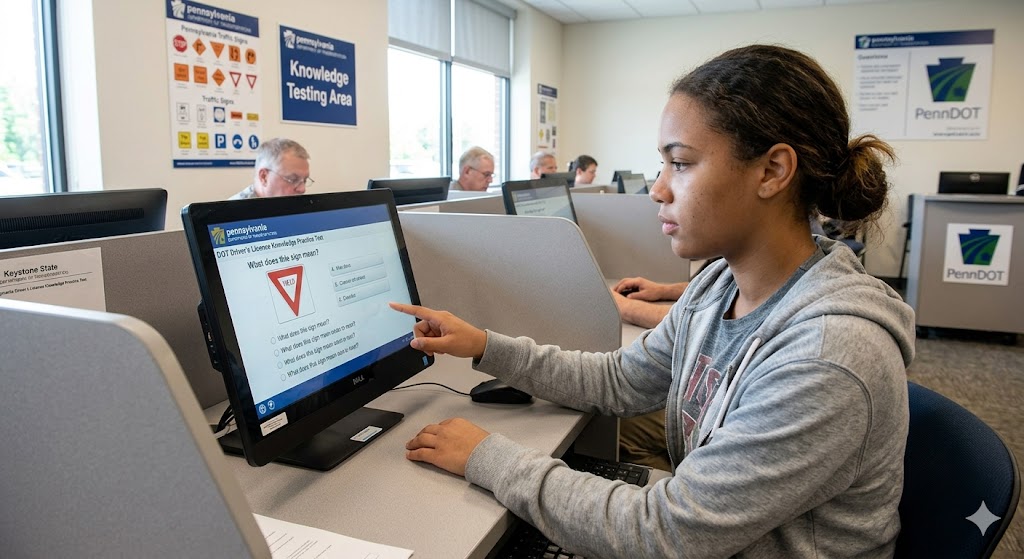
Additional Information
What the Course Entails and Exam Details
While not a formal "course" with lectures, preparation for this exam involves a comprehensive study of the official Pennsylvania Driver’s Manual. You must master a wide range of topics that are critical for safe and lawful driving.
The exam details and core syllabus include:
Pennsylvania Traffic Laws: Understanding right-of-way rules, speed limits in different zones, signaling requirements, and laws regarding turning and passing.
Road Signs and Markings: Identifying and interpreting standard regulatory, warning, and informational signs, as well as pavement markings.
Safe Driving Practices: Learning defensive driving techniques, maintaining safe following distances, and handling various driving conditions (e.g., night driving, bad weather).
Sharing the Road: Knowledge of rules for interacting safely with pedestrians, cyclists, motorcyclists, and large commercial vehicles.
DUI Laws and Substance Abuse: Understanding the legal and safety consequences of driving under the influence of alcohol or drugs in Pennsylvania.
Licensing Procedures: Familiarity with the steps to obtain a learner’s permit, junior license, and unrestricted license.
The official knowledge exam is administered directly by the Pennsylvania Department of Transportation (PennDOT).
What to Expect in the Final Exam
Knowing what to expect can significantly reduce test-day anxiety. The Pennsylvania knowledge exam is a theory-based test administered via a computer touchscreen.
Here are the specific details of the final exam format:
Format: The exam consists of multiple-choice questions. These questions are drawn directly from the information provided in the PA Driver’s Manual.
Number of Questions: There are typically 18 questions on the exam.
Passing Score: To pass, you must correctly answer at least 15 out of the 18 questions (a score of roughly 83%).
Time Limit: There is no official time limit for the exam; you can take the time you need to read each question carefully. However, most applicants finish within 20-30 minutes.
Language Options: The exam is available in English, Spanish, and several other languages.
Specific Rules: You are not permitted to use the Driver’s Manual, notes, or any electronic devices during the test.
How to Study and Exam Centers
Effective study habits are the key to passing the knowledge test on your first attempt. Relying solely on general knowledge is often insufficient.
Here are actionable study strategies and official testing information:
How to Study
Thoroughly Read the PA Driver’s Manual: This is your most important resource. The actual exam is based entirely on this document. Read it multiple times.
Use Practice Tests: Taking multiple online Pennsylvania-specific practice tests (like the one this guide supports) is crucial. They familiarize you with the question format and help identify areas where you need more study.
Focus on Road Signs: Use flashcards or dedicated online tools to memorize the shape, color, and meaning of all standard road signs.
Simulate Exam Conditions: When taking practice tests, do so in a quiet environment without consulting the manual, to build your confidence and mimic the real experience.
Exam Centers
The official Pennsylvania knowledge exam cannot be taken online from home. You must visit a physical testing location.
PennDOT Driver License Centers: The vast majority of applicants take their knowledge test at a local PennDOT Driver License Center. You can find the nearest center using the locator tool on the official PennDOT website.
Appointments and Walk-ins: While some centers may accept walk-ins, it is highly recommended to schedule an appointment in advance via the PennDOT website to minimize wait times.
Required Documentation: Remember to bring all necessary identification, proof of residency, and Social Security information as outlined in the learner’s permit application requirements.
Job Opportunities from the Course
While this specific test does not yield a professional certificate, passing it is the mandatory first step toward obtaining your Pennsylvania driver’s license. A valid driver’s license is either a requirement or a significant asset for numerous career paths.
Securing your license unlocks opportunities in various sectors, including:
Delivery Driver (Food, Retail, Courier Services)
Rideshare Driver (Uber, Lyft)
Commercial Driver’s License (CDL) Trainee (e.g., Trucking, Bus Driving)
Emergency Services (EMT, Paramedic, Firefighter)
Police Officer / Law Enforcement
Mobile Service Technician (HVAC, Plumbing, Cable/Internet)
Field Sales Representative
Real Estate Agent
Construction Worker / Tradesperson (requiring travel to job sites)
Home Health Aide (requiring client transport or travel)
Frequently Asked Questions
Reviews
5.0
Based on 0 reviews
Leave a Review
No reviews yet. Be the first to review!