
Pennsylvania Envirothon Forestry Practice Test
$69.00
- Buy to unlock unlimited access to all Quiz questions and Answers in this Quiz.
- After purchase you can print a PDF of the whole quiz at any point. The PDF will contain the questions and the correct answers.
About this Exam
The Pennsylvania Envirothon is the state's largest and most prestigious natural resource education program, culminating in a multi-stage team competition for high school students. This academic event challenges teams of five students to think critically about the natural world and their roles as future stewards. Students are tested on their knowledge in five core areas: Aquatic Ecology, Forestry, Soils and Land Use, Wildlife, and a Current Environmental Issue. The Forestry component, specifically supported by the Pennsylvania Department of Conservation and Natural Resources (DCNR) Bureau of Forestry, is designed for students interested in tree biology, forest ecosystems, and sustainable forest management. Participating in the Pennsylvania Envirothon Forestry Practice Test is the essential first step for any team aspiring to compete at the county or state level.
Ready to test your knowledge?
Buy Now to Access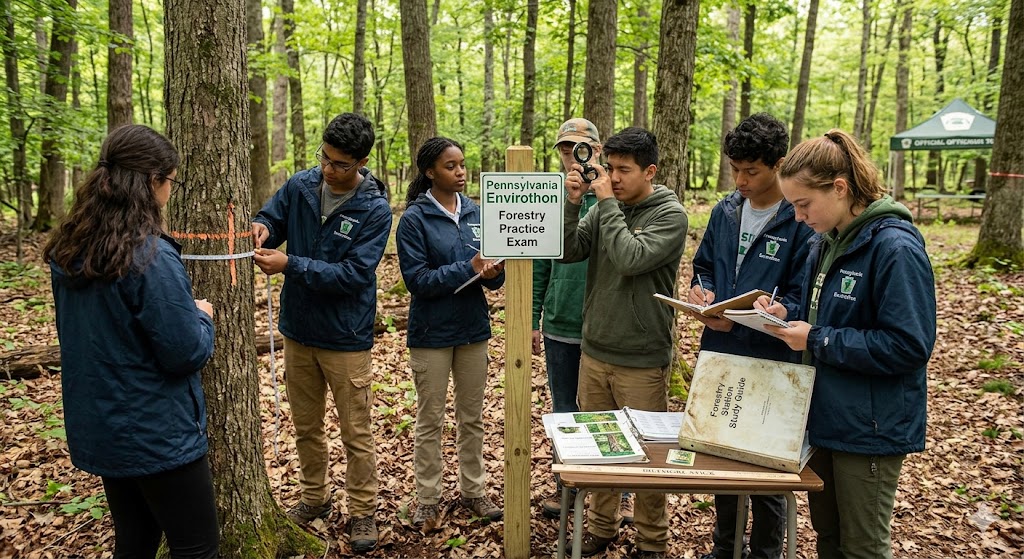
Additional Information
What the Course Entails and Exam Details
The path to competing in the Pennsylvania Envirothon's Forestry station involves mastering a comprehensive syllabus. Students must gain an in-depth understanding of basic forestry principles and practices. Key topics covered include tree identification of common species native to Pennsylvania (including noxious weeds and invasive plants), understanding vertical forest structure, and recognizing successional stages. Furthermore, the course requires teams to develop proficiency with common forestry tools to collect accurate field data. They will learn to use instruments like a diameter tape for measuring tree diameter at breast height (DBH), a clinometer for determining tree height, and a Biltmore stick and wedge prism for determining forest volume and basal area. Studying for this station also encompasses understanding forest ecology, silviculture concepts, wildfire prevention, and the impacts of pests, diseases, and climate change on Pennsylvania’s forests.
What to Expect in the Final Exam
It is important for students to realize that the "final exam" for the Pennsylvania Envirothon is not a standard written test taken in a classroom. Instead, it is a dynamic, multi-modal field competition. While the preparation may include written components, the actual state-level Forestry station challenge will be held outdoors in a real forest setting. Each team will rotate to this station and have a set time to complete a test that blends theoretical knowledge with practical skills. You should expect questions that require hands-on application, such as: identifying a specific tree in place, measuring the board-foot volume of a standing tree, determining a site index, or analyzing a forest management scenario. There is no individual "passing score"; rather, a team's combined score at this station, along with the other four stations, will determine their overall ranking in the county or state competition.
How to Study and Exam Centers
Preparation for the Pennsylvania Envirothon requires both individual study and collaborative teamwork. The official Pennsylvania Envirothon website provides a dedicated page for "Forestry Learning Objectives and Reference Materials." These resources are comprehensive and include the essential study guides, manuals, and common tree lists curated by the DCNR Bureau of Forestry. A key study strategy is to move beyond books and practice in the field. Students should find a local forest to practice identifying trees by leaf, bark, and bud, and they must become fluid in the use of the required forestry tools.
For "Exam Centers," it’s important to remember that there are no static, authorized physical locations like Pearson VUE centers. The Pennsylvania Envirothon competition is held annually, moving between different host locations such as state parks, conservation districts, or nature centers. The actual "exam" occurs during the competition itself. Students must be part of a registered five-member team from their school district or organization to participate. Information regarding registration, dates, and locations for your specific county or the statewide event is managed through the official Pennsylvania Envirothon website and local conservation districts.
Job Opportunities from the Course
Participating in the Pennsylvania Envirothon, particularly the Forestry track, serves as an excellent foundation for pursuing further education and careers in natural resource management, environmental science, and agriculture. Students who excel in this competition develop highly sought-after skills in teamwork, problem-solving, and critical thinking that apply across many professional paths. Some of the direct career paths and job titles this course unlocks include:
Forester
Forest Technician
Forest Ranger / DCNR Ranger Trainee
Conservation Scientist
Environmental Educator
Arborist
Wildlife Habitat Specialist
Wetland Delineator
Urban and Community Forestry Specialist
Logging Field Supervisor
Land Use Planner
Frequently Asked Questions
Reviews
5.0
Based on 0 reviews
Leave a Review
No reviews yet. Be the first to review!