
Pennsylvania Envirothon Soil Practice Test
$69.00
- Buy to unlock unlimited access to all Quiz questions and Answers in this Quiz.
- After purchase you can print a PDF of the whole quiz at any point. The PDF will contain the questions and the correct answers.
About this Exam
The Pennsylvania Envirothon is a premier environmental high school competition in the United States, designed to challenge students' knowledge of natural resources across five key areas: Aquatic Ecology, Forestry, Soil/Land Use, Wildlife, and Current Environmental Issues.
The [Pennsylvania Envirothon Soil Practice Test] is an essential preparatory tool, meticulously crafted for high school students, science teams, and individual competitors seeking to master the Soil and Land Use component of this rigorous competition. This specialized study guide is not just for competition; it is ideal for any student interested in soil science, agricultural practices, or environmental conservation, providing a comprehensive review of the fundamental principles of pedology—the study of soils in their natural environment. Using this practice test will sharpen the critical thinking and practical skills needed for success in both local and state Envirothon competitions.
Ready to test your knowledge?
Buy Now to Access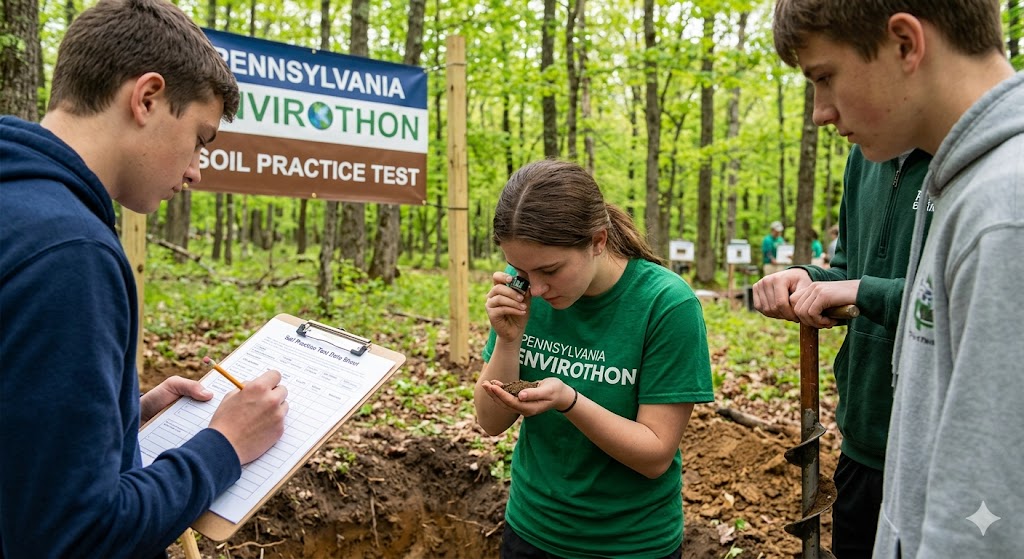
Additional Information
What the Course Entails and Exam Details
This practice test is an deep-dive curriculum condensed into exam format, focusing on the five main "pillars" of soil science as defined by the Envirothon study materials.
Students must first grasp Soil Formation and Characteristics, which involves understanding how climate, parent material, topography, organisms, and time interact to create different soil profiles. Next, the exam details move into Soil Properties, covering essential physical, chemical, and biological attributes, including soil texture (the balance of sand, silt, and clay), soil structure, pH levels, cation exchange capacity (CEC), and the dynamic role of the soil food web in nutrient cycling.
The core application aspect is Soil Classification and Mapping. Competitors learn to read and interpret soil surveys, use the USDA Textural Triangle, and understand the USDA Natural Resources Conservation Service (NRCS) Web Soil Survey, a crucial skill for modern land-use management. Finally, the test covers Soil Conservation and Management, addressing critical issues like erosion control (using techniques such as contour plowing and cover crops), understanding soil-water relationships (drainage, permeability), and promoting sustainable land management practices.
What to Expect in the Final Exam
While the final Envirothon Soil competition involves a hands-on, station-based practical exam, this practice test format provides a critical simulation of the knowledge required.
In the actual competition, you can expect a mixed-format test often worth 100 points, typically presented as a written test with multiple-choice, true/false, fill-in-the-blank, and short-answer questions at a designated outdoor station. This station almost always features an exposed soil pit, where students must physically enter and analyze the visible soil horizons. You will be expected to determine the soil texture through the "feel method," assess soil structure, color (using a Munsell color chart), and make drainage interpretations based on features like mottling.
Success requires interpreting practical land-use scenarios. For example, a question might present a specific soil map unit and ask if it is suitable for agricultural crops, a dwelling with a basement, or a septic system. The practice test helps you build the necessary baseline knowledge and critical thinking skills to answer these practical, field-based questions quickly and accurately, simulating the high-pressure environment of the final event. There is no universally fixed passing score; instead, teams compete for the highest overall score at each station, which contributes to their cumulative total.
How to Study and Exam Centers
Effective studying for the soil Envirothon requires a two-part approach, combining both classroom-based study and extensive field experience.
First, utilize the comprehensive resources provided by the Pennsylvania Envirothon organization and the NRCS. This includes study guides, fact sheets, and technical documents. Start with the basics and use this practice test frequently to identify areas where your knowledge is weak. Memorize the 12 Soil Orders and their key characteristics. Become highly familiar with the USDA Web Soil Survey, practicing by looking up different land tracts.
Second, get outside! Find local soil pits or construction sites and practice identifying horizons, determining texture by feel (using the flow chart method), and estimating drainage classes. Reviewing Munsell color charts on real samples is crucial. Many local Conservation Districts and state parks host Envirothon training days, which are excellent opportunities for hands-on learning. Since this is an educational competition, the final "Exam Centers" are designated local and state competition sites, typically outdoor venues chosen by the organizing committees within Pennsylvania, rather than traditional proctored centers like Pearson VUE.
Job Opportunities from the Course
A strong foundation in soil science through the Envirothon opens doors to diverse and critical careers in environmental protection, agriculture, and land management. The deep understanding gained through the [Pennsylvania Envirothon Soil Practice Test] is the first step toward a rewarding professional career.
Job titles and career paths available for those specializing in soil and land use include:
Soil Scientist – Classifies soil, monitors health, and conducts research for NRCS, EPA, or private consulting firms.
Conservationist/Conservation Planner – Helps landowners implement practices to reduce erosion and improve soil health on agricultural land.
Agronomist/Crop Consultant – Optimizes crop yield and nutrient management while protecting soil resources for agricultural businesses.
Environmental Consultant – Conducts environmental assessments and ensures compliance with land-use regulations.
Land Use Planner – Uses soil maps and data to make informed decisions about zoning and development projects.
Hydrologist/Wetland Specialist – Studies soil-water interactions and helps delineate wetland boundaries.
Soil and Water Conservation District Manager – Oversees local programs promoting natural resource conservation.
By excelling in the soil component of the Pennsylvania Envirothon, students are not just participating in a competition; they are building the essential toolkit needed to tackle future environmental challenges.
Frequently Asked Questions
Reviews
5.0
Based on 0 reviews
Leave a Review
No reviews yet. Be the first to review!