
Pennsylvania Psychology Law Practice Exam
$69.00
- Buy to unlock unlimited access to all Quiz questions and Answers in this Quiz.
- After purchase you can print a PDF of the whole quiz at any point. The PDF will contain the questions and the correct answers.
About this Exam
The Pennsylvania Psychology Law Examination (PPLE) is a vital, state-specific assessment and the final hurdle for individuals seeking licensure to practice psychology independently within the Commonwealth of Pennsylvania. Unlike the national Examination for Professional Practice in Psychology (EPPP), which tests broad psychological knowledge, the PPLE focuses exclusively on the unique laws, regulations, and ethical standards that govern the profession within Pennsylvania.
This exam is designed for aspiring psychologists who have already completed their doctoral education and supervised experience requirements and, typically, have passed the EPPP. Its purpose is to ensure that every licensed psychologist is thoroughly familiar with the legal framework of their practice, thereby protecting the public and maintaining the highest standards of professional conduct in the state. Successfully passing the PPLE is a mandatory step to obtaining your license and officially beginning your career as a Licensed Psychologist in Pennsylvania.
Ready to test your knowledge?
Buy Now to Access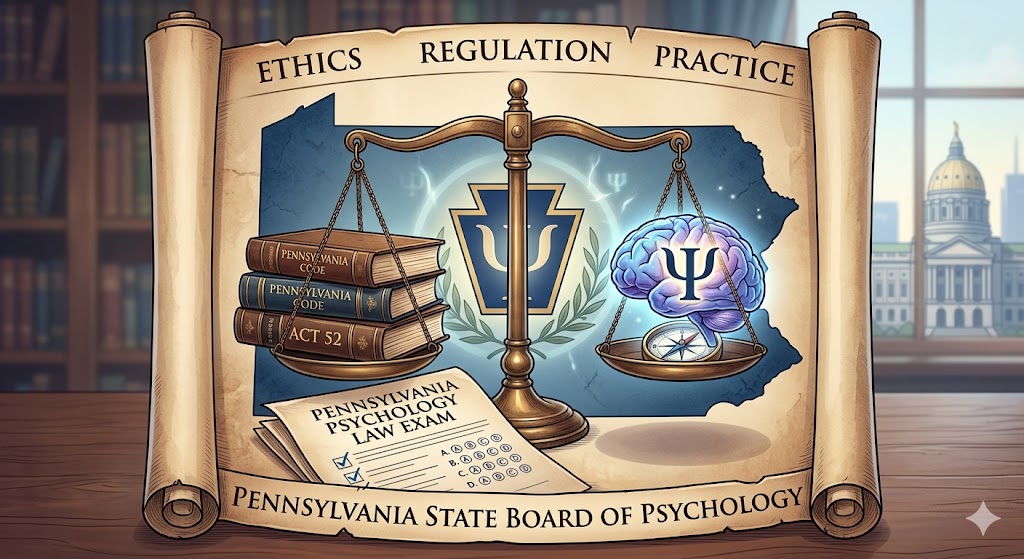
Additional Information
What the Course Entails and Exam Details
Preparing for the Pennsylvania Psychology Law Exam requires a dedicated and deep dive into the foundational legal and ethical documents of the state. The course material is not generalized ethics but the specific application of Pennsylvania law to the practice of psychology. The core of your study will be based on three critical pillars:
The Professional Psychologists Practice Act (Act 52): This is the overarching enabling legislation that establishes the State Board of Psychology and defines the scope of practice, licensure requirements, and the board's powers, including disciplinary actions. It outlines who can call themselves a "psychologist" and the fundamental duties of the profession.
The Pennsylvania Code, Chapter 41: This section of the administrative code provides the detailed regulations created by the State Board of Psychology. It expands upon Act 52, detailing specific rules on advertising, confidentiality, record-keeping, supervision requirements for trainees, and the code of ethics that all licensees must follow.
The Mental Health Procedures Act (MHPA): Crucial for any practicing clinician, this act governs voluntary and involuntary treatment of mentally ill individuals. You must understand the legal standards for involuntary commitment (the well-known "Section 302" process), the rights of patients, and the role of the psychologist within these legal proceedings.
The "course" is essentially a rigorous, self-directed program of study focused on these primary legal texts, making it one of the most practical and legally significant components of your entire professional training.
What to Expect in the Final Exam
The PPLE is a concise and focused test administered in a controlled, professional environment. Understanding its format can help demystify the experience and improve your performance:
Format: The exam consists of 30 multiple-choice questions. Each question has four options, with only one correct answer. Some questions may be pre-test items that are not scored, but you will not know which ones, so treat every question as if it counts.
Time Limit: You will be given one hour (60 minutes) to complete the 30 questions. This is approximately two minutes per question, which is a comfortable pace for multiple-choice if you are well-prepared, allowing you to read carefully and review your answers.
Passing Score: To pass the PPLE, you must achieve a scaled score of 75%. This means you must answer a certain number of questions correctly, with the exact number adjusted slightly based on the difficulty of the specific form of the exam you receive.
Scoring Policy: There is no penalty for guessing. Your score is based solely on the number of correct answers you provide. If you are unsure of an answer, make an educated guess, as you have a 25% chance of being correct, which is always better than a guaranteed 0% for leaving it blank.
Administration: The PPLE is a computer-based exam. You will take it on a computer at a designated testing center. The interface is intuitive, but a tutorial is typically provided at the start of the session to familiarize you with the system.
How to Study and Exam Centers
Preparation for the PPLE is all about specificity. Here are actionable strategies and information on taking the test:
Go to the Source: Do not rely solely on summary guides. The most important step is to download and read the full text of the essential documents: the Professional Psychologists Practice Act, Pennsylvania Code, Chapter 41, and the Mental Health Procedures Act. Highlight, annotate, and summarize key sections, paying close attention to definitions, timelines, and mandatory duties.
Create Structured Study Material: Organize your notes around the key areas. For example, create a section on "Involuntary Commitment" with all relevant parts of the MHPA, and another on "Ethical Obligations" with relevant sections from the Pennsylvania Code.
Use Active Recall and Flashcards: Create flashcards for critical definitions, legal section numbers, specific timeframes (e.g., how long a psychologist has to notify the board of an address change), and ethical rules.
Take Practice Exams: This is one of the most effective study methods. Seek out reliable, up-to-date practice exams specific to the Pennsylvania Psychology Law Exam. This will help you become familiar with the types of questions asked and the legal reasoning required.
Exam Center Information: The exam is not taken online from home. Once you have met all other prerequisites and receive "Authorization to Test" (ATT) from the Pennsylvania State Board of Psychology, you will be able to schedule your exam at a designated computer-based testing center, such as a Pearson VUE location or a similar professional testing facility. You must register and pay for the exam through the approved testing agency, and then select a physical center and time that works for you.
Job Opportunities from the Course
Passing the PPLE and achieving licensure as a Psychologist in Pennsylvania opens the door to a wide range of career opportunities across various practice settings. A license is the essential credential for independent practice, allowing you to diagnose and treat mental health conditions, conduct assessments, and provide consultation services. The following job titles and career paths are unlocked by this crucial step:
Private Practice Psychologist: The most common goal for many, this path allows you to open your own office or join a group practice, offering therapy and assessment to a clientele you build.
Clinical Psychologist (Healthcare Systems): Work in hospitals, community mental health centers, Veterans Affairs (VA) facilities, or primary care clinics as a licensed clinician providing direct patient care.
Counseling Psychologist: Often found in university counseling centers, offering therapy to students for personal, academic, and career concerns.
Neuropsychologist: Specializing in the relationship between brain function and behavior, conducting specialized assessments in medical or private settings.
Forensic Psychologist: Applying psychological principles to legal issues, conducting evaluations for courts, working in correctional facilities, or providing expert testimony.
School Psychologist (with corresponding certification): While often requiring a specific school psychology certificate in addition to or instead of general licensure, holding a full psychology license can expand your roles and responsibilities within educational systems.
Healthcare Administrator/Clinical Director: Lead teams, manage programs, and develop policies within mental health or social service organizations.
Research Psychologist (with additional academic focus): Continue in academic and research settings, with licensure adding a valuable dimension to your work, especially in clinical research.
Consultant Psychologist: Advise businesses, government agencies, or other organizations on organizational behavior, leadership, or program evaluation.
Frequently Asked Questions
Reviews
5.0
Based on 0 reviews
Leave a Review
No reviews yet. Be the first to review!