
Pennsylvania System of School Assessment (PSSA) Vocabulary – Grade 8 Practice Test
$69.00
- Buy to unlock unlimited access to all Quiz questions and Answers in this Quiz.
- After purchase you can print a PDF of the whole quiz at any point. The PDF will contain the questions and the correct answers.
About this Exam
The Pennsylvania System of School Assessment (PSSA) Grade 8 Vocabulary test measures students' understanding of words and phrases critical for successful reading comprehension and effective communication.
Designed for eighth-grade students in Pennsylvania, this standardized test evaluates whether students have mastered key vocabulary skills aligned with the state's academic standards.
Understanding a wide range of words is foundational for academic achievement across all subjects and is essential for developing stronger literacy skills that students will carry forward into high school.
Ready to test your knowledge?
Buy Now to Access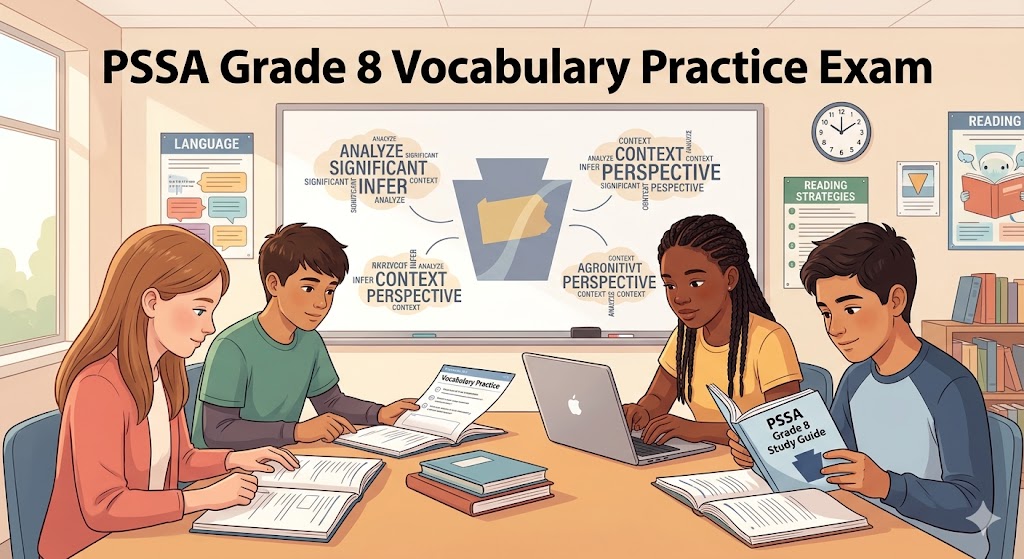
Additional Information
PSSA Grade 8 Vocabulary Test Content and Skills
While the PSSA is an overall English Language Arts (ELA) assessment, vocabulary is a core component integrated throughout the test, especially in reading passages.
The primary areas of focus for Grade 8 vocabulary include:
Using context clues to determine the meaning of unknown or multiple-meaning words and phrases within reading passages.
Analyzing word relationships (such as synonyms, antonyms, and analogies).
Understanding figurative language, including similes, metaphors, personification, and hyperbole.
Identifying and understanding common Greek and Latin roots, prefixes, and suffixes.
Distinguishing denotations and connotations of words to understand nuance.
These skills are vital for a comprehensive understanding of diverse texts that students encounter in 8th grade and beyond.
What to Expect in the Final Exam Format
The Grade 8 ELA PSSA, which includes the vocabulary assessment, is typically administered over multiple sessions lasting several hours each, spaced across several days.
The vocabulary questions are presented within the reading sections and usually consist of multiple-choice questions requiring students to:
Select the best definition for a specified word as used in a text.
Identify the correct synonym or antonym for a given word.
Analyze a sentence that uses a complex word and determine its function or meaning.
A student's performance on the vocabulary section contributes significantly to their overall ELA score. Student scores fall into one of four performance levels: Advanced, Proficient, Basic, or Below Basic. The goal for students and schools is to achieve proficiency, indicating mastery of 8th-grade academic standards.
How to Study and Test Administration
Effective preparation for the PSSA Grade 8 Vocabulary questions involves consistent and diverse language building. Students should not only review but also actively use new words in context.
Key study strategies include:
Reading widely: Engaging with a variety of challenging texts is the single best way to improve vocabulary.
Using a vocabulary journal: Encouraging students to write down unfamiliar words, define them using context clues or a dictionary, and create original sentences using those words.
Utilizing flashcards: Digital or physical flashcards can help reinforce word meanings, especially for dynamic words or common roots.
Practicing with sample questions: Reviewing official PSSA sample items from previous years can familiarize students with the phrasing and difficulty level of vocabulary questions.
Discussing word usage: encouraging students to engage in conversations where they can apply and hear new terms used correctly.
The PSSA is administered directly in the student's regular school during a specified testing window in the spring, determined by the Pennsylvania Department of Education. It is not taken at external, private testing centers like Pearson VUE. Students typically take the exam in their classrooms during school hours.
Job Opportunities from Educational Advancement
Performing well on the PSSA Grade 8 Vocabulary section does not directly grant a certification or lead to a specific job opening for 8th-grade students. However, achieving high scores demonstrates fundamental language proficiency that is critical for success in high school, college, and beyond.
The strong reading and analytical skills validated by this assessment set a crucial foundation for any career path involving communication, critical thinking, and information processing. Students who develop advanced vocabulary skills often find themselves better prepared for careers in fields including:
Education and Academic Research
Law and Legal Services
Writing, Journalism, and Publishing
Marketing, Advertising, and Communications
Public Administration and Management
Research and Analysis in various sectors
Demonstrating strong literacy skills early on helps pave the way toward these and other successful professional futures.
Frequently Asked Questions
Reviews
5.0
Based on 0 reviews
Leave a Review
No reviews yet. Be the first to review!