
Pennsylvania Title 18 Practice Test
$69.00
- Buy to unlock unlimited access to all Quiz questions and Answers in this Quiz.
- After purchase you can print a PDF of the whole quiz at any point. The PDF will contain the questions and the correct answers.
About this Exam
Pennsylvania Title 18, commonly known as the Pennsylvania Crimes Code, is the definitive body of law that defines all criminal offenses within the Commonwealth. It serves as the legal foundation for law enforcement officers, attorneys, judges, and other justice professionals. Understanding Title 18 is not just a requirement; it is an essential skill for anyone aiming to uphold the law and ensure public safety in Pennsylvania. This practice exam is meticulously designed for aspiring police officers, state troopers, detectives, paralegals, and law students preparing for their final, official examinations and certifications, such as those from MPOETC, the State Police, or the Pennsylvania Bar. It offers a realistic simulation to test your knowledge, build confidence, and identify areas for further study, making it a critical tool for success.
Ready to test your knowledge?
Buy Now to Access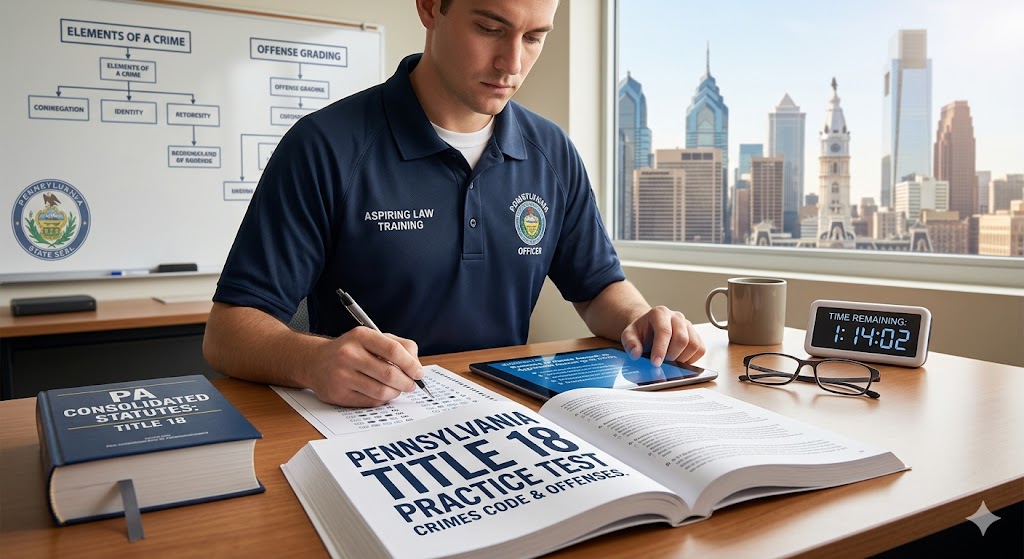
Additional Information
What the Course Entails and Exam Details
This practice exam does not constitute a "course" in itself, but rather evaluates your comprehension of the complex and extensive Pennsylvania Title 18 code. While various training academies and educational institutions offer comprehensive courses on Pennsylvania criminal law, this test provides a focused assessment of the code's core principles. The practice exam typically covers the following key articles and chapters within Title 18: Part I (Preliminary Provisions), Part II (Definition of Specific Offenses), including offenses involving danger to the person (such as Homicide, Assault, and Kidnapping), offenses against property (Arson, Burglary, Robbery, and Theft), offenses against public administration (Bribery, Falsification, and Obstructing Governmental Operations), offenses against public order (Riot and Disorderly Conduct), and other miscellaneous offenses, including the Uniform Firearms Act. It tests your ability to not only recall specific statute definitions but also to apply those definitions to factual scenarios to determine appropriate criminal charges, grades, and defenses.
What to Expect in the Final Exam
It is crucial to understand that there is no single, official "Pennsylvania Title 18 Final Exam." Instead, the knowledge of Title 18 is a mandatory component of numerous official licensing and certification exams across various career paths. For aspiring municipal police officers, the Municipal Police Officers' Education and Training Commission (MPOETC) certification exam will heavily test your knowledge of Title 18 through multiple-choice and scenario-based questions. The specific format, number of questions, and passing score (often around 70% or higher for law enforcement roles) are determined by the respective governing body. Exams are typically time-limited, and you will be expected to demonstrate a precise application of the code in varied contexts. You should anticipate questions that present a detailed set of facts and require you to identify the most applicable offense, its classification (felony, misdemeanor, or summary), and any relevant general principles of justification or culpability.
How to Study and Exam Centers
Effective study begins with a thorough and repeated reading of the Pennsylvania Crimes Code itself, focusing on the specific elements of each offense. We recommend supplementing your reading with detailed study guides, case law analysis, and flashcards for quick recall of key definitions and statutory grades. Taking regular practice tests, like this one, is one of the most effective ways to familiarize yourself with the question types and identify knowledge gaps. Form a study group to discuss scenario-based questions, as explaining the code's application will deepen your own understanding. For the final, official exams, you must register through the appropriate agency. For MPOETC, this involves completing an accredited police academy program, which then coordinates the testing. State Police candidates take exams administered by Pearson VUE at their official testing centers. Legal professionals take the Pennsylvania Bar Exam, administered by the Pennsylvania Board of Law Examiners at designated large-scale venues. Always confirm specific exam details, including center locations, with the relevant official body.
Job Opportunities from the Course
A strong, verifiable mastery of Pennsylvania Title 18 is a foundational requirement for numerous prestigious and rewarding careers in the criminal justice and legal fields. It unlocks a clear path toward professional growth and specialization.
Key career opportunities include:
Municipal Police Officer
Pennsylvania State Trooper
Detective / Criminal Investigator
Attorney (Prosecutor or Defense)
Paralegal / Legal Assistant
Private Investigator
Probation and Parole Officer
Corporate Security Manager
University or Transit Police Officer
Magisterial District Judge Staff
Frequently Asked Questions
Reviews
5.0
Based on 0 reviews
Leave a Review
No reviews yet. Be the first to review!