
Pennsylvania Underground Storage Tank (UST) Certification Practice Exam
$69.00
- Buy to unlock unlimited access to all Quiz questions and Answers in this Quiz.
- After purchase you can print a PDF of the whole quiz at any point. The PDF will contain the questions and the correct answers.
About this Exam
The Pennsylvania Underground Storage Tank (UST) Certification is a crucial qualification for professionals involved in the installation, operation, maintenance, testing, and closure of UST systems within the Commonwealth. Managed by the Pennsylvania Department of Environmental Protection (DEP), this certification ensures that individuals possess the knowledge and skills necessary to protect the environment and public health from potential leaks or spills of hazardous substances stored underground. The exam is designed for tank installers, inspectors, owners/operators, and testers who must demonstrate compliance with the state's specific and stringent regulatory requirements. Successfully obtaining this certification signifies expertise in critical environmental compliance, helping prevent groundwater contamination and other serious hazards.
Ready to test your knowledge?
Buy Now to Access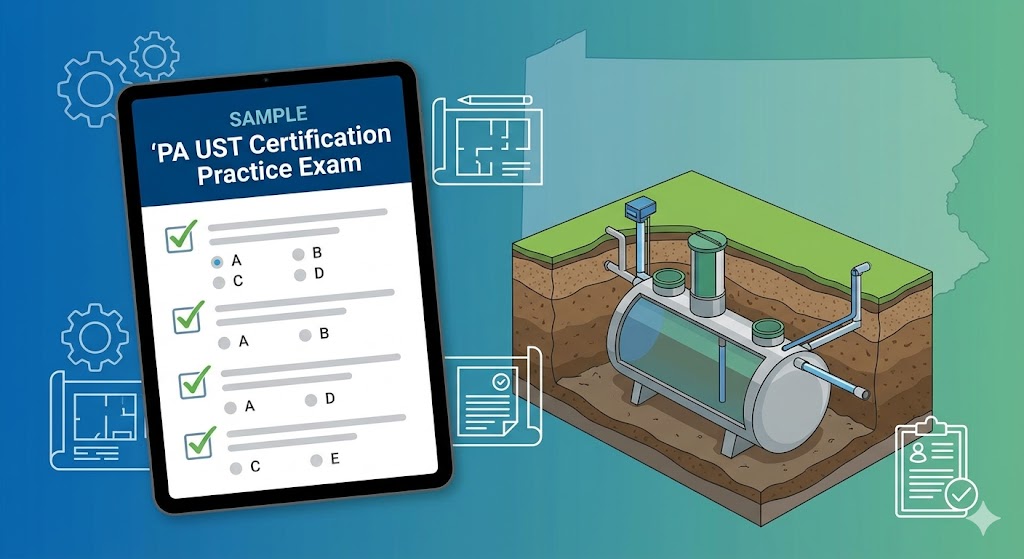
Additional Information
What the Course Entails and Exam Details
To prepare for the Pennsylvania UST Certification Exam, individuals typically undergo comprehensive training, either through authorized courses or rigorous self-study, focusing on the specific regulatory framework and technical requirements established by the Pennsylvania DEP.
The course of study covers essential topics such as:
Understanding Pennsylvania Regulations: Deep dive into PA Title 25, Chapter 245, detailing all aspects of UST management.
UST System Components and Materials: Knowledge of different tank and piping materials (e.g., steel, fiberglass), and secondary containment systems.
Spill and Overfill Prevention: Detailed requirements for devices like catch basins, drop tubes, and overfill alarms.
Leak Detection Methods: Learning and selecting various mandated leak detection methods, including Automatic Tank Gauging (ATG), statistical inventory reconciliation, and groundwater monitoring.
Corrosion Protection: Principles of cathodic protection systems and when they are required.
Installation and Closure Procedures: Proper techniques for installing new systems, making modifications, and safely closing existing USTs.
Financial Responsibility: Understanding requirements for demonstrating financial assurance in the event of a release.
Operator Training (A, B, and C): Specific duties and responsibilities for different classes of operators.
What to Expect in the Final Exam
The actual Pennsylvania UST Certification exam is a robust assessment of regulatory knowledge. Here are key details to expect:
Format: The exam typically consists of multiple-choice questions. These questions assess both recall of specific regulations and the practical application of these rules to realistic scenarios.
Passing Score: While specific details might vary slightly depending on the certification class (e.g., UMX for Installers, UTT for Testers), candidates generally must achieve a passing score of 80% or higher to become certified.
Time Limit: Expect a strict time limit (often around 2–3 hours), challenging you to answer questions efficiently and accurately. There is typically ample time if you are well-prepared.
Rules: The exam is typically "closed book." You are generally not permitted to bring external notes, manuals, or reference materials into the testing room. Testing environments are proctored to ensure integrity.
How to Study and Exam Centers
Preparation Strategies:
Master the DEP Regulations: This is the absolute foundation of your study. Thoroughly review PA Title 25, Chapter 245. Highlight key sections, create summaries, and understand the practical implications of each regulation.
Use Official DEP Study Guides: The Pennsylvania DEP often provides official study guides and reference materials designed specifically for each certification category. These are your most reliable resources.
Take Authorized Training: Enrolling in a preparation course authorized by the DEP can offer valuable structured learning, expert instruction, and practical practice exams. These courses translate complex regulations into understandable concepts.
Utilize Practice Exams: Practice tests, like the one this comprehensive article prepares you for, are vital. They help identify knowledge gaps, familiarize you with the multiple-choice format, and improve your time management. Simulate real exam conditions as closely as possible.
Taking the Exam:
Pennsylvania uses independent testing services to administer the certification exams at specific locations across the Commonwealth. To take the exam:
Submit Your Application: You must first submit a complete certification application to the Pennsylvania DEP, including evidence of any required experience.
Receive Authorization: Once approved by the DEP, you will receive instructions and an authorization code to register for the exam.
Schedule via the Testing Provider: You will typically use a designated online portal (often managed by the testing contractor) to choose a date and a specific, physical testing center convenient for you. These testing centers are professional environments designed for secure exam administration.
Job Opportunities from the Course
A Pennsylvania UST Certification is not just a regulatory hurdle; it is a highly marketable credential in the environmental compliance and construction sectors. This certification unlocks several specific career paths:
Certified UST Installer (UMX): Specializes in the proper installation and modification of entire UST systems.
Certified UST Inspector (IUM): Focuses on conducting mandatory inspections of existing UST systems to ensure compliance with all operational regulations.
Certified UST Tester (UTT): Qualified to perform mandated tests on leak detection equipment and integrity checks on UST components.
Certified UST Operater (Class A or B): Crucial role in managing the overall compliance and operational safety of UST facilities (e.g., service stations, fleet fueling).
Environmental Compliance Manager/Officer: Oversees environmental safety and regulatory compliance within larger corporations that operate multiple USTs.
Environmental Consultant: Provides expert advice to tank owners on regulatory requirements, risk assessment, and leak prevention.
Frequently Asked Questions
Reviews
5.0
Based on 0 reviews
Leave a Review
No reviews yet. Be the first to review!