
Perinatal Pediatrics and Diagnostic Skills Practice Test
$69.00
- Buy to unlock unlimited access to all Quiz questions and Answers in this Quiz.
- After purchase you can print a PDF of the whole quiz at any point. The PDF will contain the questions and the correct answers.
About this Exam
The Perinatal Pediatrics and Diagnostic Skills Practice Test is a critical tool for medical students, pediatric residents, and other aspiring healthcare professionals specializing in the care of neonates and infants. This exam is designed to rigorously evaluate a candidate's clinical knowledge, critical thinking, and practical decision-making skills required for identifying, diagnosing, and managing complex medical conditions in the perinatal period. This certification validates expertise that is crucial for improving infant health outcomes and provides a competitive edge in pediatric and neonatal healthcare fields. It is intended for those seeking a specialized role that focuses on the vital care needed from birth through the first critical months of life.
Ready to test your knowledge?
Buy Now to Access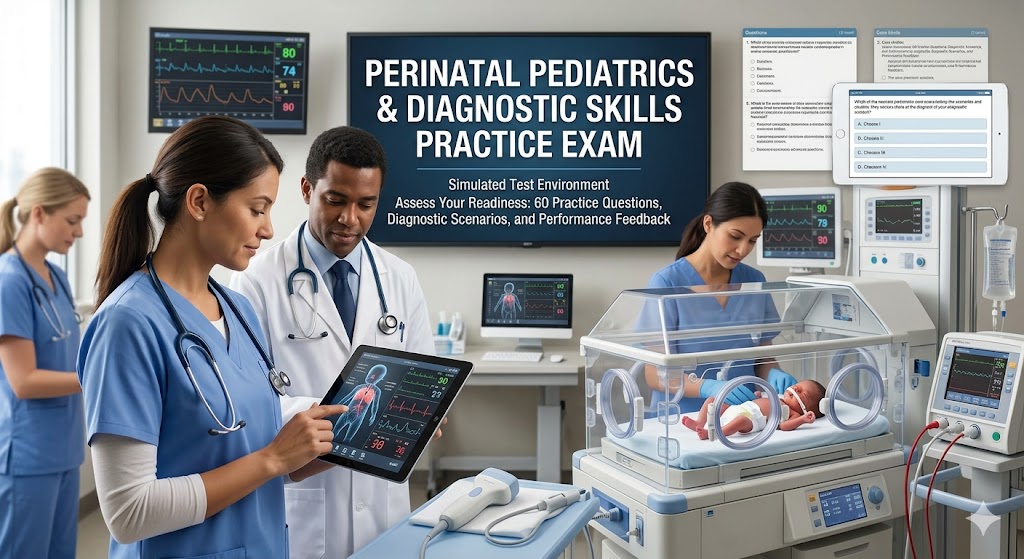
Additional Information
What the Course Entails and Exam Details
This comprehensive assessment covers a broad spectrum of neonatal medical knowledge and hands-on skills. The content is divided into several major modules, ensuring a holistic understanding of perinatal health. Key areas include neonatal resuscitation procedures, initial assessment and stabilization, a deep dive into common and complex congenital anomalies, and management strategies for pre-term and low-birth-weight infants. Candidates must master a variety of diagnostic skills, such as physical assessment techniques, the application of various imaging principles in small patients, the collection and accurate interpretation of relevant laboratory data, and real-world clinical problem-solving. This includes effective communication and dynamic care coordination within a multidisciplinary medical team.
What to Expect in the Final Exam
The final certification exam for Perinatal Pediatrics and Diagnostic Skills is a multifaceted assessment with both a theoretical and practical component. The first part is a proctored, standardized knowledge exam consisting of 75-100 multiple-choice questions (MCQs), designed to test a candidate's comprehensive recall and application of medical facts. The second portion is a series of case-based diagnostic simulations, where candidates are presented with complex clinical scenarios and must choose the correct sequence of diagnostic tests and interventions. The overall time limit for the entire process is 3 hours. A comprehensive passing score of at least 80% is typically required across both exam components, reflecting a strong command of the vital skills necessary for professional practice. Candidates are prohibited from using external references during the examination and must complete the test within a single sitting under the direct observation of a certified proctor.
How to Study and Exam Centers
Effective preparation is key to success on the Perinatal Pediatrics and Diagnostic Skills Practice Test. A strong strategy starts with consistent review of recognized neonatal guidelines and pediatric textbooks. Focus heavily on practice-based learning by using reputable online question banks that mirror the structure of the exam, taking timed simulated practice tests, and participating in small group clinical case study discussions. Visual learners benefit significantly from utilizing medical anatomy diagrams and video demonstrations for key diagnostic skills. For practical components, consider scheduling structured, hands-on training sessions with a mentor or participating in simulated clinical environments to practice diagnostic procedures and team communication under realistic pressure. The official certification exam is administered through authorized professional bodies and a network of physical testing centers, such as Pearson VUE. In some instances, a proctored online format may be available for candidates who cannot access a physical center, or through accredited specialized pediatric training programs and university medical centers that act as authorized assessment locations.
Job Opportunities from the Course
Upon completion of this certification, multiple career paths in advanced neonatal care become available to the successful candidate. A few of the highly sought-after job titles include:
Neonatal Intensive Care Unit (NICU) Nurse
Neonatal Nurse Practitioner
Perinatal Nurse
Newborn Hospitalist Physician
Respiratory Therapist specializing in Neonatal Care
Maternal-Fetal Medicine (MFM) RN
Pediatric Care Coordinator for at-risk infants
High-Risk Infant Diagnostic Specialist
Frequently Asked Questions
Reviews
5.0
Based on 0 reviews
Leave a Review
No reviews yet. Be the first to review!